

1 Introduction to Laser Micro-to-Nano Manufacturing
49
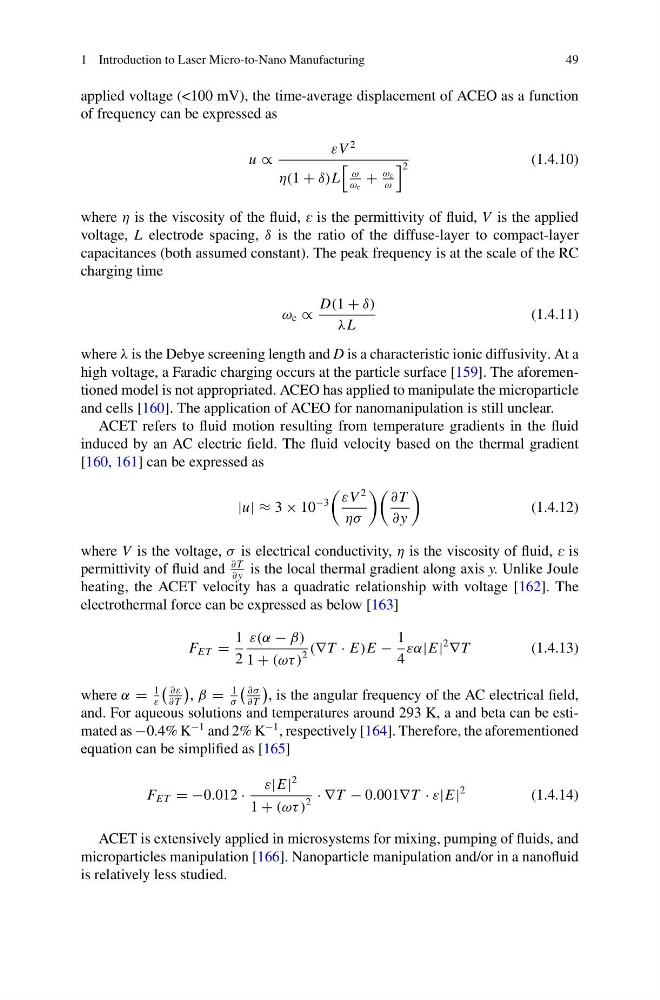
applied voltage (<100 mV), the time-average displacement of ACEO as a function
of frequency can be expressed as
u ∝
εV
2
η(1 + δ)L
ω
ω c
+
ω c
ω
2
(1.4.10)
where η is the viscosity of the fluid, E is the permittivity of fluid, V is the applied
voltage, L electrode spacing, δ is the ratio of the diffuse-layer to compact-layer
capacitances (both assumed constant). The peak frequency is at the scale of the RC
charging time
ω c ∝
D(1 + δ)
λL
(1.4.11)
where λ is the Debye screening length and D is a characteristic ionic diffusivity. At a
high voltage, a Faradic charging occurs at the particle surface [159]. The aforementioned model is not appropriated. ACEO has applied to manipulate the microparticle
and cells [160]. The application of ACEO for nanomanipulation is still unclear.
ACET refers to fluid motion resulting from temperature gradients in the fluid
induced by an AC electric field. The fluid velocity based on the thermal gradient
[160, 161] can be expressed as
|u| ≈ 3 × 10
−3
εV
2
ησ
∂ T
∂ y
(1.4.12)
where V is the voltage, σ is electrical conductivity, η is the viscosity of fluid, E is
permittivity of fluid and
∂ T
∂ y
is the local thermal gradient along axis y. Unlike Joule
heating, the ACET velocity has a quadratic relationship with voltage [162]. The
electrothermal force can be expressed as below [163]
F ET =
1
2
ε(α − β)
1 + (ωτ )
2
(∇T · E)E −
1
4
εα|E|
2
∇T
(1.4.13)
where α =
1
ε
∂ε
∂ T
, β =
1
σ
∂σ
∂ T
, is the angular frequency of the AC electrical field,
and. For aqueous solutions and temperatures around 293 K, a and beta can be estimated as −0.4% K
−1 and 2% K
−1 , respectively [164]. Therefore, the aforementioned
equation can be simplified as [165]
F ET = −0.012 ·
ε|E|
2
1 + (ωτ )
2
· ∇T − 0.001∇T · ε|E|
2
(1.4.14)
ACET is extensively applied in microsystems for mixing, pumping of fluids, and
microparticles manipulation [166]. Nanoparticle manipulation and/or in a nanofluid
is relatively less studied.
49
applied voltage (<100 mV), the time-average displacement of ACEO as a function
of frequency can be expressed as
u ∝
εV
2
η(1 + δ)L
ω
ω c
+
ω c
ω
2
(1.4.10)
where η is the viscosity of the fluid, E is the permittivity of fluid, V is the applied
voltage, L electrode spacing, δ is the ratio of the diffuse-layer to compact-layer
capacitances (both assumed constant). The peak frequency is at the scale of the RC
charging time
ω c ∝
D(1 + δ)
λL
(1.4.11)
where λ is the Debye screening length and D is a characteristic ionic diffusivity. At a
high voltage, a Faradic charging occurs at the particle surface [159]. The aforementioned model is not appropriated. ACEO has applied to manipulate the microparticle
and cells [160]. The application of ACEO for nanomanipulation is still unclear.
ACET refers to fluid motion resulting from temperature gradients in the fluid
induced by an AC electric field. The fluid velocity based on the thermal gradient
[160, 161] can be expressed as
|u| ≈ 3 × 10
−3
εV
2
ησ
∂ T
∂ y
(1.4.12)
where V is the voltage, σ is electrical conductivity, η is the viscosity of fluid, E is
permittivity of fluid and
∂ T
∂ y
is the local thermal gradient along axis y. Unlike Joule
heating, the ACET velocity has a quadratic relationship with voltage [162]. The
electrothermal force can be expressed as below [163]
F ET =
1
2
ε(α − β)
1 + (ωτ )
2
(∇T · E)E −
1
4
εα|E|
2
∇T
(1.4.13)
where α =
1
ε
∂ε
∂ T
, β =
1
σ
∂σ
∂ T
, is the angular frequency of the AC electrical field,
and. For aqueous solutions and temperatures around 293 K, a and beta can be estimated as −0.4% K
−1 and 2% K
−1 , respectively [164]. Therefore, the aforementioned
equation can be simplified as [165]
F ET = −0.012 ·
ε|E|
2
1 + (ωτ )
2
· ∇T − 0.001∇T · ε|E|
2
(1.4.14)
ACET is extensively applied in microsystems for mixing, pumping of fluids, and
microparticles manipulation [166]. Nanoparticle manipulation and/or in a nanofluid
is relatively less studied.