

1 Introduction to Laser Micro-to-Nano Manufacturing
47
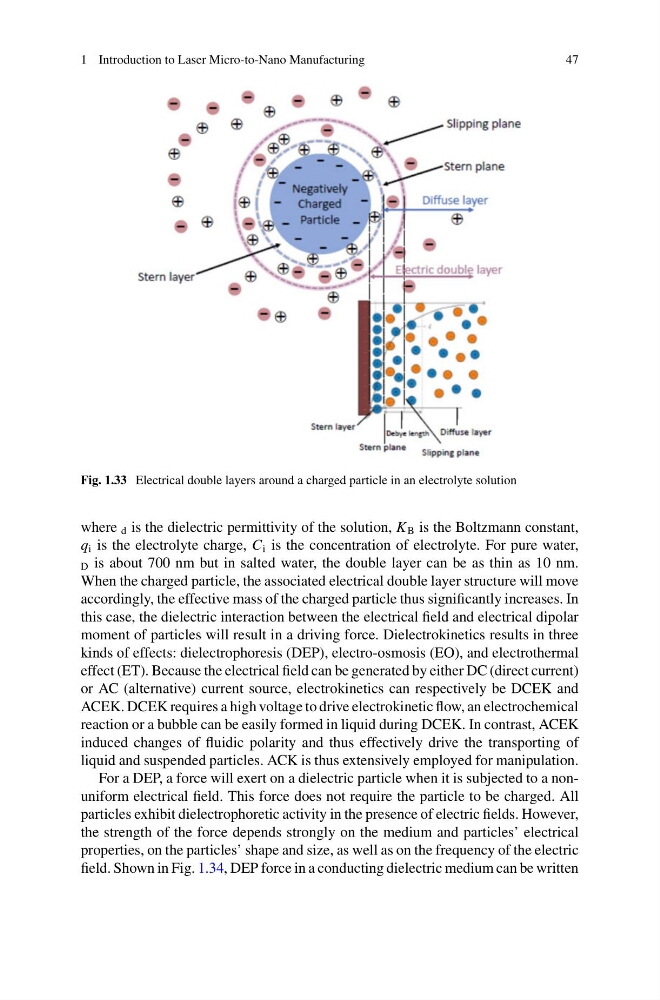
Fig. 1.33 Electrical double layers around a charged particle in an electrolyte solution
where d is the dielectric permittivity of the solution, K B is the Boltzmann constant,
q i is the electrolyte charge, C i is the concentration of electrolyte. For pure water,
D is about 700 nm but in salted water, the double layer can be as thin as 10 nm.
When the charged particle, the associated electrical double layer structure will move
accordingly, the effective mass of the charged particle thus significantly increases. In
this case, the dielectric interaction between the electrical field and electrical dipolar
moment of particles will result in a driving force. Dielectrokinetics results in three
kinds of effects: dielectrophoresis (DEP), electro-osmosis (EO), and electrothermal
effect (ET). Because the electrical field can be generated by either DC (direct current)
or AC (alternative) current source, electrokinetics can respectively be DCEK and
ACEK. DCEK requires a high voltage to drive electrokinetic flow, an electrochemical
reaction or a bubble can be easily formed in liquid during DCEK. In contrast, ACEK
induced changes of fluidic polarity and thus effectively drive the transporting of
liquid and suspended particles. ACK is thus extensively employed for manipulation.
For a DEP, a force will exert on a dielectric particle when it is subjected to a nonuniform electrical field. This force does not require the particle to be charged. All
particles exhibit dielectrophoretic activity in the presence of electric fields. However,
the strength of the force depends strongly on the medium and particles’ electrical
properties, on the particles’ shape and size, as well as on the frequency of the electric
field. Shown in Fig. 1.34, DEP force in a conducting dielectric medium can be written
47
Fig. 1.33 Electrical double layers around a charged particle in an electrolyte solution
where d is the dielectric permittivity of the solution, K B is the Boltzmann constant,
q i is the electrolyte charge, C i is the concentration of electrolyte. For pure water,
D is about 700 nm but in salted water, the double layer can be as thin as 10 nm.
When the charged particle, the associated electrical double layer structure will move
accordingly, the effective mass of the charged particle thus significantly increases. In
this case, the dielectric interaction between the electrical field and electrical dipolar
moment of particles will result in a driving force. Dielectrokinetics results in three
kinds of effects: dielectrophoresis (DEP), electro-osmosis (EO), and electrothermal
effect (ET). Because the electrical field can be generated by either DC (direct current)
or AC (alternative) current source, electrokinetics can respectively be DCEK and
ACEK. DCEK requires a high voltage to drive electrokinetic flow, an electrochemical
reaction or a bubble can be easily formed in liquid during DCEK. In contrast, ACEK
induced changes of fluidic polarity and thus effectively drive the transporting of
liquid and suspended particles. ACK is thus extensively employed for manipulation.
For a DEP, a force will exert on a dielectric particle when it is subjected to a nonuniform electrical field. This force does not require the particle to be charged. All
particles exhibit dielectrophoretic activity in the presence of electric fields. However,
the strength of the force depends strongly on the medium and particles’ electrical
properties, on the particles’ shape and size, as well as on the frequency of the electric
field. Shown in Fig. 1.34, DEP force in a conducting dielectric medium can be written