

42
A. Hu et al.
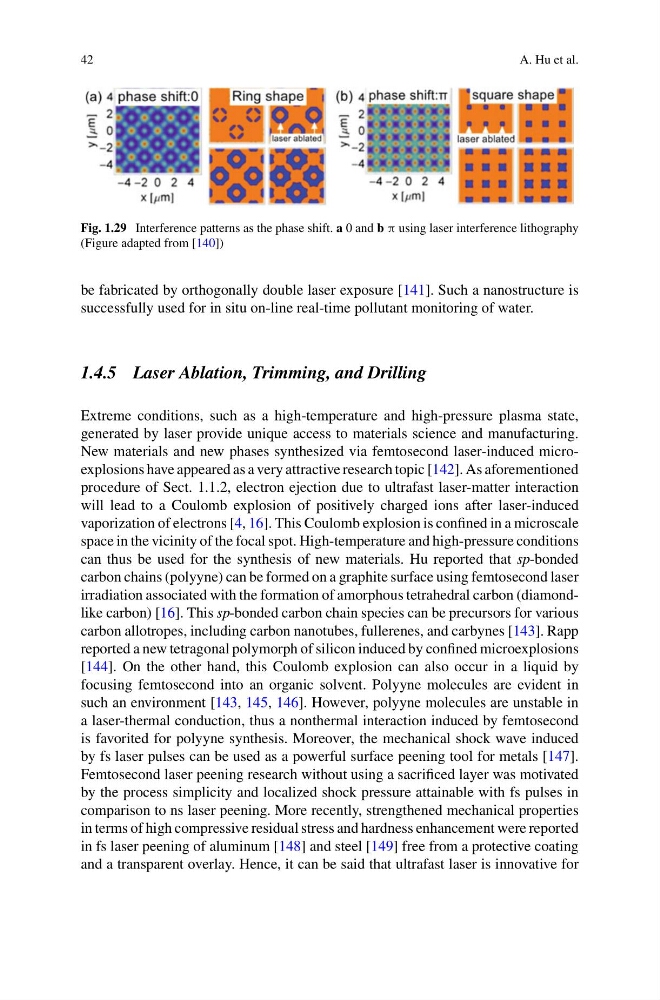
Fig. 1.29 Interference patterns as the phase shift. a 0 and b π using laser interference lithography
(Figure adapted from [140])
be fabricated by orthogonally double laser exposure [141]. Such a nanostructure is
successfully used for in situ on-line real-time pollutant monitoring of water.
1.4.5 Laser Ablation, Trimming, and Drilling
Extreme conditions, such as a high-temperature and high-pressure plasma state,
generated by laser provide unique access to materials science and manufacturing.
New materials and new phases synthesized via femtosecond laser-induced microexplosions have appeared as a very attractive research topic [142]. As aforementioned
procedure of Sect. 1.1.2, electron ejection due to ultrafast laser-matter interaction
will lead to a Coulomb explosion of positively charged ions after laser-induced
vaporization of electrons [4, 16]. This Coulomb explosion is confined in a microscale
space in the vicinity of the focal spot. High-temperature and high-pressure conditions
can thus be used for the synthesis of new materials. Hu reported that sp-bonded
carbon chains (polyyne) can be formed on a graphite surface using femtosecond laser
irradiation associated with the formation of amorphous tetrahedral carbon (diamondlike carbon) [16]. This sp-bonded carbon chain species can be precursors for various
carbon allotropes, including carbon nanotubes, fullerenes, and carbynes [143]. Rapp
reported a new tetragonal polymorph of silicon induced by confined microexplosions
[144]. On the other hand, this Coulomb explosion can also occur in a liquid by
focusing femtosecond into an organic solvent. Polyyne molecules are evident in
such an environment [143, 145, 146]. However, polyyne molecules are unstable in
a laser-thermal conduction, thus a nonthermal interaction induced by femtosecond
is favorited for polyyne synthesis. Moreover, the mechanical shock wave induced
by fs laser pulses can be used as a powerful surface peening tool for metals [147].
Femtosecond laser peening research without using a sacrificed layer was motivated
by the process simplicity and localized shock pressure attainable with fs pulses in
comparison to ns laser peening. More recently, strengthened mechanical properties
in terms of high compressive residual stress and hardness enhancement were reported
in fs laser peening of aluminum [148] and steel [149] free from a protective coating
and a transparent overlay. Hence, it can be said that ultrafast laser is innovative for
A. Hu et al.
Fig. 1.29 Interference patterns as the phase shift. a 0 and b π using laser interference lithography
(Figure adapted from [140])
be fabricated by orthogonally double laser exposure [141]. Such a nanostructure is
successfully used for in situ on-line real-time pollutant monitoring of water.
1.4.5 Laser Ablation, Trimming, and Drilling
Extreme conditions, such as a high-temperature and high-pressure plasma state,
generated by laser provide unique access to materials science and manufacturing.
New materials and new phases synthesized via femtosecond laser-induced microexplosions have appeared as a very attractive research topic [142]. As aforementioned
procedure of Sect. 1.1.2, electron ejection due to ultrafast laser-matter interaction
will lead to a Coulomb explosion of positively charged ions after laser-induced
vaporization of electrons [4, 16]. This Coulomb explosion is confined in a microscale
space in the vicinity of the focal spot. High-temperature and high-pressure conditions
can thus be used for the synthesis of new materials. Hu reported that sp-bonded
carbon chains (polyyne) can be formed on a graphite surface using femtosecond laser
irradiation associated with the formation of amorphous tetrahedral carbon (diamondlike carbon) [16]. This sp-bonded carbon chain species can be precursors for various
carbon allotropes, including carbon nanotubes, fullerenes, and carbynes [143]. Rapp
reported a new tetragonal polymorph of silicon induced by confined microexplosions
[144]. On the other hand, this Coulomb explosion can also occur in a liquid by
focusing femtosecond into an organic solvent. Polyyne molecules are evident in
such an environment [143, 145, 146]. However, polyyne molecules are unstable in
a laser-thermal conduction, thus a nonthermal interaction induced by femtosecond
is favorited for polyyne synthesis. Moreover, the mechanical shock wave induced
by fs laser pulses can be used as a powerful surface peening tool for metals [147].
Femtosecond laser peening research without using a sacrificed layer was motivated
by the process simplicity and localized shock pressure attainable with fs pulses in
comparison to ns laser peening. More recently, strengthened mechanical properties
in terms of high compressive residual stress and hardness enhancement were reported
in fs laser peening of aluminum [148] and steel [149] free from a protective coating
and a transparent overlay. Hence, it can be said that ultrafast laser is innovative for