

1 Introduction to Laser Micro-to-Nano Manufacturing
21
The dielectric fiber, as we discussed in Fig. 1.10, on the contrary, with an extending
of the evanescent fields, dramatically enlarges the mode sizes and eventually lose the
effective confinement with a decreasing fiber diameter.
The dispersion relation of SPPs obeys the equation
β = k 0
ε d ε m
ε d + ε m
(1.2.20)
in which k 0 =
ω
c
is the wavevector of the light in vacuum, ε m an ε d are the dielectric
functions of the metal and the surrounding dielectric. The wavevector of the SPP
mode k sp = β is obvious smaller than that of the light in vacuum. Therefore unlike
LSPs, SPPs cannot be launched directly by incident light due to the momentum
mismatch between the photons and plasmons. Techniques such as prism coupling,
lens focusing, nanowire coupling and electron excitation were developed for the
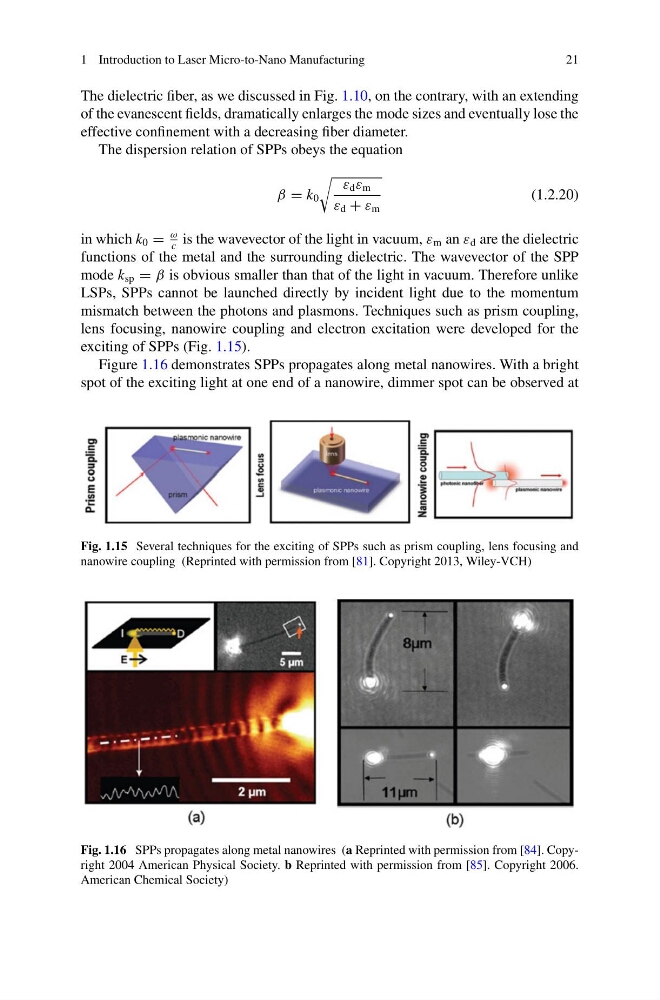
exciting of SPPs (Fig. 1.15).
Figure 1.16 demonstrates SPPs propagates along metal nanowires. With a bright
spot of the exciting light at one end of a nanowire, dimmer spot can be observed at
Fig. 1.15 Several techniques for the exciting of SPPs such as prism coupling, lens focusing and
nanowire coupling (Reprinted with permission from [81]. Copyright 2013, Wiley-VCH)
Fig. 1.16 SPPs propagates along metal nanowires (a Reprinted with permission from [84]. Copyright 2004 American Physical Society. b Reprinted with permission from [85]. Copyright 2006.
American Chemical Society)
21
The dielectric fiber, as we discussed in Fig. 1.10, on the contrary, with an extending
of the evanescent fields, dramatically enlarges the mode sizes and eventually lose the
effective confinement with a decreasing fiber diameter.
The dispersion relation of SPPs obeys the equation
β = k 0
ε d ε m
ε d + ε m
(1.2.20)
in which k 0 =
ω
c
is the wavevector of the light in vacuum, ε m an ε d are the dielectric
functions of the metal and the surrounding dielectric. The wavevector of the SPP
mode k sp = β is obvious smaller than that of the light in vacuum. Therefore unlike
LSPs, SPPs cannot be launched directly by incident light due to the momentum
mismatch between the photons and plasmons. Techniques such as prism coupling,
lens focusing, nanowire coupling and electron excitation were developed for the
exciting of SPPs (Fig. 1.15).
Figure 1.16 demonstrates SPPs propagates along metal nanowires. With a bright
spot of the exciting light at one end of a nanowire, dimmer spot can be observed at
Fig. 1.15 Several techniques for the exciting of SPPs such as prism coupling, lens focusing and
nanowire coupling (Reprinted with permission from [81]. Copyright 2013, Wiley-VCH)
Fig. 1.16 SPPs propagates along metal nanowires (a Reprinted with permission from [84]. Copyright 2004 American Physical Society. b Reprinted with permission from [85]. Copyright 2006.
American Chemical Society)