

20
A. Hu et al.
where β is the propagation constant of the SPP mode, k x , k y , κ x and κ y are the
component of the wavevector perpendicular to the interface in the two media, i.e.,
the metal cladding and surrounding dielectric. Note that, surface plasmons typically
involve complex ε m with negative real part and large imaginary part of ε m . The
k x and k y can be imaginary, making it possible to confine and guide the light beyond
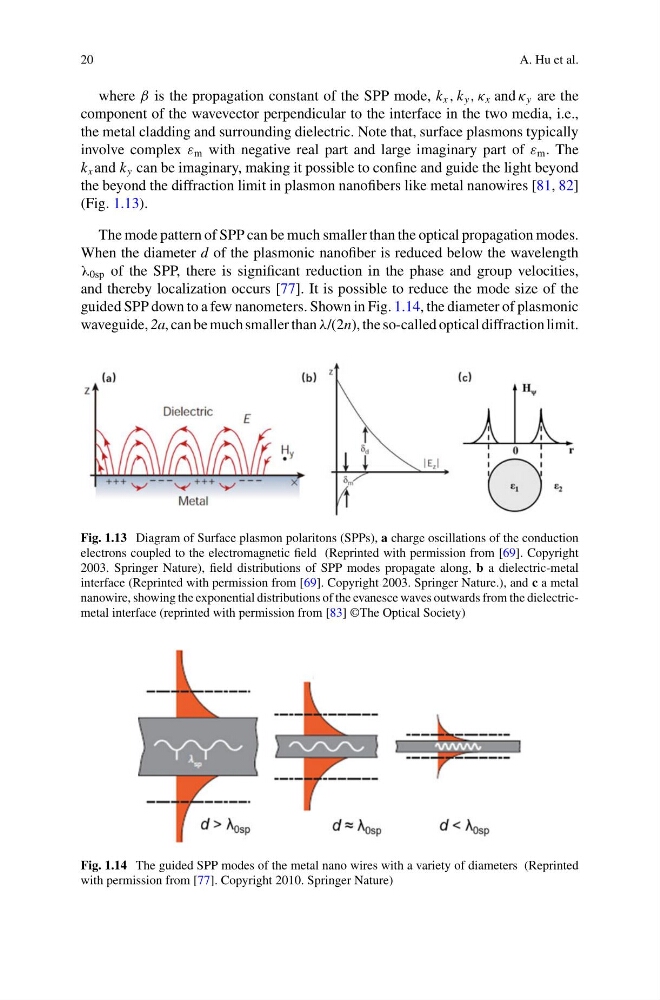
the beyond the diffraction limit in plasmon nanofibers like metal nanowires [81, 82]
(Fig. 1.13).
The mode pattern of SPP can be much smaller than the optical propagation modes.
When the diameter d of the plasmonic nanofiber is reduced below the wavelength
λ 0sp of the SPP, there is significant reduction in the phase and group velocities,
and thereby localization occurs [77]. It is possible to reduce the mode size of the
guided SPP down to a few nanometers. Shown in Fig. 1.14, the diameter of plasmonic
waveguide, 2a, can be much smaller than λ/(2n), the so-called optical diffraction limit.
Fig. 1.13 Diagram of Surface plasmon polaritons (SPPs), a charge oscillations of the conduction
electrons coupled to the electromagnetic field (Reprinted with permission from [69]. Copyright
2003. Springer Nature), field distributions of SPP modes propagate along, b a dielectric-metal
interface (Reprinted with permission from [69]. Copyright 2003. Springer Nature.), and c a metal
nanowire, showing the exponential distributions of the evanesce waves outwards from the dielectricmetal interface (reprinted with permission from [83] ©The Optical Society)
Fig. 1.14 The guided SPP modes of the metal nano wires with a variety of diameters (Reprinted
with permission from [77]. Copyright 2010. Springer Nature)
A. Hu et al.
where β is the propagation constant of the SPP mode, k x , k y , κ x and κ y are the
component of the wavevector perpendicular to the interface in the two media, i.e.,
the metal cladding and surrounding dielectric. Note that, surface plasmons typically
involve complex ε m with negative real part and large imaginary part of ε m . The
k x and k y can be imaginary, making it possible to confine and guide the light beyond
the beyond the diffraction limit in plasmon nanofibers like metal nanowires [81, 82]
(Fig. 1.13).
The mode pattern of SPP can be much smaller than the optical propagation modes.
When the diameter d of the plasmonic nanofiber is reduced below the wavelength
λ 0sp of the SPP, there is significant reduction in the phase and group velocities,
and thereby localization occurs [77]. It is possible to reduce the mode size of the
guided SPP down to a few nanometers. Shown in Fig. 1.14, the diameter of plasmonic
waveguide, 2a, can be much smaller than λ/(2n), the so-called optical diffraction limit.
Fig. 1.13 Diagram of Surface plasmon polaritons (SPPs), a charge oscillations of the conduction
electrons coupled to the electromagnetic field (Reprinted with permission from [69]. Copyright
2003. Springer Nature), field distributions of SPP modes propagate along, b a dielectric-metal
interface (Reprinted with permission from [69]. Copyright 2003. Springer Nature.), and c a metal
nanowire, showing the exponential distributions of the evanesce waves outwards from the dielectricmetal interface (reprinted with permission from [83] ©The Optical Society)
Fig. 1.14 The guided SPP modes of the metal nano wires with a variety of diameters (Reprinted
with permission from [77]. Copyright 2010. Springer Nature)