

11 Lithium-Ion Battery—3D Micro-/Nano-Structuring, Modification …
325
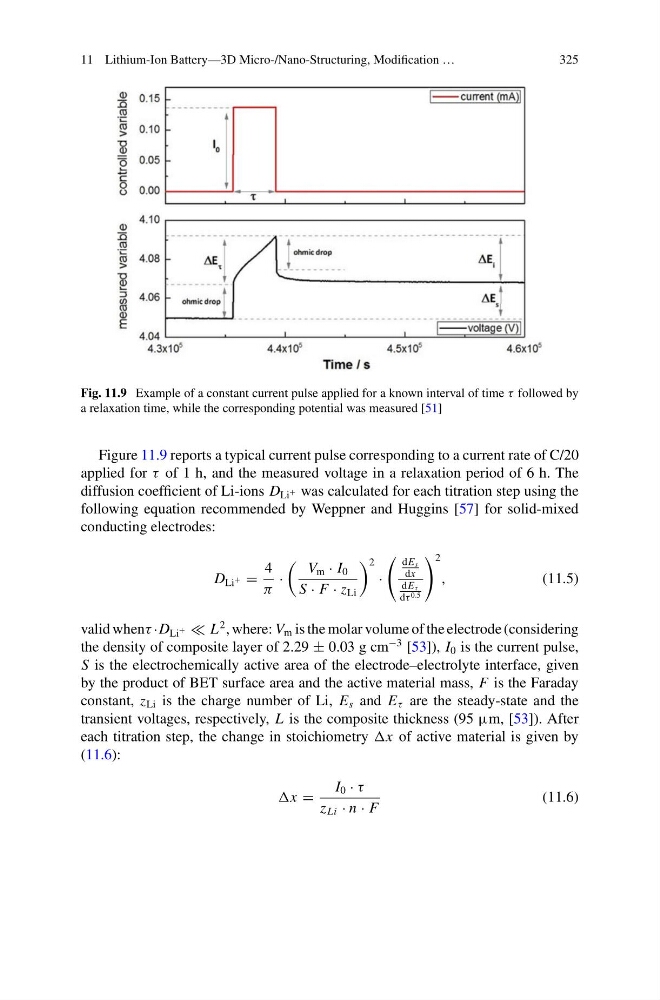
Fig. 11.9 Example of a constant current pulse applied for a known interval of time τ followed by
a relaxation time, while the corresponding potential was measured [51]
Figure 11.9 reports a typical current pulse corresponding to a current rate of C/20
applied for τ of 1 h, and the measured voltage in a relaxation period of 6 h. The
diffusion coefficient of Li-ions D Li
+ was calculated for each titration step using the
following equation recommended by Weppner and Huggins [57] for solid-mixed
conducting electrodes:
D Li
+ =
4
π
·
V m · I 0
S · F · z Li
2
·
dE s
dx
dE τ
dτ 0.5
2
,
(11.5)
valid whenτ ·D Li
+ L
2 , where: V m is the molar volume of the electrode (considering
the density of composite layer of 2.29 ± 0.03 g cm
−3 [53]), I 0 is the current pulse,
S is the electrochemically active area of the electrode–electrolyte interface, given
by the product of BET surface area and the active material mass, F is the Faraday
constant, z Li is the charge number of Li, E s and E τ are the steady-state and the
transient voltages, respectively, L is the composite thickness (95 μm, [53]). After
each titration step, the change in stoichiometry x of active material is given by
(11.6):
x =
I 0 · τ
z Li · n · F
(11.6)
325
Fig. 11.9 Example of a constant current pulse applied for a known interval of time τ followed by
a relaxation time, while the corresponding potential was measured [51]
Figure 11.9 reports a typical current pulse corresponding to a current rate of C/20
applied for τ of 1 h, and the measured voltage in a relaxation period of 6 h. The
diffusion coefficient of Li-ions D Li
+ was calculated for each titration step using the
following equation recommended by Weppner and Huggins [57] for solid-mixed
conducting electrodes:
D Li
+ =
4
π
·
V m · I 0
S · F · z Li
2
·
dE s
dx
dE τ
dτ 0.5
2
,
(11.5)
valid whenτ ·D Li
+ L
2 , where: V m is the molar volume of the electrode (considering
the density of composite layer of 2.29 ± 0.03 g cm
−3 [53]), I 0 is the current pulse,
S is the electrochemically active area of the electrode–electrolyte interface, given
by the product of BET surface area and the active material mass, F is the Faraday
constant, z Li is the charge number of Li, E s and E τ are the steady-state and the
transient voltages, respectively, L is the composite thickness (95 μm, [53]). After
each titration step, the change in stoichiometry x of active material is given by
(11.6):
x =
I 0 · τ
z Li · n · F
(11.6)