

320
W. Pfleging et al.
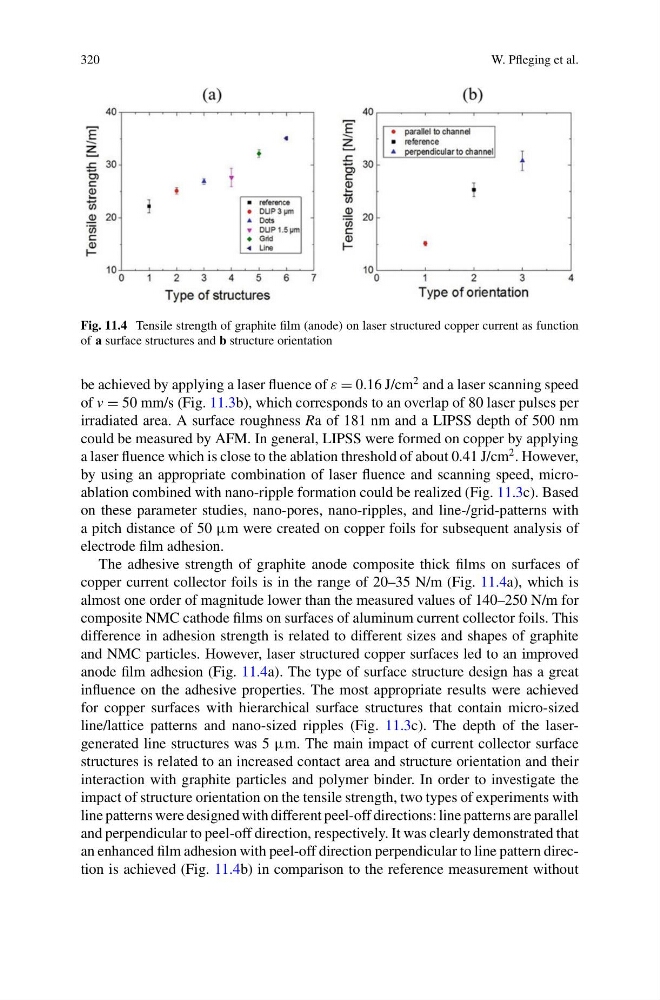
Fig. 11.4 Tensile strength of graphite film (anode) on laser structured copper current as function
of a surface structures and b structure orientation
be achieved by applying a laser fluence of ε = 0.16 J/cm
2 and a laser scanning speed
of v = 50 mm/s (Fig. 11.3b), which corresponds to an overlap of 80 laser pulses per
irradiated area. A surface roughness Ra of 181 nm and a LIPSS depth of 500 nm
could be measured by AFM. In general, LIPSS were formed on copper by applying
a laser fluence which is close to the ablation threshold of about 0.41 J/cm
2 . However,
by using an appropriate combination of laser fluence and scanning speed, microablation combined with nano-ripple formation could be realized (Fig. 11.3c). Based
on these parameter studies, nano-pores, nano-ripples, and line-/grid-patterns with
a pitch distance of 50 μm were created on copper foils for subsequent analysis of
electrode film adhesion.
The adhesive strength of graphite anode composite thick films on surfaces of
copper current collector foils is in the range of 20–35 N/m (Fig. 11.4a), which is
almost one order of magnitude lower than the measured values of 140–250 N/m for
composite NMC cathode films on surfaces of aluminum current collector foils. This
difference in adhesion strength is related to different sizes and shapes of graphite
and NMC particles. However, laser structured copper surfaces led to an improved
anode film adhesion (Fig. 11.4a). The type of surface structure design has a great
influence on the adhesive properties. The most appropriate results were achieved
for copper surfaces with hierarchical surface structures that contain micro-sized
line/lattice patterns and nano-sized ripples (Fig. 11.3c). The depth of the lasergenerated line structures was 5 μm. The main impact of current collector surface
structures is related to an increased contact area and structure orientation and their
interaction with graphite particles and polymer binder. In order to investigate the
impact of structure orientation on the tensile strength, two types of experiments with
line patterns were designed with different peel-off directions: line patterns are parallel
and perpendicular to peel-off direction, respectively. It was clearly demonstrated that
an enhanced film adhesion with peel-off direction perpendicular to line pattern direction is achieved (Fig. 11.4b) in comparison to the reference measurement without
W. Pfleging et al.
Fig. 11.4 Tensile strength of graphite film (anode) on laser structured copper current as function
of a surface structures and b structure orientation
be achieved by applying a laser fluence of ε = 0.16 J/cm
2 and a laser scanning speed
of v = 50 mm/s (Fig. 11.3b), which corresponds to an overlap of 80 laser pulses per
irradiated area. A surface roughness Ra of 181 nm and a LIPSS depth of 500 nm
could be measured by AFM. In general, LIPSS were formed on copper by applying
a laser fluence which is close to the ablation threshold of about 0.41 J/cm
2 . However,
by using an appropriate combination of laser fluence and scanning speed, microablation combined with nano-ripple formation could be realized (Fig. 11.3c). Based
on these parameter studies, nano-pores, nano-ripples, and line-/grid-patterns with
a pitch distance of 50 μm were created on copper foils for subsequent analysis of
electrode film adhesion.
The adhesive strength of graphite anode composite thick films on surfaces of
copper current collector foils is in the range of 20–35 N/m (Fig. 11.4a), which is
almost one order of magnitude lower than the measured values of 140–250 N/m for
composite NMC cathode films on surfaces of aluminum current collector foils. This
difference in adhesion strength is related to different sizes and shapes of graphite
and NMC particles. However, laser structured copper surfaces led to an improved
anode film adhesion (Fig. 11.4a). The type of surface structure design has a great
influence on the adhesive properties. The most appropriate results were achieved
for copper surfaces with hierarchical surface structures that contain micro-sized
line/lattice patterns and nano-sized ripples (Fig. 11.3c). The depth of the lasergenerated line structures was 5 μm. The main impact of current collector surface
structures is related to an increased contact area and structure orientation and their
interaction with graphite particles and polymer binder. In order to investigate the
impact of structure orientation on the tensile strength, two types of experiments with
line patterns were designed with different peel-off directions: line patterns are parallel
and perpendicular to peel-off direction, respectively. It was clearly demonstrated that
an enhanced film adhesion with peel-off direction perpendicular to line pattern direction is achieved (Fig. 11.4b) in comparison to the reference measurement without