

318
W. Pfleging et al.
11.2.2 Laser-Induced Periodic Surface Structures (LIPPS)
The formation mechanisms and applications of LIPSS, often termed as ripples, are
under intense investigation. LIPSS are nano-scaled surface structures composed of
wave-like structures, which exhibit a clear correlation to the incident laser wavelength and polarization. LIPSS can be generated on almost any type of material
such as metal, glass, polymer, or semiconductors. A complete understanding of the
comprehensive mechanism of LIPSS formation is currently not available.
Regarding the structure periodicity of LIPSS, one distinguishes two different
LIPSS categories: low spatial frequency LIPSS (LSFL) and high spatial frequency
LIPSS (HSFL). For LSFL, one of the proposed mechanisms for strong absorbing
materials, such as semiconductors and metal, is the so-called interference theory: the
structures are formed by interaction of the incident laser beam and excited surface
plasmon polaritons (SPP) [45–47]. SPP are surface electromagnetic waves, which
are excited by the incident laser beam. The LSFL is usually perpendicular oriented
to the laser beam polarization and exhibits a periodicity that is a bit smaller than
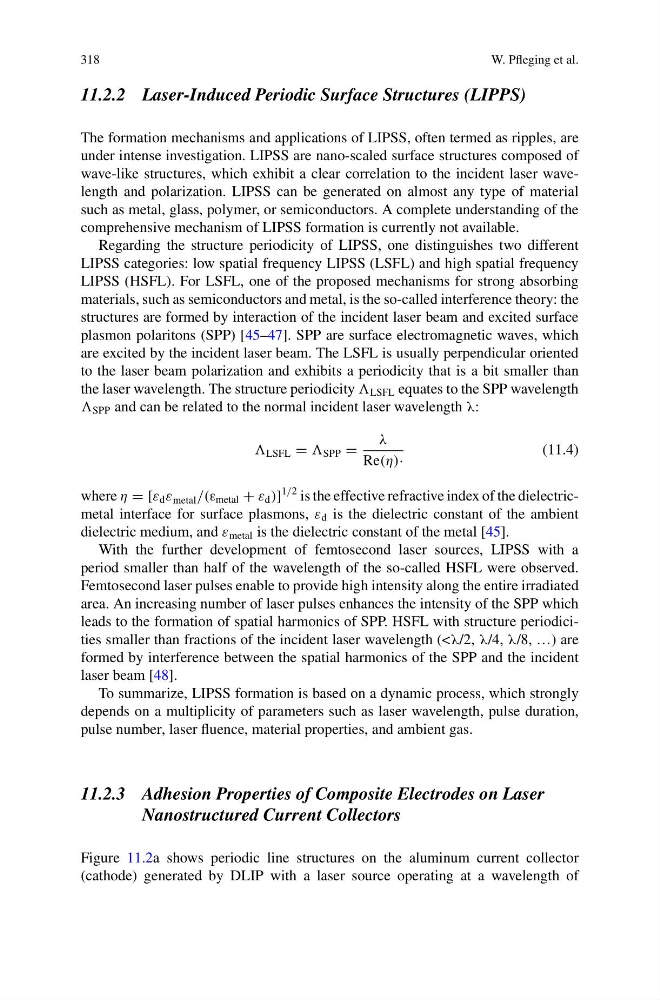
the laser wavelength. The structure periodicity LSFL equates to the SPP wavelength
SPP and can be related to the normal incident laser wavelength λ:
LSFL = SPP =
λ
Re(η)·
(11.4)
where η = [ε d ε metal /(ε metal + ε d )]
1/2 is the effective refractive index of the dielectricmetal interface for surface plasmons, ε d is the dielectric constant of the ambient
dielectric medium, and ε metal is the dielectric constant of the metal [45].
With the further development of femtosecond laser sources, LIPSS with a
period smaller than half of the wavelength of the so-called HSFL were observed.
Femtosecond laser pulses enable to provide high intensity along the entire irradiated
area. An increasing number of laser pulses enhances the intensity of the SPP which
leads to the formation of spatial harmonics of SPP. HSFL with structure periodicities smaller than fractions of the incident laser wavelength (<λ/2, λ/4, λ/8, …) are
formed by interference between the spatial harmonics of the SPP and the incident
laser beam [48].
To summarize, LIPSS formation is based on a dynamic process, which strongly
depends on a multiplicity of parameters such as laser wavelength, pulse duration,
pulse number, laser fluence, material properties, and ambient gas.
11.2.3 Adhesion Properties of Composite Electrodes on Laser
Nanostructured Current Collectors
Figure 11.2a shows periodic line structures on the aluminum current collector
(cathode) generated by DLIP with a laser source operating at a wavelength of
W. Pfleging et al.
11.2.2 Laser-Induced Periodic Surface Structures (LIPPS)
The formation mechanisms and applications of LIPSS, often termed as ripples, are
under intense investigation. LIPSS are nano-scaled surface structures composed of
wave-like structures, which exhibit a clear correlation to the incident laser wavelength and polarization. LIPSS can be generated on almost any type of material
such as metal, glass, polymer, or semiconductors. A complete understanding of the
comprehensive mechanism of LIPSS formation is currently not available.
Regarding the structure periodicity of LIPSS, one distinguishes two different
LIPSS categories: low spatial frequency LIPSS (LSFL) and high spatial frequency
LIPSS (HSFL). For LSFL, one of the proposed mechanisms for strong absorbing
materials, such as semiconductors and metal, is the so-called interference theory: the
structures are formed by interaction of the incident laser beam and excited surface
plasmon polaritons (SPP) [45–47]. SPP are surface electromagnetic waves, which
are excited by the incident laser beam. The LSFL is usually perpendicular oriented
to the laser beam polarization and exhibits a periodicity that is a bit smaller than
the laser wavelength. The structure periodicity LSFL equates to the SPP wavelength
SPP and can be related to the normal incident laser wavelength λ:
LSFL = SPP =
λ
Re(η)·
(11.4)
where η = [ε d ε metal /(ε metal + ε d )]
1/2 is the effective refractive index of the dielectricmetal interface for surface plasmons, ε d is the dielectric constant of the ambient
dielectric medium, and ε metal is the dielectric constant of the metal [45].
With the further development of femtosecond laser sources, LIPSS with a
period smaller than half of the wavelength of the so-called HSFL were observed.
Femtosecond laser pulses enable to provide high intensity along the entire irradiated
area. An increasing number of laser pulses enhances the intensity of the SPP which
leads to the formation of spatial harmonics of SPP. HSFL with structure periodicities smaller than fractions of the incident laser wavelength (<λ/2, λ/4, λ/8, …) are
formed by interference between the spatial harmonics of the SPP and the incident
laser beam [48].
To summarize, LIPSS formation is based on a dynamic process, which strongly
depends on a multiplicity of parameters such as laser wavelength, pulse duration,
pulse number, laser fluence, material properties, and ambient gas.
11.2.3 Adhesion Properties of Composite Electrodes on Laser
Nanostructured Current Collectors
Figure 11.2a shows periodic line structures on the aluminum current collector
(cathode) generated by DLIP with a laser source operating at a wavelength of