

10 Laser Scanning Stereolithography
307
electronic and ionic conductivities, and chemical and mechanical stabilities at high
operating temperatures. The energy efficiency is influenced by the anode microstructure, and the fuel gas diffusion and electrochemical reactions on the electrode surfaces
composed of YSZ/Ni/Gas triple-phase boundary proceed simultaneously. YSZ-Ni
porous anodes have been fabricated to realize large surface areas and high activations
[3–5].
In this study, solid electrodes with dendritic microstructures and wide surface
areas were used to realize effective gas diffusion and appropriate mechanical strength.
The permeability of the cavity network design and fluid implementation was optimized through the finite element method. The dendritic structures constructed from
micrometer-order ceramic rods with coordination numbers of 4, 6, 8, and 12 were
designed in a computer application. The aspect ratios of the rod diameter to length
were valued from 0.75 to 3.00. The gaseous fluid properties and stress distributions
in dendritic electrodes were simulated and visualized.
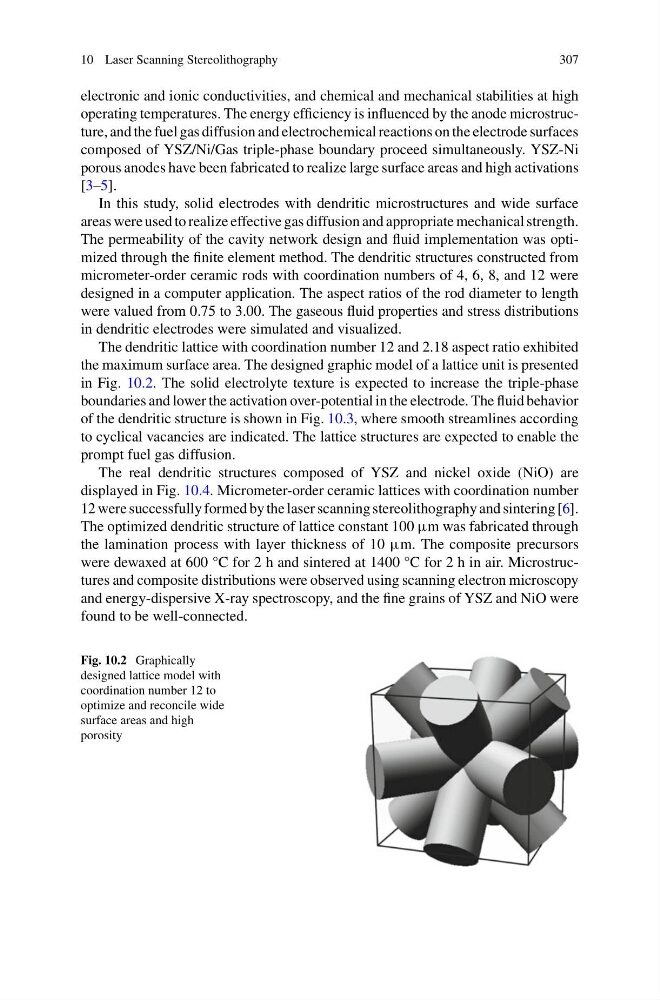
The dendritic lattice with coordination number 12 and 2.18 aspect ratio exhibited
the maximum surface area. The designed graphic model of a lattice unit is presented
in Fig. 10.2. The solid electrolyte texture is expected to increase the triple-phase
boundaries and lower the activation over-potential in the electrode. The fluid behavior
of the dendritic structure is shown in Fig. 10.3, where smooth streamlines according
to cyclical vacancies are indicated. The lattice structures are expected to enable the
prompt fuel gas diffusion.
The real dendritic structures composed of YSZ and nickel oxide (NiO) are
displayed in Fig. 10.4. Micrometer-order ceramic lattices with coordination number
12 were successfully formed by the laser scanning stereolithography and sintering [6].
The optimized dendritic structure of lattice constant 100 µm was fabricated through
the lamination process with layer thickness of 10 µm. The composite precursors
were dewaxed at 600 °C for 2 h and sintered at 1400 °C for 2 h in air. Microstructures and composite distributions were observed using scanning electron microscopy
and energy-dispersive X-ray spectroscopy, and the fine grains of YSZ and NiO were
found to be well-connected.
Fig. 10.2 Graphically
designed lattice model with
coordination number 12 to
optimize and reconcile wide
surface areas and high
porosity
307
electronic and ionic conductivities, and chemical and mechanical stabilities at high
operating temperatures. The energy efficiency is influenced by the anode microstructure, and the fuel gas diffusion and electrochemical reactions on the electrode surfaces
composed of YSZ/Ni/Gas triple-phase boundary proceed simultaneously. YSZ-Ni
porous anodes have been fabricated to realize large surface areas and high activations
[3–5].
In this study, solid electrodes with dendritic microstructures and wide surface
areas were used to realize effective gas diffusion and appropriate mechanical strength.
The permeability of the cavity network design and fluid implementation was optimized through the finite element method. The dendritic structures constructed from
micrometer-order ceramic rods with coordination numbers of 4, 6, 8, and 12 were
designed in a computer application. The aspect ratios of the rod diameter to length
were valued from 0.75 to 3.00. The gaseous fluid properties and stress distributions
in dendritic electrodes were simulated and visualized.
The dendritic lattice with coordination number 12 and 2.18 aspect ratio exhibited
the maximum surface area. The designed graphic model of a lattice unit is presented
in Fig. 10.2. The solid electrolyte texture is expected to increase the triple-phase
boundaries and lower the activation over-potential in the electrode. The fluid behavior
of the dendritic structure is shown in Fig. 10.3, where smooth streamlines according
to cyclical vacancies are indicated. The lattice structures are expected to enable the
prompt fuel gas diffusion.
The real dendritic structures composed of YSZ and nickel oxide (NiO) are
displayed in Fig. 10.4. Micrometer-order ceramic lattices with coordination number
12 were successfully formed by the laser scanning stereolithography and sintering [6].
The optimized dendritic structure of lattice constant 100 µm was fabricated through
the lamination process with layer thickness of 10 µm. The composite precursors
were dewaxed at 600 °C for 2 h and sintered at 1400 °C for 2 h in air. Microstructures and composite distributions were observed using scanning electron microscopy
and energy-dispersive X-ray spectroscopy, and the fine grains of YSZ and NiO were
found to be well-connected.
Fig. 10.2 Graphically
designed lattice model with
coordination number 12 to
optimize and reconcile wide
surface areas and high
porosity