

7 Micro-hole Arrays and Net-like Structure Fabrication …
241
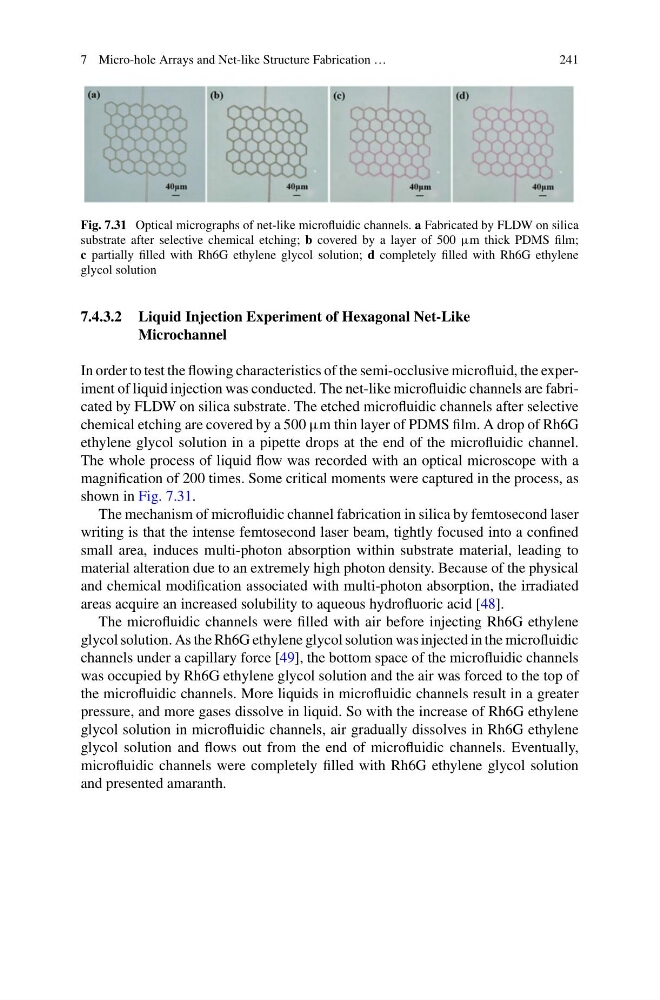
Fig. 7.31 Optical micrographs of net-like microfluidic channels. a Fabricated by FLDW on silica
substrate after selective chemical etching; b covered by a layer of 500 μm thick PDMS film;
c partially filled with Rh6G ethylene glycol solution; d completely filled with Rh6G ethylene
glycol solution
7.4.3.2 Liquid Injection Experiment of Hexagonal Net-Like
Microchannel
In order to test the flowing characteristics of the semi-occlusive microfluid, the experiment of liquid injection was conducted. The net-like microfluidic channels are fabricated by FLDW on silica substrate. The etched microfluidic channels after selective
chemical etching are covered by a 500 μm thin layer of PDMS film. A drop of Rh6G
ethylene glycol solution in a pipette drops at the end of the microfluidic channel.
The whole process of liquid flow was recorded with an optical microscope with a
magnification of 200 times. Some critical moments were captured in the process, as
shown in Fig. 7.31.
The mechanism of microfluidic channel fabrication in silica by femtosecond laser
writing is that the intense femtosecond laser beam, tightly focused into a confined
small area, induces multi-photon absorption within substrate material, leading to
material alteration due to an extremely high photon density. Because of the physical
and chemical modification associated with multi-photon absorption, the irradiated
areas acquire an increased solubility to aqueous hydrofluoric acid [48].
The microfluidic channels were filled with air before injecting Rh6G ethylene
glycol solution. As the Rh6G ethylene glycol solution was injected in the microfluidic
channels under a capillary force [49], the bottom space of the microfluidic channels
was occupied by Rh6G ethylene glycol solution and the air was forced to the top of
the microfluidic channels. More liquids in microfluidic channels result in a greater
pressure, and more gases dissolve in liquid. So with the increase of Rh6G ethylene
glycol solution in microfluidic channels, air gradually dissolves in Rh6G ethylene
glycol solution and flows out from the end of microfluidic channels. Eventually,
microfluidic channels were completely filled with Rh6G ethylene glycol solution
and presented amaranth.
241
Fig. 7.31 Optical micrographs of net-like microfluidic channels. a Fabricated by FLDW on silica
substrate after selective chemical etching; b covered by a layer of 500 μm thick PDMS film;
c partially filled with Rh6G ethylene glycol solution; d completely filled with Rh6G ethylene
glycol solution
7.4.3.2 Liquid Injection Experiment of Hexagonal Net-Like
Microchannel
In order to test the flowing characteristics of the semi-occlusive microfluid, the experiment of liquid injection was conducted. The net-like microfluidic channels are fabricated by FLDW on silica substrate. The etched microfluidic channels after selective
chemical etching are covered by a 500 μm thin layer of PDMS film. A drop of Rh6G
ethylene glycol solution in a pipette drops at the end of the microfluidic channel.
The whole process of liquid flow was recorded with an optical microscope with a
magnification of 200 times. Some critical moments were captured in the process, as
shown in Fig. 7.31.
The mechanism of microfluidic channel fabrication in silica by femtosecond laser
writing is that the intense femtosecond laser beam, tightly focused into a confined
small area, induces multi-photon absorption within substrate material, leading to
material alteration due to an extremely high photon density. Because of the physical
and chemical modification associated with multi-photon absorption, the irradiated
areas acquire an increased solubility to aqueous hydrofluoric acid [48].
The microfluidic channels were filled with air before injecting Rh6G ethylene
glycol solution. As the Rh6G ethylene glycol solution was injected in the microfluidic
channels under a capillary force [49], the bottom space of the microfluidic channels
was occupied by Rh6G ethylene glycol solution and the air was forced to the top of
the microfluidic channels. More liquids in microfluidic channels result in a greater
pressure, and more gases dissolve in liquid. So with the increase of Rh6G ethylene
glycol solution in microfluidic channels, air gradually dissolves in Rh6G ethylene
glycol solution and flows out from the end of microfluidic channels. Eventually,
microfluidic channels were completely filled with Rh6G ethylene glycol solution
and presented amaranth.