

228
G. Feng et al.
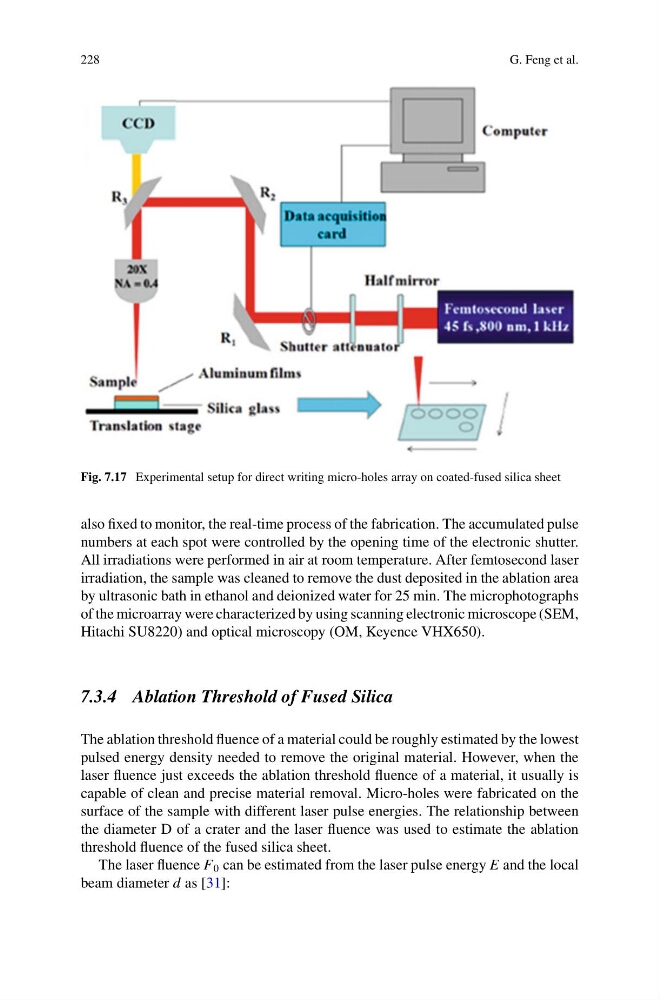
Fig. 7.17 Experimental setup for direct writing micro-holes array on coated-fused silica sheet
also fixed to monitor, the real-time process of the fabrication. The accumulated pulse
numbers at each spot were controlled by the opening time of the electronic shutter.
All irradiations were performed in air at room temperature. After femtosecond laser
irradiation, the sample was cleaned to remove the dust deposited in the ablation area
by ultrasonic bath in ethanol and deionized water for 25 min. The microphotographs
of the microarray were characterized by using scanning electronic microscope (SEM,
Hitachi SU8220) and optical microscopy (OM, Keyence VHX650).
7.3.4 Ablation Threshold of Fused Silica
The ablation threshold fluence of a material could be roughly estimated by the lowest
pulsed energy density needed to remove the original material. However, when the
laser fluence just exceeds the ablation threshold fluence of a material, it usually is
capable of clean and precise material removal. Micro-holes were fabricated on the
surface of the sample with different laser pulse energies. The relationship between
the diameter D of a crater and the laser fluence was used to estimate the ablation
threshold fluence of the fused silica sheet.
The laser fluence F 0 can be estimated from the laser pulse energy E and the local
beam diameter d as [31]:
G. Feng et al.
Fig. 7.17 Experimental setup for direct writing micro-holes array on coated-fused silica sheet
also fixed to monitor, the real-time process of the fabrication. The accumulated pulse
numbers at each spot were controlled by the opening time of the electronic shutter.
All irradiations were performed in air at room temperature. After femtosecond laser
irradiation, the sample was cleaned to remove the dust deposited in the ablation area
by ultrasonic bath in ethanol and deionized water for 25 min. The microphotographs
of the microarray were characterized by using scanning electronic microscope (SEM,
Hitachi SU8220) and optical microscopy (OM, Keyence VHX650).
7.3.4 Ablation Threshold of Fused Silica
The ablation threshold fluence of a material could be roughly estimated by the lowest
pulsed energy density needed to remove the original material. However, when the
laser fluence just exceeds the ablation threshold fluence of a material, it usually is
capable of clean and precise material removal. Micro-holes were fabricated on the
surface of the sample with different laser pulse energies. The relationship between
the diameter D of a crater and the laser fluence was used to estimate the ablation
threshold fluence of the fused silica sheet.
The laser fluence F 0 can be estimated from the laser pulse energy E and the local
beam diameter d as [31]: