

204
F. Chen and J. R. V. de Aldana
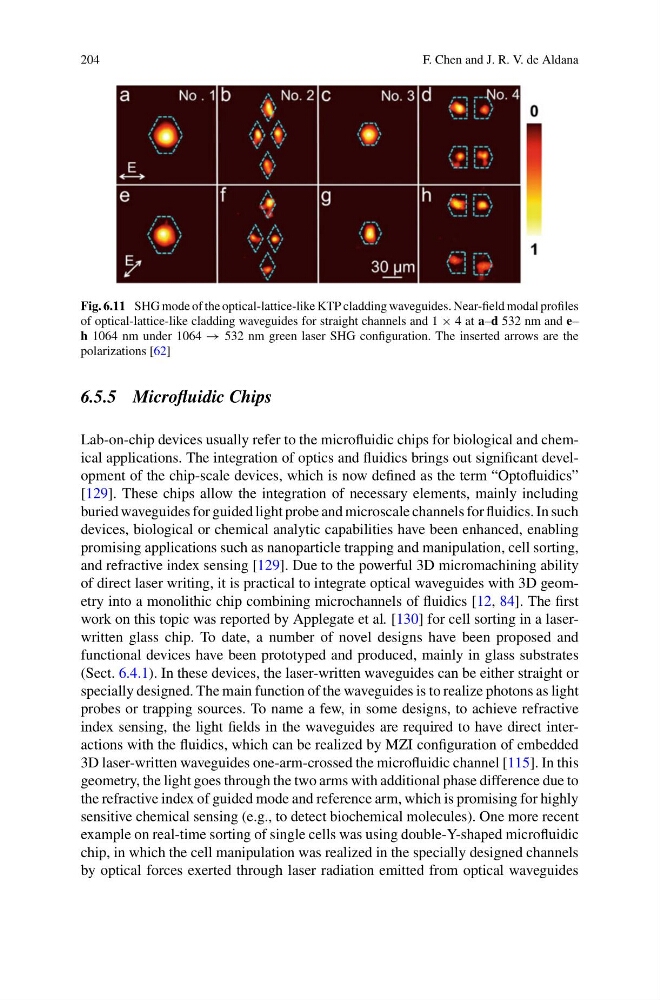
Fig. 6.11 SHG mode of the optical-lattice-like KTP cladding waveguides. Near-field modal profiles
of optical-lattice-like cladding waveguides for straight channels and 1 × 4 at a–d 532 nm and e–
h 1064 nm under 1064 → 532 nm green laser SHG configuration. The inserted arrows are the
polarizations [62]
6.5.5 Microfluidic Chips
Lab-on-chip devices usually refer to the microfluidic chips for biological and chemical applications. The integration of optics and fluidics brings out significant development of the chip-scale devices, which is now defined as the term “Optofluidics”
[129]. These chips allow the integration of necessary elements, mainly including
buried waveguides for guided light probe and microscale channels for fluidics. In such
devices, biological or chemical analytic capabilities have been enhanced, enabling
promising applications such as nanoparticle trapping and manipulation, cell sorting,
and refractive index sensing [129]. Due to the powerful 3D micromachining ability
of direct laser writing, it is practical to integrate optical waveguides with 3D geometry into a monolithic chip combining microchannels of fluidics [12, 84]. The first
work on this topic was reported by Applegate et al. [130] for cell sorting in a laserwritten glass chip. To date, a number of novel designs have been proposed and
functional devices have been prototyped and produced, mainly in glass substrates
(Sect. 6.4.1). In these devices, the laser-written waveguides can be either straight or
specially designed. The main function of the waveguides is to realize photons as light
probes or trapping sources. To name a few, in some designs, to achieve refractive
index sensing, the light fields in the waveguides are required to have direct interactions with the fluidics, which can be realized by MZI configuration of embedded
3D laser-written waveguides one-arm-crossed the microfluidic channel [115]. In this
geometry, the light goes through the two arms with additional phase difference due to
the refractive index of guided mode and reference arm, which is promising for highly
sensitive chemical sensing (e.g., to detect biochemical molecules). One more recent
example on real-time sorting of single cells was using double-Y-shaped microfluidic
chip, in which the cell manipulation was realized in the specially designed channels
by optical forces exerted through laser radiation emitted from optical waveguides
F. Chen and J. R. V. de Aldana
Fig. 6.11 SHG mode of the optical-lattice-like KTP cladding waveguides. Near-field modal profiles
of optical-lattice-like cladding waveguides for straight channels and 1 × 4 at a–d 532 nm and e–
h 1064 nm under 1064 → 532 nm green laser SHG configuration. The inserted arrows are the
polarizations [62]
6.5.5 Microfluidic Chips
Lab-on-chip devices usually refer to the microfluidic chips for biological and chemical applications. The integration of optics and fluidics brings out significant development of the chip-scale devices, which is now defined as the term “Optofluidics”
[129]. These chips allow the integration of necessary elements, mainly including
buried waveguides for guided light probe and microscale channels for fluidics. In such
devices, biological or chemical analytic capabilities have been enhanced, enabling
promising applications such as nanoparticle trapping and manipulation, cell sorting,
and refractive index sensing [129]. Due to the powerful 3D micromachining ability
of direct laser writing, it is practical to integrate optical waveguides with 3D geometry into a monolithic chip combining microchannels of fluidics [12, 84]. The first
work on this topic was reported by Applegate et al. [130] for cell sorting in a laserwritten glass chip. To date, a number of novel designs have been proposed and
functional devices have been prototyped and produced, mainly in glass substrates
(Sect. 6.4.1). In these devices, the laser-written waveguides can be either straight or
specially designed. The main function of the waveguides is to realize photons as light
probes or trapping sources. To name a few, in some designs, to achieve refractive
index sensing, the light fields in the waveguides are required to have direct interactions with the fluidics, which can be realized by MZI configuration of embedded
3D laser-written waveguides one-arm-crossed the microfluidic channel [115]. In this
geometry, the light goes through the two arms with additional phase difference due to
the refractive index of guided mode and reference arm, which is promising for highly
sensitive chemical sensing (e.g., to detect biochemical molecules). One more recent
example on real-time sorting of single cells was using double-Y-shaped microfluidic
chip, in which the cell manipulation was realized in the specially designed channels
by optical forces exerted through laser radiation emitted from optical waveguides