

6 Direct Femtosecond Laser Writing of Optical Waveguides …
203
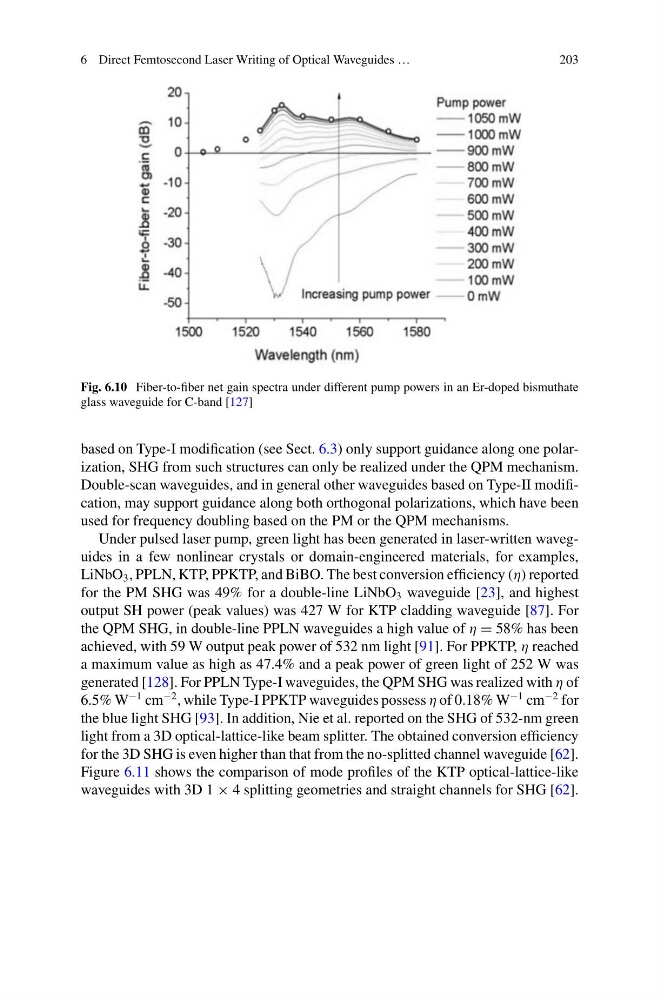
Fig. 6.10 Fiber-to-fiber net gain spectra under different pump powers in an Er-doped bismuthate
glass waveguide for C-band [127]
based on Type-I modification (see Sect. 6.3) only support guidance along one polarization, SHG from such structures can only be realized under the QPM mechanism.
Double-scan waveguides, and in general other waveguides based on Type-II modification, may support guidance along both orthogonal polarizations, which have been
used for frequency doubling based on the PM or the QPM mechanisms.
Under pulsed laser pump, green light has been generated in laser-written waveguides in a few nonlinear crystals or domain-engineered materials, for examples,
LiNbO 3 , PPLN, KTP, PPKTP, and BiBO. The best conversion efficiency (η) reported
for the PM SHG was 49% for a double-line LiNbO 3 waveguide [23], and highest
output SH power (peak values) was 427 W for KTP cladding waveguide [87]. For
the QPM SHG, in double-line PPLN waveguides a high value of η = 58% has been
achieved, with 59 W output peak power of 532 nm light [91]. For PPKTP, η reached
a maximum value as high as 47.4% and a peak power of green light of 252 W was
generated [128]. For PPLN Type-I waveguides, the QPM SHG was realized with η of
6.5% W
−1 cm
−2 , while Type-I PPKTP waveguides possess η of 0.18% W
−1 cm
−2 for
the blue light SHG [93]. In addition, Nie et al. reported on the SHG of 532-nm green
light from a 3D optical-lattice-like beam splitter. The obtained conversion efficiency
for the 3D SHG is even higher than that from the no-splitted channel waveguide [62].
Figure 6.11 shows the comparison of mode profiles of the KTP optical-lattice-like
waveguides with 3D 1 × 4 splitting geometries and straight channels for SHG [62].
203
Fig. 6.10 Fiber-to-fiber net gain spectra under different pump powers in an Er-doped bismuthate
glass waveguide for C-band [127]
based on Type-I modification (see Sect. 6.3) only support guidance along one polarization, SHG from such structures can only be realized under the QPM mechanism.
Double-scan waveguides, and in general other waveguides based on Type-II modification, may support guidance along both orthogonal polarizations, which have been
used for frequency doubling based on the PM or the QPM mechanisms.
Under pulsed laser pump, green light has been generated in laser-written waveguides in a few nonlinear crystals or domain-engineered materials, for examples,
LiNbO 3 , PPLN, KTP, PPKTP, and BiBO. The best conversion efficiency (η) reported
for the PM SHG was 49% for a double-line LiNbO 3 waveguide [23], and highest
output SH power (peak values) was 427 W for KTP cladding waveguide [87]. For
the QPM SHG, in double-line PPLN waveguides a high value of η = 58% has been
achieved, with 59 W output peak power of 532 nm light [91]. For PPKTP, η reached
a maximum value as high as 47.4% and a peak power of green light of 252 W was
generated [128]. For PPLN Type-I waveguides, the QPM SHG was realized with η of
6.5% W
−1 cm
−2 , while Type-I PPKTP waveguides possess η of 0.18% W
−1 cm
−2 for
the blue light SHG [93]. In addition, Nie et al. reported on the SHG of 532-nm green
light from a 3D optical-lattice-like beam splitter. The obtained conversion efficiency
for the 3D SHG is even higher than that from the no-splitted channel waveguide [62].
Figure 6.11 shows the comparison of mode profiles of the KTP optical-lattice-like
waveguides with 3D 1 × 4 splitting geometries and straight channels for SHG [62].