

6 Direct Femtosecond Laser Writing of Optical Waveguides …
191
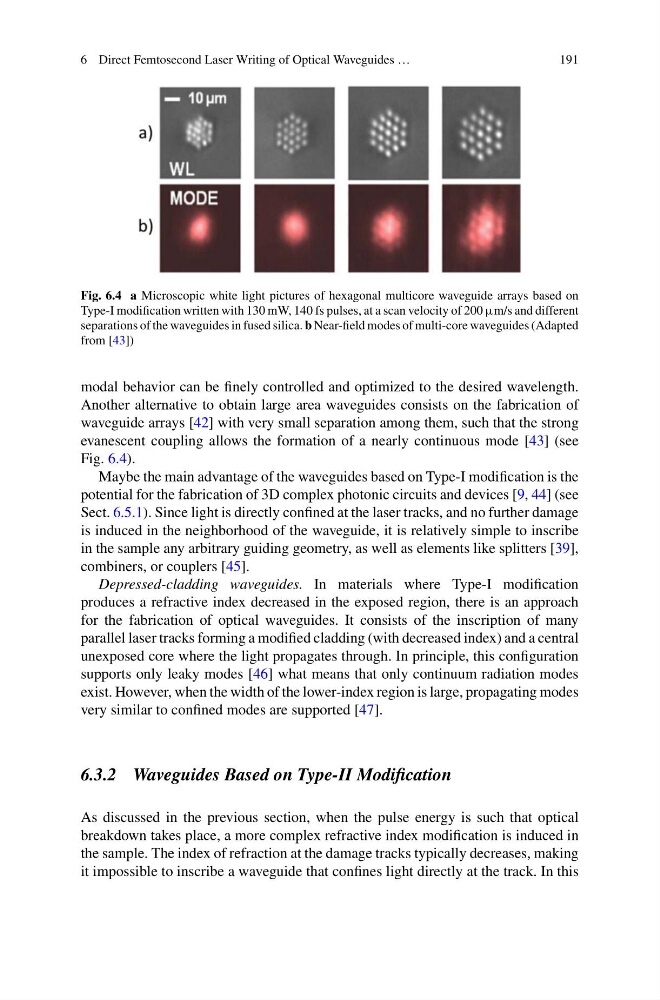
Fig. 6.4 a Microscopic white light pictures of hexagonal multicore waveguide arrays based on
Type-I modification written with 130 mW, 140 fs pulses, at a scan velocity of 200 µm/s and different
separations of the waveguides in fused silica. b Near-field modes of multi-core waveguides (Adapted
from [43])
modal behavior can be finely controlled and optimized to the desired wavelength.
Another alternative to obtain large area waveguides consists on the fabrication of
waveguide arrays [42] with very small separation among them, such that the strong
evanescent coupling allows the formation of a nearly continuous mode [43] (see
Fig. 6.4).
Maybe the main advantage of the waveguides based on Type-I modification is the
potential for the fabrication of 3D complex photonic circuits and devices [9, 44] (see
Sect. 6.5.1). Since light is directly confined at the laser tracks, and no further damage
is induced in the neighborhood of the waveguide, it is relatively simple to inscribe
in the sample any arbitrary guiding geometry, as well as elements like splitters [39],
combiners, or couplers [45].
Depressed-cladding waveguides. In materials where Type-I modification
produces a refractive index decreased in the exposed region, there is an approach
for the fabrication of optical waveguides. It consists of the inscription of many
parallel laser tracks forming a modified cladding (with decreased index) and a central
unexposed core where the light propagates through. In principle, this configuration
supports only leaky modes [46] what means that only continuum radiation modes
exist. However, when the width of the lower-index region is large, propagating modes
very similar to confined modes are supported [47].
6.3.2 Waveguides Based on Type-II Modification
As discussed in the previous section, when the pulse energy is such that optical
breakdown takes place, a more complex refractive index modification is induced in
the sample. The index of refraction at the damage tracks typically decreases, making
it impossible to inscribe a waveguide that confines light directly at the track. In this
191
Fig. 6.4 a Microscopic white light pictures of hexagonal multicore waveguide arrays based on
Type-I modification written with 130 mW, 140 fs pulses, at a scan velocity of 200 µm/s and different
separations of the waveguides in fused silica. b Near-field modes of multi-core waveguides (Adapted
from [43])
modal behavior can be finely controlled and optimized to the desired wavelength.
Another alternative to obtain large area waveguides consists on the fabrication of
waveguide arrays [42] with very small separation among them, such that the strong
evanescent coupling allows the formation of a nearly continuous mode [43] (see
Fig. 6.4).
Maybe the main advantage of the waveguides based on Type-I modification is the
potential for the fabrication of 3D complex photonic circuits and devices [9, 44] (see
Sect. 6.5.1). Since light is directly confined at the laser tracks, and no further damage
is induced in the neighborhood of the waveguide, it is relatively simple to inscribe
in the sample any arbitrary guiding geometry, as well as elements like splitters [39],
combiners, or couplers [45].
Depressed-cladding waveguides. In materials where Type-I modification
produces a refractive index decreased in the exposed region, there is an approach
for the fabrication of optical waveguides. It consists of the inscription of many
parallel laser tracks forming a modified cladding (with decreased index) and a central
unexposed core where the light propagates through. In principle, this configuration
supports only leaky modes [46] what means that only continuum radiation modes
exist. However, when the width of the lower-index region is large, propagating modes
very similar to confined modes are supported [47].
6.3.2 Waveguides Based on Type-II Modification
As discussed in the previous section, when the pulse energy is such that optical
breakdown takes place, a more complex refractive index modification is induced in
the sample. The index of refraction at the damage tracks typically decreases, making
it impossible to inscribe a waveguide that confines light directly at the track. In this