

5 Dry Laser Peening: Ultrashort Pulsed Laser Peening …
171
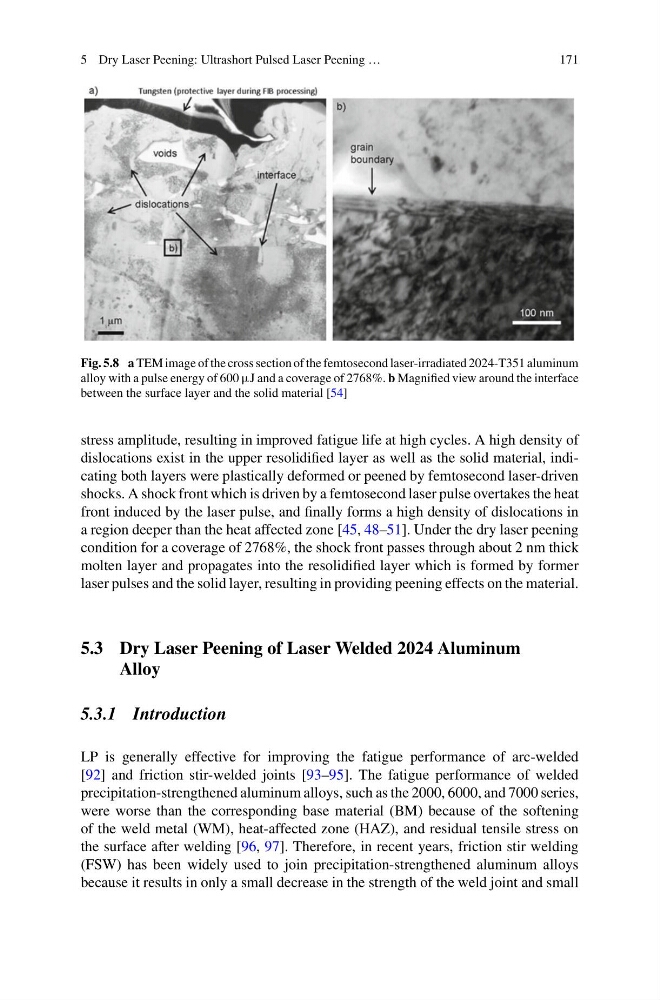
Fig. 5.8 a TEM image of the cross section of the femtosecond laser-irradiated 2024-T351 aluminum
alloy with a pulse energy of 600 μJ and a coverage of 2768%. b Magnified view around the interface
between the surface layer and the solid material [54]
stress amplitude, resulting in improved fatigue life at high cycles. A high density of
dislocations exist in the upper resolidified layer as well as the solid material, indicating both layers were plastically deformed or peened by femtosecond laser-driven
shocks. A shock front which is driven by a femtosecond laser pulse overtakes the heat
front induced by the laser pulse, and finally forms a high density of dislocations in
a region deeper than the heat affected zone [45, 48–51]. Under the dry laser peening
condition for a coverage of 2768%, the shock front passes through about 2 nm thick
molten layer and propagates into the resolidified layer which is formed by former
laser pulses and the solid layer, resulting in providing peening effects on the material.
5.3 Dry Laser Peening of Laser Welded 2024 Aluminum
Alloy
5.3.1 Introduction
LP is generally effective for improving the fatigue performance of arc-welded
[92] and friction stir-welded joints [93–95]. The fatigue performance of welded
precipitation-strengthened aluminum alloys, such as the 2000, 6000, and 7000 series,
were worse than the corresponding base material (BM) because of the softening
of the weld metal (WM), heat-affected zone (HAZ), and residual tensile stress on
the surface after welding [96, 97]. Therefore, in recent years, friction stir welding
(FSW) has been widely used to join precipitation-strengthened aluminum alloys
because it results in only a small decrease in the strength of the weld joint and small
171
Fig. 5.8 a TEM image of the cross section of the femtosecond laser-irradiated 2024-T351 aluminum
alloy with a pulse energy of 600 μJ and a coverage of 2768%. b Magnified view around the interface
between the surface layer and the solid material [54]
stress amplitude, resulting in improved fatigue life at high cycles. A high density of
dislocations exist in the upper resolidified layer as well as the solid material, indicating both layers were plastically deformed or peened by femtosecond laser-driven
shocks. A shock front which is driven by a femtosecond laser pulse overtakes the heat
front induced by the laser pulse, and finally forms a high density of dislocations in
a region deeper than the heat affected zone [45, 48–51]. Under the dry laser peening
condition for a coverage of 2768%, the shock front passes through about 2 nm thick
molten layer and propagates into the resolidified layer which is formed by former
laser pulses and the solid layer, resulting in providing peening effects on the material.
5.3 Dry Laser Peening of Laser Welded 2024 Aluminum
Alloy
5.3.1 Introduction
LP is generally effective for improving the fatigue performance of arc-welded
[92] and friction stir-welded joints [93–95]. The fatigue performance of welded
precipitation-strengthened aluminum alloys, such as the 2000, 6000, and 7000 series,
were worse than the corresponding base material (BM) because of the softening
of the weld metal (WM), heat-affected zone (HAZ), and residual tensile stress on
the surface after welding [96, 97]. Therefore, in recent years, friction stir welding
(FSW) has been widely used to join precipitation-strengthened aluminum alloys
because it results in only a small decrease in the strength of the weld joint and small