

5 Dry Laser Peening: Ultrashort Pulsed Laser Peening …
167
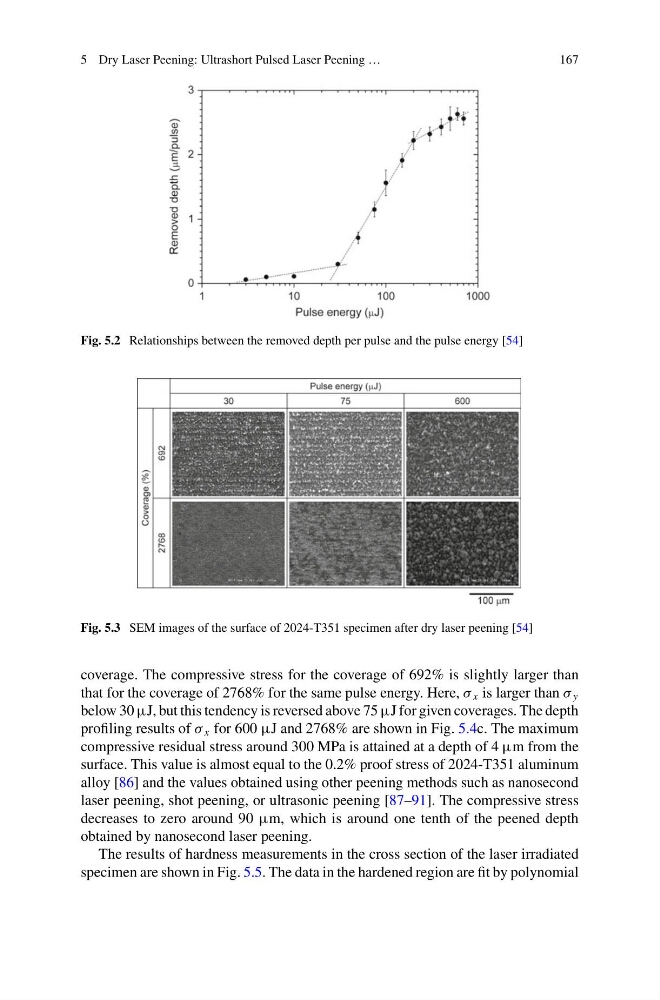
Fig. 5.2 Relationships between the removed depth per pulse and the pulse energy [54]
Fig. 5.3 SEM images of the surface of 2024-T351 specimen after dry laser peening [54]
coverage. The compressive stress for the coverage of 692% is slightly larger than
that for the coverage of 2768% for the same pulse energy. Here, σ x is larger than σ y
below 30 μJ, but this tendency is reversed above 75 μJ for given coverages. The depth
profiling results of σ x for 600 μJ and 2768% are shown in Fig. 5.4c. The maximum
compressive residual stress around 300 MPa is attained at a depth of 4 μm from the
surface. This value is almost equal to the 0.2% proof stress of 2024-T351 aluminum
alloy [86] and the values obtained using other peening methods such as nanosecond
laser peening, shot peening, or ultrasonic peening [87–91]. The compressive stress
decreases to zero around 90 μm, which is around one tenth of the peened depth
obtained by nanosecond laser peening.
The results of hardness measurements in the cross section of the laser irradiated
specimen are shown in Fig. 5.5. The data in the hardened region are fit by polynomial
167
Fig. 5.2 Relationships between the removed depth per pulse and the pulse energy [54]
Fig. 5.3 SEM images of the surface of 2024-T351 specimen after dry laser peening [54]
coverage. The compressive stress for the coverage of 692% is slightly larger than
that for the coverage of 2768% for the same pulse energy. Here, σ x is larger than σ y
below 30 μJ, but this tendency is reversed above 75 μJ for given coverages. The depth
profiling results of σ x for 600 μJ and 2768% are shown in Fig. 5.4c. The maximum
compressive residual stress around 300 MPa is attained at a depth of 4 μm from the
surface. This value is almost equal to the 0.2% proof stress of 2024-T351 aluminum
alloy [86] and the values obtained using other peening methods such as nanosecond
laser peening, shot peening, or ultrasonic peening [87–91]. The compressive stress
decreases to zero around 90 μm, which is around one tenth of the peened depth
obtained by nanosecond laser peening.
The results of hardness measurements in the cross section of the laser irradiated
specimen are shown in Fig. 5.5. The data in the hardened region are fit by polynomial