

4 Laser-Induced Synthesis and Processing of Nanoparticles …
155
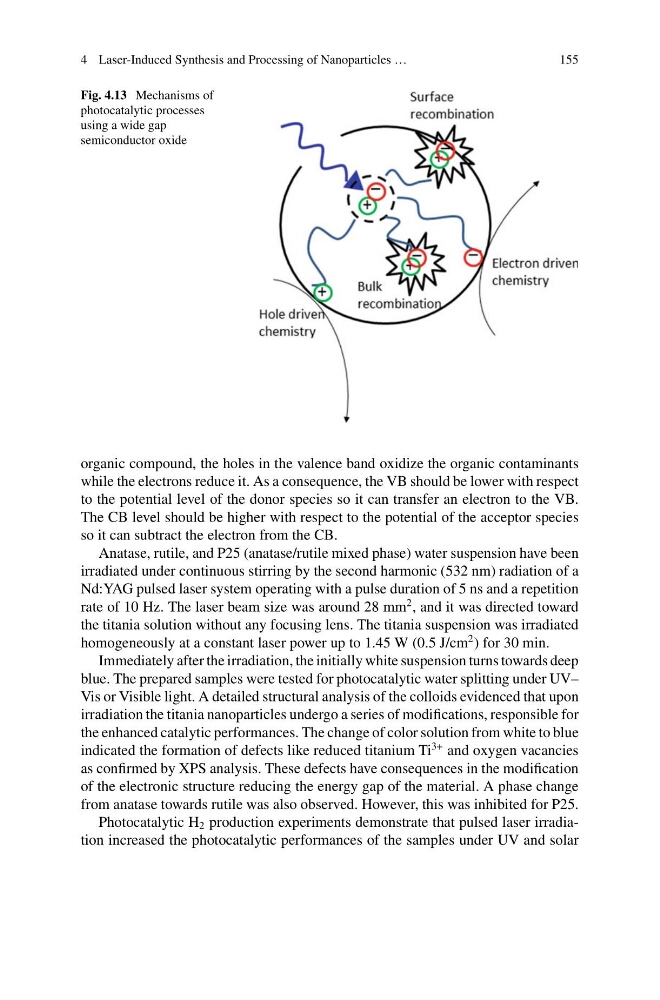
Fig. 4.13 Mechanisms of
photocatalytic processes
using a wide gap
semiconductor oxide
organic compound, the holes in the valence band oxidize the organic contaminants
while the electrons reduce it. As a consequence, the VB should be lower with respect
to the potential level of the donor species so it can transfer an electron to the VB.
The CB level should be higher with respect to the potential of the acceptor species
so it can subtract the electron from the CB.
Anatase, rutile, and P25 (anatase/rutile mixed phase) water suspension have been
irradiated under continuous stirring by the second harmonic (532 nm) radiation of a
Nd:YAG pulsed laser system operating with a pulse duration of 5 ns and a repetition
rate of 10 Hz. The laser beam size was around 28 mm
2 , and it was directed toward
the titania solution without any focusing lens. The titania suspension was irradiated
homogeneously at a constant laser power up to 1.45 W (0.5 J/cm
2 ) for 30 min.
Immediately after the irradiation, the initially white suspension turns towards deep
blue. The prepared samples were tested for photocatalytic water splitting under UV–
Vis or Visible light. A detailed structural analysis of the colloids evidenced that upon
irradiation the titania nanoparticles undergo a series of modifications, responsible for
the enhanced catalytic performances. The change of color solution from white to blue
indicated the formation of defects like reduced titanium Ti
3+ and oxygen vacancies
as confirmed by XPS analysis. These defects have consequences in the modification
of the electronic structure reducing the energy gap of the material. A phase change
from anatase towards rutile was also observed. However, this was inhibited for P25.
Photocatalytic H 2 production experiments demonstrate that pulsed laser irradiation increased the photocatalytic performances of the samples under UV and solar
155
Fig. 4.13 Mechanisms of
photocatalytic processes
using a wide gap
semiconductor oxide
organic compound, the holes in the valence band oxidize the organic contaminants
while the electrons reduce it. As a consequence, the VB should be lower with respect
to the potential level of the donor species so it can transfer an electron to the VB.
The CB level should be higher with respect to the potential of the acceptor species
so it can subtract the electron from the CB.
Anatase, rutile, and P25 (anatase/rutile mixed phase) water suspension have been
irradiated under continuous stirring by the second harmonic (532 nm) radiation of a
Nd:YAG pulsed laser system operating with a pulse duration of 5 ns and a repetition
rate of 10 Hz. The laser beam size was around 28 mm
2 , and it was directed toward
the titania solution without any focusing lens. The titania suspension was irradiated
homogeneously at a constant laser power up to 1.45 W (0.5 J/cm
2 ) for 30 min.
Immediately after the irradiation, the initially white suspension turns towards deep
blue. The prepared samples were tested for photocatalytic water splitting under UV–
Vis or Visible light. A detailed structural analysis of the colloids evidenced that upon
irradiation the titania nanoparticles undergo a series of modifications, responsible for
the enhanced catalytic performances. The change of color solution from white to blue
indicated the formation of defects like reduced titanium Ti
3+ and oxygen vacancies
as confirmed by XPS analysis. These defects have consequences in the modification
of the electronic structure reducing the energy gap of the material. A phase change
from anatase towards rutile was also observed. However, this was inhibited for P25.
Photocatalytic H 2 production experiments demonstrate that pulsed laser irradiation increased the photocatalytic performances of the samples under UV and solar