

154
G. Compagnini et al.
their morphology and size, their chemical composition, or crystalline phase. Furthermore, laser irradiation in liquid resulting in NPs melting or fragmentation also induces
defects in titania structure.
As previously demonstrated, ‘in liquid’ laser irradiation technique has been
demonstrated to be an interesting method to easily increase the photocatalytic activity
of TiO 2 and other nanomaterials towards the degradation of organic pollutants and
water splitting application [88, 89]. It’s an easy, low cost, eco-friendly, and tunable
technique to modify inorganic semiconductors directly in water. Very recently, hydrogenated blue titania has been found to greatly enhance both solar absorption and
photocatalytic methyl orange decomposition compared to the pristine TiO 2 [90].
Visible active titania colloids were obtained by UV laser irradiation of anatase NPs
dispersed in ethanol and the as modified samples showed an higher photocatalytic
activity either under UV and solar irradiation with respect to untreated material. The
use of ethanol as solvent in the laser processes was found to be the best choice to
improve the activity of TiO 2 sample under visible light. This is explained in more
detail in the following paragraphs.
Here, we report a study on the use of laser irradiation in liquids for improving
the photocatalytic activity of titanium dioxide [91]. We use laser irradiation for
the introduction of defects inside titania (as Ti
3+ and O-vacancies) to improve the
photocatalytic activity of titania for water splitting. In this case, the proposed method
can be ‘built-in’, since laser irradiation and hydrogen production can be performed in
the same system at the same site. Indeed, laser irradiation is performed on aqueous
titania dispersions which can be directly used for the subsequent water splitting
process.
Unlike a conductor, a semiconductor like titania has well defined VB and CB.
Energy difference between these two levels is said to be the band gap Eg. Without
excitation, both the electrons and holes are in the valence band. When semiconductors
are excited by photons with energy equal to or higher than their band gap energy
level, electrons receive energy from the photons and are thus promoted from VB to
CB. This reaction can be expressed as:
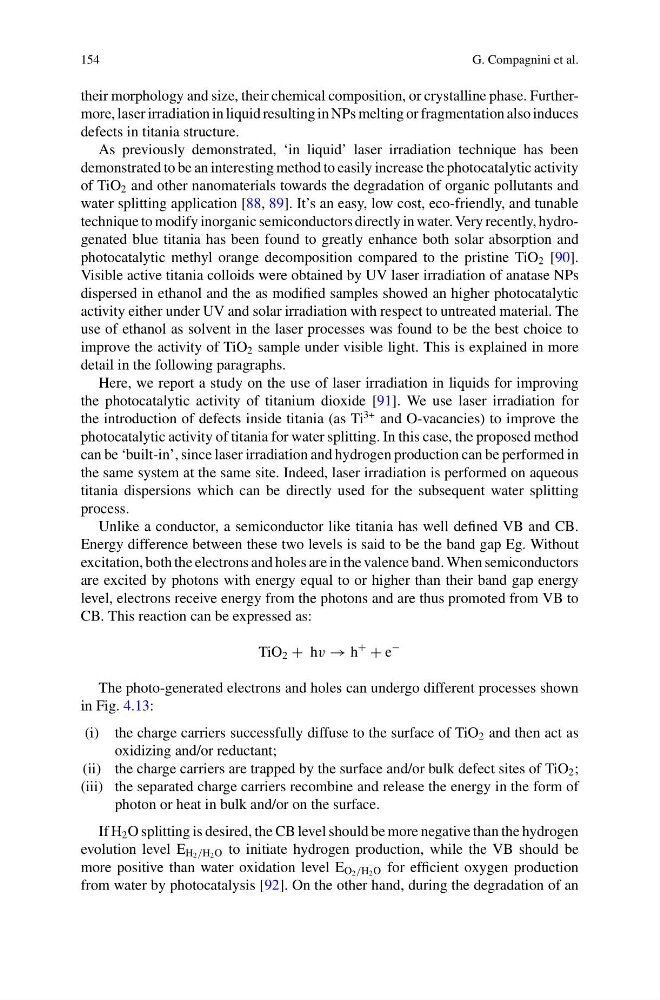
TiO 2 + hv → h
+
+ e
−
The photo-generated electrons and holes can undergo different processes shown
in Fig. 4.13:
(i) the charge carriers successfully diffuse to the surface of TiO 2 and then act as
oxidizing and/or reductant;
(ii) the charge carriers are trapped by the surface and/or bulk defect sites of TiO 2 ;
(iii) the separated charge carriers recombine and release the energy in the form of
photon or heat in bulk and/or on the surface.
If H 2 O splitting is desired, the CB level should be more negative than the hydrogen
evolution level E H 2 /H 2 O to initiate hydrogen production, while the VB should be
more positive than water oxidation level E O 2 /H 2 O for efficient oxygen production
from water by photocatalysis [92]. On the other hand, during the degradation of an
G. Compagnini et al.
their morphology and size, their chemical composition, or crystalline phase. Furthermore, laser irradiation in liquid resulting in NPs melting or fragmentation also induces
defects in titania structure.
As previously demonstrated, ‘in liquid’ laser irradiation technique has been
demonstrated to be an interesting method to easily increase the photocatalytic activity
of TiO 2 and other nanomaterials towards the degradation of organic pollutants and
water splitting application [88, 89]. It’s an easy, low cost, eco-friendly, and tunable
technique to modify inorganic semiconductors directly in water. Very recently, hydrogenated blue titania has been found to greatly enhance both solar absorption and
photocatalytic methyl orange decomposition compared to the pristine TiO 2 [90].
Visible active titania colloids were obtained by UV laser irradiation of anatase NPs
dispersed in ethanol and the as modified samples showed an higher photocatalytic
activity either under UV and solar irradiation with respect to untreated material. The
use of ethanol as solvent in the laser processes was found to be the best choice to
improve the activity of TiO 2 sample under visible light. This is explained in more
detail in the following paragraphs.
Here, we report a study on the use of laser irradiation in liquids for improving
the photocatalytic activity of titanium dioxide [91]. We use laser irradiation for
the introduction of defects inside titania (as Ti
3+ and O-vacancies) to improve the
photocatalytic activity of titania for water splitting. In this case, the proposed method
can be ‘built-in’, since laser irradiation and hydrogen production can be performed in
the same system at the same site. Indeed, laser irradiation is performed on aqueous
titania dispersions which can be directly used for the subsequent water splitting
process.
Unlike a conductor, a semiconductor like titania has well defined VB and CB.
Energy difference between these two levels is said to be the band gap Eg. Without
excitation, both the electrons and holes are in the valence band. When semiconductors
are excited by photons with energy equal to or higher than their band gap energy
level, electrons receive energy from the photons and are thus promoted from VB to
CB. This reaction can be expressed as:
TiO 2 + hv → h
+
+ e
−
The photo-generated electrons and holes can undergo different processes shown
in Fig. 4.13:
(i) the charge carriers successfully diffuse to the surface of TiO 2 and then act as
oxidizing and/or reductant;
(ii) the charge carriers are trapped by the surface and/or bulk defect sites of TiO 2 ;
(iii) the separated charge carriers recombine and release the energy in the form of
photon or heat in bulk and/or on the surface.
If H 2 O splitting is desired, the CB level should be more negative than the hydrogen
evolution level E H 2 /H 2 O to initiate hydrogen production, while the VB should be
more positive than water oxidation level E O 2 /H 2 O for efficient oxygen production
from water by photocatalysis [92]. On the other hand, during the degradation of an