

152
G. Compagnini et al.
The antibacterial properties of laser-irradiated graphene oxide were recently
demonstrated in a paper by Buccheri et al. [74]. The test was performed on
Escherichia coli using both GO and laser-irradiated GO, showing that the higher
antibacterial activity is obtained for GO irradiated at least for three hours. These
properties seem to be correlated to the resulting morphology and size of laser-treated
GO and independent of the kind and amount of oxygen functionalities. Indeed, Xray photoelectron spectroscopy, Raman spectroscopy, dynamic light scattering, and
scanning electron microscopy show a reduction of the GO flakes size after visible
laser irradiation, preserving a considerable content of oxygen and hydrophilicity
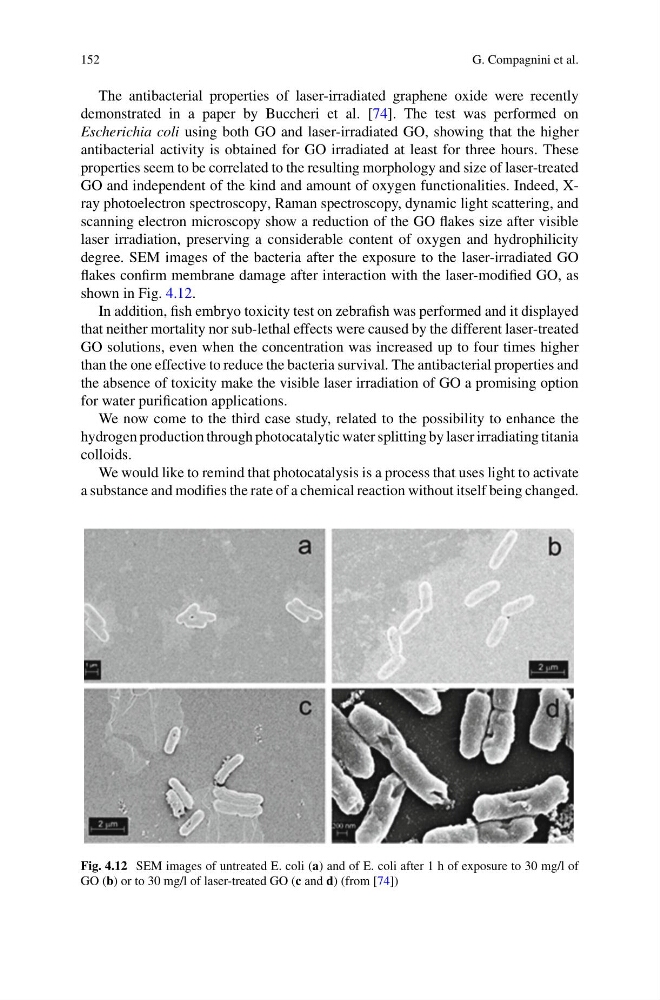
degree. SEM images of the bacteria after the exposure to the laser-irradiated GO
flakes confirm membrane damage after interaction with the laser-modified GO, as
shown in Fig. 4.12.
In addition, fish embryo toxicity test on zebrafish was performed and it displayed
that neither mortality nor sub-lethal effects were caused by the different laser-treated
GO solutions, even when the concentration was increased up to four times higher
than the one effective to reduce the bacteria survival. The antibacterial properties and
the absence of toxicity make the visible laser irradiation of GO a promising option
for water purification applications.
We now come to the third case study, related to the possibility to enhance the
hydrogen production through photocatalytic water splitting by laser irradiating titania
colloids.
We would like to remind that photocatalysis is a process that uses light to activate
a substance and modifies the rate of a chemical reaction without itself being changed.
Fig. 4.12 SEM images of untreated E. coli (a) and of E. coli after 1 h of exposure to 30 mg/l of
GO (b) or to 30 mg/l of laser-treated GO (c and d) (from [74])
G. Compagnini et al.
The antibacterial properties of laser-irradiated graphene oxide were recently
demonstrated in a paper by Buccheri et al. [74]. The test was performed on
Escherichia coli using both GO and laser-irradiated GO, showing that the higher
antibacterial activity is obtained for GO irradiated at least for three hours. These
properties seem to be correlated to the resulting morphology and size of laser-treated
GO and independent of the kind and amount of oxygen functionalities. Indeed, Xray photoelectron spectroscopy, Raman spectroscopy, dynamic light scattering, and
scanning electron microscopy show a reduction of the GO flakes size after visible
laser irradiation, preserving a considerable content of oxygen and hydrophilicity
degree. SEM images of the bacteria after the exposure to the laser-irradiated GO
flakes confirm membrane damage after interaction with the laser-modified GO, as
shown in Fig. 4.12.
In addition, fish embryo toxicity test on zebrafish was performed and it displayed
that neither mortality nor sub-lethal effects were caused by the different laser-treated
GO solutions, even when the concentration was increased up to four times higher
than the one effective to reduce the bacteria survival. The antibacterial properties and
the absence of toxicity make the visible laser irradiation of GO a promising option
for water purification applications.
We now come to the third case study, related to the possibility to enhance the
hydrogen production through photocatalytic water splitting by laser irradiating titania
colloids.
We would like to remind that photocatalysis is a process that uses light to activate
a substance and modifies the rate of a chemical reaction without itself being changed.
Fig. 4.12 SEM images of untreated E. coli (a) and of E. coli after 1 h of exposure to 30 mg/l of
GO (b) or to 30 mg/l of laser-treated GO (c and d) (from [74])