

4 Laser-Induced Synthesis and Processing of Nanoparticles …
151
tion the concentration of the residual MB rapidly decreases until 40 min. Then an
equilibrium is reached.
The amount of MB adsorbed (Q t ) at time t, was calculated according to the
equation:
Q t = [(C 0 − C t )V ]/m
where C 0 is the initial concentration of MB (mg/l), C t is the amount of adsorbed
MB on the adsorbent (mg/g), V is the volume of the solution (l) and m is the mass of
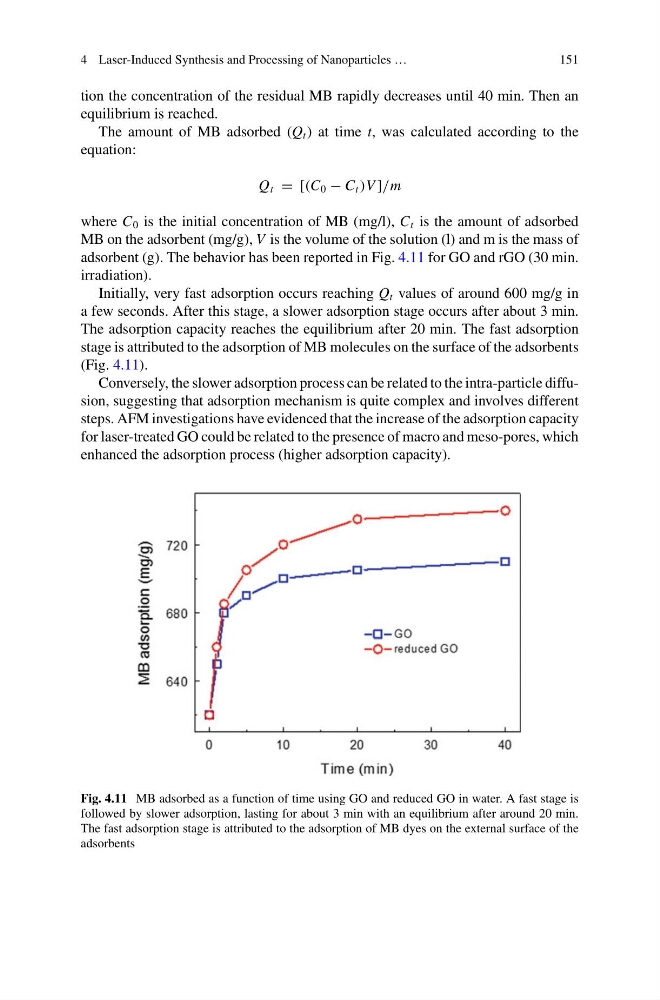
adsorbent (g). The behavior has been reported in Fig. 4.11 for GO and rGO (30 min.
irradiation).
Initially, very fast adsorption occurs reaching Q t values of around 600 mg/g in
a few seconds. After this stage, a slower adsorption stage occurs after about 3 min.
The adsorption capacity reaches the equilibrium after 20 min. The fast adsorption
stage is attributed to the adsorption of MB molecules on the surface of the adsorbents
(Fig. 4.11).
Conversely, the slower adsorption process can be related to the intra-particle diffusion, suggesting that adsorption mechanism is quite complex and involves different
steps. AFM investigations have evidenced that the increase of the adsorption capacity
for laser-treated GO could be related to the presence of macro and meso-pores, which
enhanced the adsorption process (higher adsorption capacity).
Fig. 4.11 MB adsorbed as a function of time using GO and reduced GO in water. A fast stage is
followed by slower adsorption, lasting for about 3 min with an equilibrium after around 20 min.
The fast adsorption stage is attributed to the adsorption of MB dyes on the external surface of the
adsorbents
151
tion the concentration of the residual MB rapidly decreases until 40 min. Then an
equilibrium is reached.
The amount of MB adsorbed (Q t ) at time t, was calculated according to the
equation:
Q t = [(C 0 − C t )V ]/m
where C 0 is the initial concentration of MB (mg/l), C t is the amount of adsorbed
MB on the adsorbent (mg/g), V is the volume of the solution (l) and m is the mass of
adsorbent (g). The behavior has been reported in Fig. 4.11 for GO and rGO (30 min.
irradiation).
Initially, very fast adsorption occurs reaching Q t values of around 600 mg/g in
a few seconds. After this stage, a slower adsorption stage occurs after about 3 min.
The adsorption capacity reaches the equilibrium after 20 min. The fast adsorption
stage is attributed to the adsorption of MB molecules on the surface of the adsorbents
(Fig. 4.11).
Conversely, the slower adsorption process can be related to the intra-particle diffusion, suggesting that adsorption mechanism is quite complex and involves different
steps. AFM investigations have evidenced that the increase of the adsorption capacity
for laser-treated GO could be related to the presence of macro and meso-pores, which
enhanced the adsorption process (higher adsorption capacity).
Fig. 4.11 MB adsorbed as a function of time using GO and reduced GO in water. A fast stage is
followed by slower adsorption, lasting for about 3 min with an equilibrium after around 20 min.
The fast adsorption stage is attributed to the adsorption of MB dyes on the external surface of the
adsorbents