

3 Apertureless Scanning Near-Field Optical Lithography
121
3.3.3 Cantilever Thermomechanical Behaviour
On cantilever-based SFM-setups, it is important to determine the thermomechanical
behaviour of the cantilever under laser illumination. When a tip is illuminated by a
laser, heat is diffused along the cantilever structure and causing expansion. A heat
gradient can lead to different expansion rates at different cantilever locations. This
introduces modifications on the cantilever geometry and position. Longitudinal cantilever expansion leads to a displacement of the tip position, which may compromise
the lateral resolution in nanolithography. Common silicon SPM cantilevers exhibit
a metallic coating on the back side to improve its reflectivity for the positioning
laser. This metallic layer has a different thermal expansion coefficient than silicon
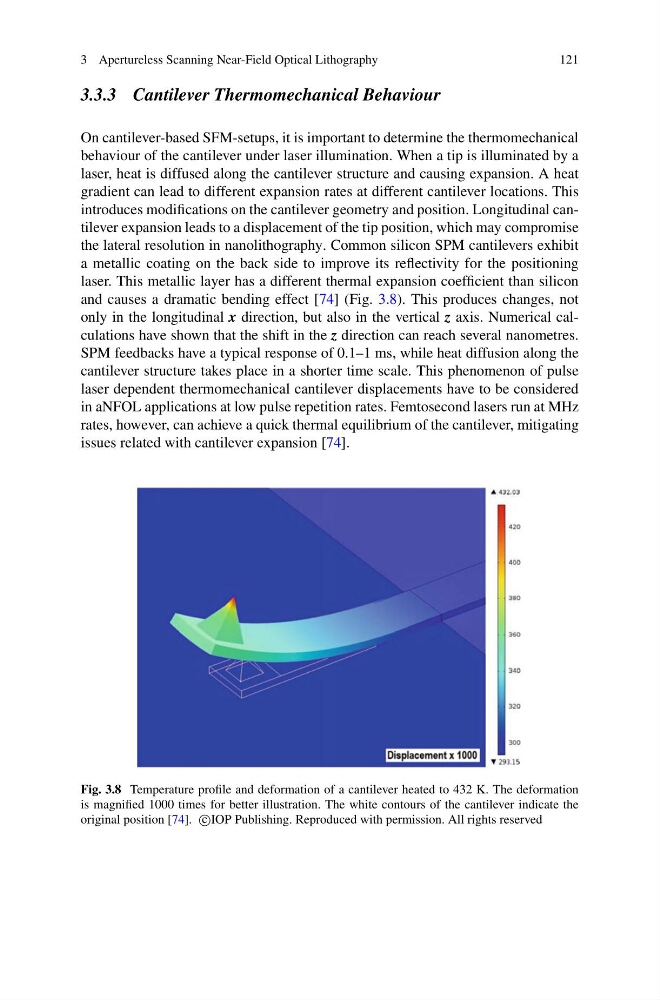
and causes a dramatic bending effect [74] (Fig. 3.8). This produces changes, not
only in the longitudinal x direction, but also in the vertical z axis. Numerical calculations have shown that the shift in the z direction can reach several nanometres.
SPM feedbacks have a typical response of 0.1–1 ms, while heat diffusion along the
cantilever structure takes place in a shorter time scale. This phenomenon of pulse
laser dependent thermomechanical cantilever displacements have to be considered
in aNFOL applications at low pulse repetition rates. Femtosecond lasers run at MHz
rates, however, can achieve a quick thermal equilibrium of the cantilever, mitigating
issues related with cantilever expansion [74].
Fig. 3.8 Temperature profile and deformation of a cantilever heated to 432 K. The deformation
is magnified 1000 times for better illustration. The white contours of the cantilever indicate the
original position [74]. c
IOP Publishing. Reproduced with permission. All rights reserved
121
3.3.3 Cantilever Thermomechanical Behaviour
On cantilever-based SFM-setups, it is important to determine the thermomechanical
behaviour of the cantilever under laser illumination. When a tip is illuminated by a
laser, heat is diffused along the cantilever structure and causing expansion. A heat
gradient can lead to different expansion rates at different cantilever locations. This
introduces modifications on the cantilever geometry and position. Longitudinal cantilever expansion leads to a displacement of the tip position, which may compromise
the lateral resolution in nanolithography. Common silicon SPM cantilevers exhibit
a metallic coating on the back side to improve its reflectivity for the positioning
laser. This metallic layer has a different thermal expansion coefficient than silicon
and causes a dramatic bending effect [74] (Fig. 3.8). This produces changes, not
only in the longitudinal x direction, but also in the vertical z axis. Numerical calculations have shown that the shift in the z direction can reach several nanometres.
SPM feedbacks have a typical response of 0.1–1 ms, while heat diffusion along the
cantilever structure takes place in a shorter time scale. This phenomenon of pulse
laser dependent thermomechanical cantilever displacements have to be considered
in aNFOL applications at low pulse repetition rates. Femtosecond lasers run at MHz
rates, however, can achieve a quick thermal equilibrium of the cantilever, mitigating
issues related with cantilever expansion [74].
Fig. 3.8 Temperature profile and deformation of a cantilever heated to 432 K. The deformation
is magnified 1000 times for better illustration. The white contours of the cantilever indicate the
original position [74]. c
IOP Publishing. Reproduced with permission. All rights reserved