

120
I. Falcón Casas and W. Kautek
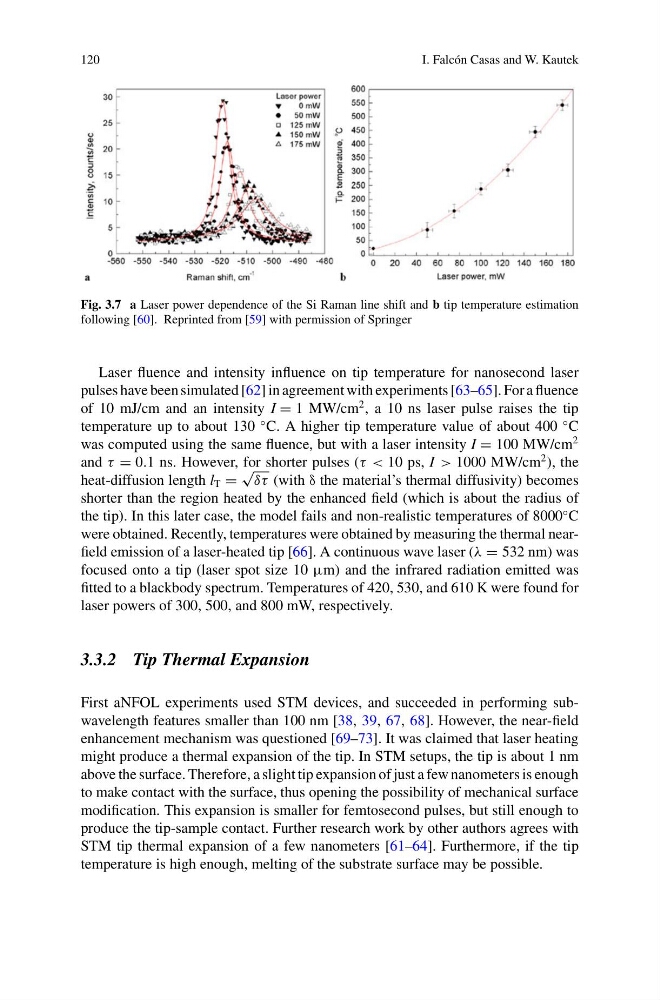
Fig. 3.7 a Laser power dependence of the Si Raman line shift and b tip temperature estimation
following [60]. Reprinted from [59] with permission of Springer
Laser fluence and intensity influence on tip temperature for nanosecond laser
pulses have been simulated [62] in agreement with experiments [63–65]. For a fluence
of 10 mJ/cm and an intensity I = 1 MW/cm
2 , a 10 ns laser pulse raises the tip
temperature up to about 130
◦ C. A higher tip temperature value of about 400
◦ C
was computed using the same fluence, but with a laser intensity I = 100 MW/cm
2
and τ = 0.1 ns. However, for shorter pulses (τ < 10 ps, I > 1000 MW/cm
2 ), the
heat-diffusion length l T =
√
δτ (with δ the material’s thermal diffusivity) becomes
shorter than the region heated by the enhanced field (which is about the radius of
the tip). In this later case, the model fails and non-realistic temperatures of 8000
◦ C
were obtained. Recently, temperatures were obtained by measuring the thermal nearfield emission of a laser-heated tip [66]. A continuous wave laser (λ = 532 nm) was
focused onto a tip (laser spot size 10 μm) and the infrared radiation emitted was
fitted to a blackbody spectrum. Temperatures of 420, 530, and 610 K were found for
laser powers of 300, 500, and 800 mW, respectively.
3.3.2 Tip Thermal Expansion
First aNFOL experiments used STM devices, and succeeded in performing subwavelength features smaller than 100 nm [38, 39, 67, 68]. However, the near-field
enhancement mechanism was questioned [69–73]. It was claimed that laser heating
might produce a thermal expansion of the tip. In STM setups, the tip is about 1 nm
above the surface. Therefore, a slight tip expansion of just a few nanometers is enough
to make contact with the surface, thus opening the possibility of mechanical surface
modification. This expansion is smaller for femtosecond pulses, but still enough to
produce the tip-sample contact. Further research work by other authors agrees with
STM tip thermal expansion of a few nanometers [61–64]. Furthermore, if the tip
temperature is high enough, melting of the substrate surface may be possible.
I. Falcón Casas and W. Kautek
Fig. 3.7 a Laser power dependence of the Si Raman line shift and b tip temperature estimation
following [60]. Reprinted from [59] with permission of Springer
Laser fluence and intensity influence on tip temperature for nanosecond laser
pulses have been simulated [62] in agreement with experiments [63–65]. For a fluence
of 10 mJ/cm and an intensity I = 1 MW/cm
2 , a 10 ns laser pulse raises the tip
temperature up to about 130
◦ C. A higher tip temperature value of about 400
◦ C
was computed using the same fluence, but with a laser intensity I = 100 MW/cm
2
and τ = 0.1 ns. However, for shorter pulses (τ < 10 ps, I > 1000 MW/cm
2 ), the
heat-diffusion length l T =
√
δτ (with δ the material’s thermal diffusivity) becomes
shorter than the region heated by the enhanced field (which is about the radius of
the tip). In this later case, the model fails and non-realistic temperatures of 8000
◦ C
were obtained. Recently, temperatures were obtained by measuring the thermal nearfield emission of a laser-heated tip [66]. A continuous wave laser (λ = 532 nm) was
focused onto a tip (laser spot size 10 μm) and the infrared radiation emitted was
fitted to a blackbody spectrum. Temperatures of 420, 530, and 610 K were found for
laser powers of 300, 500, and 800 mW, respectively.
3.3.2 Tip Thermal Expansion
First aNFOL experiments used STM devices, and succeeded in performing subwavelength features smaller than 100 nm [38, 39, 67, 68]. However, the near-field
enhancement mechanism was questioned [69–73]. It was claimed that laser heating
might produce a thermal expansion of the tip. In STM setups, the tip is about 1 nm
above the surface. Therefore, a slight tip expansion of just a few nanometers is enough
to make contact with the surface, thus opening the possibility of mechanical surface
modification. This expansion is smaller for femtosecond pulses, but still enough to
produce the tip-sample contact. Further research work by other authors agrees with
STM tip thermal expansion of a few nanometers [61–64]. Furthermore, if the tip
temperature is high enough, melting of the substrate surface may be possible.