

2 Ultrafast Laser Enabling Versatile Fabrication of Surface …
109
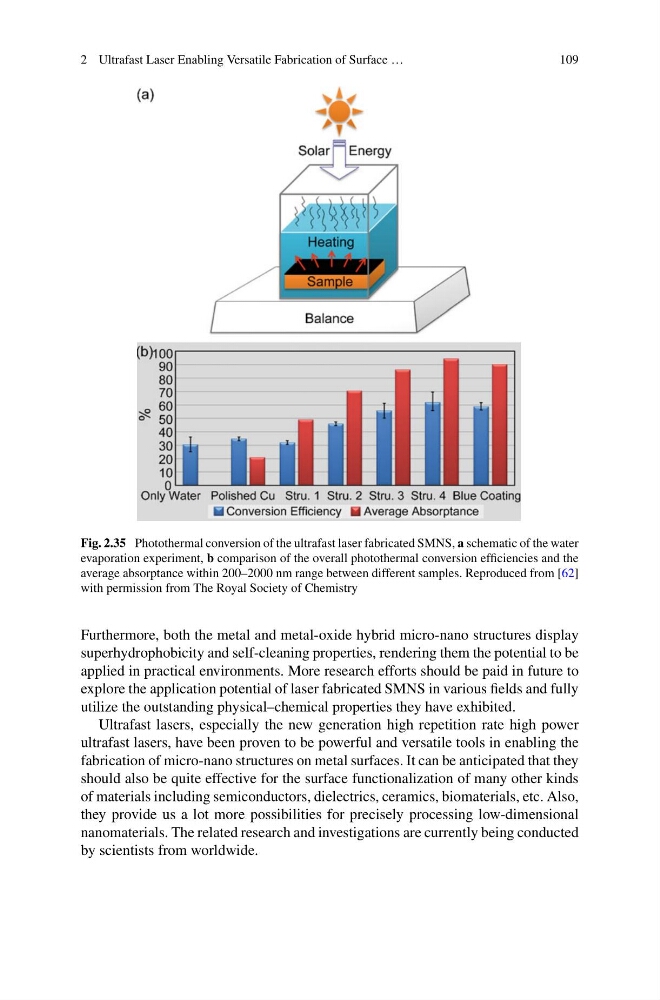
Fig. 2.35 Photothermal conversion of the ultrafast laser fabricated SMNS, a schematic of the water
evaporation experiment, b comparison of the overall photothermal conversion efficiencies and the
average absorptance within 200–2000 nm range between different samples. Reproduced from [62]
with permission from The Royal Society of Chemistry
Furthermore, both the metal and metal-oxide hybrid micro-nano structures display
superhydrophobicity and self-cleaning properties, rendering them the potential to be
applied in practical environments. More research efforts should be paid in future to
explore the application potential of laser fabricated SMNS in various fields and fully
utilize the outstanding physical–chemical properties they have exhibited.
Ultrafast lasers, especially the new generation high repetition rate high power
ultrafast lasers, have been proven to be powerful and versatile tools in enabling the
fabrication of micro-nano structures on metal surfaces. It can be anticipated that they
should also be quite effective for the surface functionalization of many other kinds
of materials including semiconductors, dielectrics, ceramics, biomaterials, etc. Also,
they provide us a lot more possibilities for precisely processing low-dimensional
nanomaterials. The related research and investigations are currently being conducted
by scientists from worldwide.
109
Fig. 2.35 Photothermal conversion of the ultrafast laser fabricated SMNS, a schematic of the water
evaporation experiment, b comparison of the overall photothermal conversion efficiencies and the
average absorptance within 200–2000 nm range between different samples. Reproduced from [62]
with permission from The Royal Society of Chemistry
Furthermore, both the metal and metal-oxide hybrid micro-nano structures display
superhydrophobicity and self-cleaning properties, rendering them the potential to be
applied in practical environments. More research efforts should be paid in future to
explore the application potential of laser fabricated SMNS in various fields and fully
utilize the outstanding physical–chemical properties they have exhibited.
Ultrafast lasers, especially the new generation high repetition rate high power
ultrafast lasers, have been proven to be powerful and versatile tools in enabling the
fabrication of micro-nano structures on metal surfaces. It can be anticipated that they
should also be quite effective for the surface functionalization of many other kinds
of materials including semiconductors, dielectrics, ceramics, biomaterials, etc. Also,
they provide us a lot more possibilities for precisely processing low-dimensional
nanomaterials. The related research and investigations are currently being conducted
by scientists from worldwide.