

108
M. Zhong and P. Fan
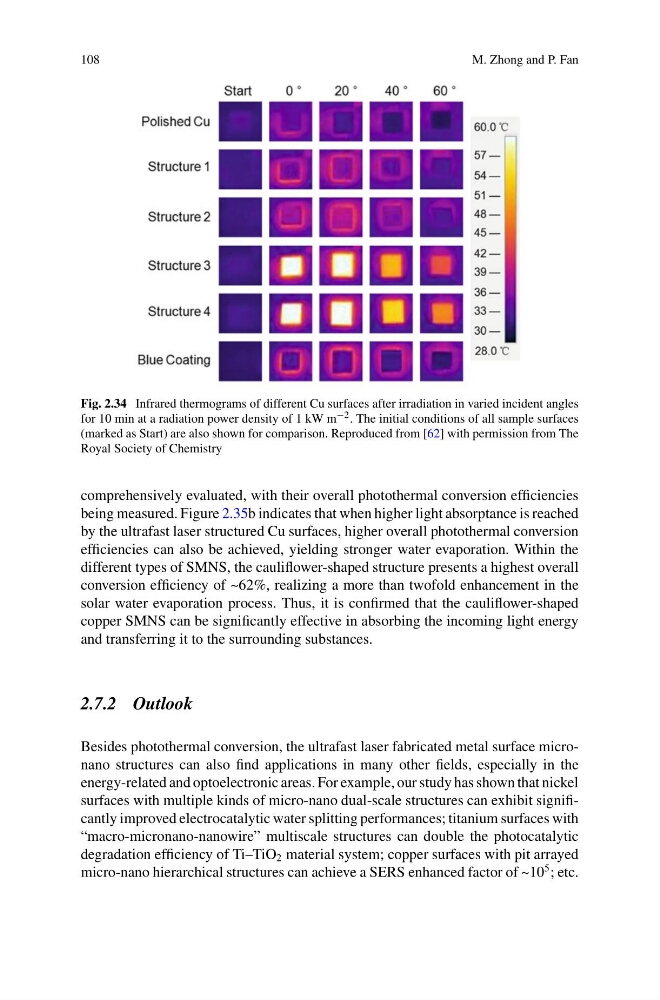
Fig. 2.34 Infrared thermograms of different Cu surfaces after irradiation in varied incident angles
for 10 min at a radiation power density of 1 kW m −2 . The initial conditions of all sample surfaces
(marked as Start) are also shown for comparison. Reproduced from [62] with permission from The
Royal Society of Chemistry
comprehensively evaluated, with their overall photothermal conversion efficiencies
being measured. Figure 2.35b indicates that when higher light absorptance is reached
by the ultrafast laser structured Cu surfaces, higher overall photothermal conversion
efficiencies can also be achieved, yielding stronger water evaporation. Within the
different types of SMNS, the cauliflower-shaped structure presents a highest overall
conversion efficiency of ~62%, realizing a more than twofold enhancement in the
solar water evaporation process. Thus, it is confirmed that the cauliflower-shaped
copper SMNS can be significantly effective in absorbing the incoming light energy
and transferring it to the surrounding substances.
2.7.2 Outlook
Besides photothermal conversion, the ultrafast laser fabricated metal surface micronano structures can also find applications in many other fields, especially in the
energy-related and optoelectronic areas. For example, our study has shown that nickel
surfaces with multiple kinds of micro-nano dual-scale structures can exhibit significantly improved electrocatalytic water splitting performances; titanium surfaces with
“macro-micronano-nanowire” multiscale structures can double the photocatalytic
degradation efficiency of Ti–TiO 2 material system; copper surfaces with pit arrayed
micro-nano hierarchical structures can achieve a SERS enhanced factor of ~10
5 ; etc.
M. Zhong and P. Fan
Fig. 2.34 Infrared thermograms of different Cu surfaces after irradiation in varied incident angles
for 10 min at a radiation power density of 1 kW m −2 . The initial conditions of all sample surfaces
(marked as Start) are also shown for comparison. Reproduced from [62] with permission from The
Royal Society of Chemistry
comprehensively evaluated, with their overall photothermal conversion efficiencies
being measured. Figure 2.35b indicates that when higher light absorptance is reached
by the ultrafast laser structured Cu surfaces, higher overall photothermal conversion
efficiencies can also be achieved, yielding stronger water evaporation. Within the
different types of SMNS, the cauliflower-shaped structure presents a highest overall
conversion efficiency of ~62%, realizing a more than twofold enhancement in the
solar water evaporation process. Thus, it is confirmed that the cauliflower-shaped
copper SMNS can be significantly effective in absorbing the incoming light energy
and transferring it to the surrounding substances.
2.7.2 Outlook
Besides photothermal conversion, the ultrafast laser fabricated metal surface micronano structures can also find applications in many other fields, especially in the
energy-related and optoelectronic areas. For example, our study has shown that nickel
surfaces with multiple kinds of micro-nano dual-scale structures can exhibit significantly improved electrocatalytic water splitting performances; titanium surfaces with
“macro-micronano-nanowire” multiscale structures can double the photocatalytic
degradation efficiency of Ti–TiO 2 material system; copper surfaces with pit arrayed
micro-nano hierarchical structures can achieve a SERS enhanced factor of ~10
5 ; etc.