

2 Ultrafast Laser Enabling Versatile Fabrication of Surface …
97
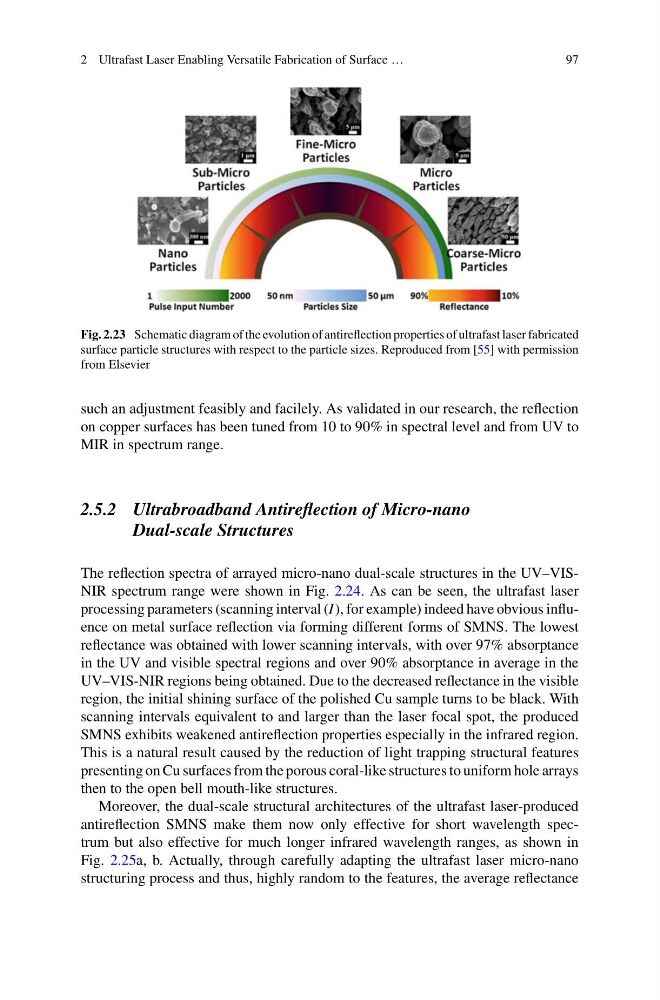
Fig. 2.23 Schematic diagram of the evolution of antireflection properties of ultrafast laser fabricated
surface particle structures with respect to the particle sizes. Reproduced from [55] with permission
from Elsevier
such an adjustment feasibly and facilely. As validated in our research, the reflection
on copper surfaces has been tuned from 10 to 90% in spectral level and from UV to
MIR in spectrum range.
2.5.2 Ultrabroadband Antireflection of Micro-nano
Dual-scale Structures
The reflection spectra of arrayed micro-nano dual-scale structures in the UV–VISNIR spectrum range were shown in Fig. 2.24. As can be seen, the ultrafast laser
processing parameters (scanning interval (I), for example) indeed have obvious influence on metal surface reflection via forming different forms of SMNS. The lowest
reflectance was obtained with lower scanning intervals, with over 97% absorptance
in the UV and visible spectral regions and over 90% absorptance in average in the
UV–VIS-NIR regions being obtained. Due to the decreased reflectance in the visible
region, the initial shining surface of the polished Cu sample turns to be black. With
scanning intervals equivalent to and larger than the laser focal spot, the produced
SMNS exhibits weakened antireflection properties especially in the infrared region.
This is a natural result caused by the reduction of light trapping structural features
presenting on Cu surfaces from the porous coral-like structures to uniform hole arrays
then to the open bell mouth-like structures.
Moreover, the dual-scale structural architectures of the ultrafast laser-produced
antireflection SMNS make them now only effective for short wavelength spectrum but also effective for much longer infrared wavelength ranges, as shown in
Fig. 2.25a, b. Actually, through carefully adapting the ultrafast laser micro-nano
structuring process and thus, highly random to the features, the average reflectance
97
Fig. 2.23 Schematic diagram of the evolution of antireflection properties of ultrafast laser fabricated
surface particle structures with respect to the particle sizes. Reproduced from [55] with permission
from Elsevier
such an adjustment feasibly and facilely. As validated in our research, the reflection
on copper surfaces has been tuned from 10 to 90% in spectral level and from UV to
MIR in spectrum range.
2.5.2 Ultrabroadband Antireflection of Micro-nano
Dual-scale Structures
The reflection spectra of arrayed micro-nano dual-scale structures in the UV–VISNIR spectrum range were shown in Fig. 2.24. As can be seen, the ultrafast laser
processing parameters (scanning interval (I), for example) indeed have obvious influence on metal surface reflection via forming different forms of SMNS. The lowest
reflectance was obtained with lower scanning intervals, with over 97% absorptance
in the UV and visible spectral regions and over 90% absorptance in average in the
UV–VIS-NIR regions being obtained. Due to the decreased reflectance in the visible
region, the initial shining surface of the polished Cu sample turns to be black. With
scanning intervals equivalent to and larger than the laser focal spot, the produced
SMNS exhibits weakened antireflection properties especially in the infrared region.
This is a natural result caused by the reduction of light trapping structural features
presenting on Cu surfaces from the porous coral-like structures to uniform hole arrays
then to the open bell mouth-like structures.
Moreover, the dual-scale structural architectures of the ultrafast laser-produced
antireflection SMNS make them now only effective for short wavelength spectrum but also effective for much longer infrared wavelength ranges, as shown in
Fig. 2.25a, b. Actually, through carefully adapting the ultrafast laser micro-nano
structuring process and thus, highly random to the features, the average reflectance