

96
M. Zhong and P. Fan
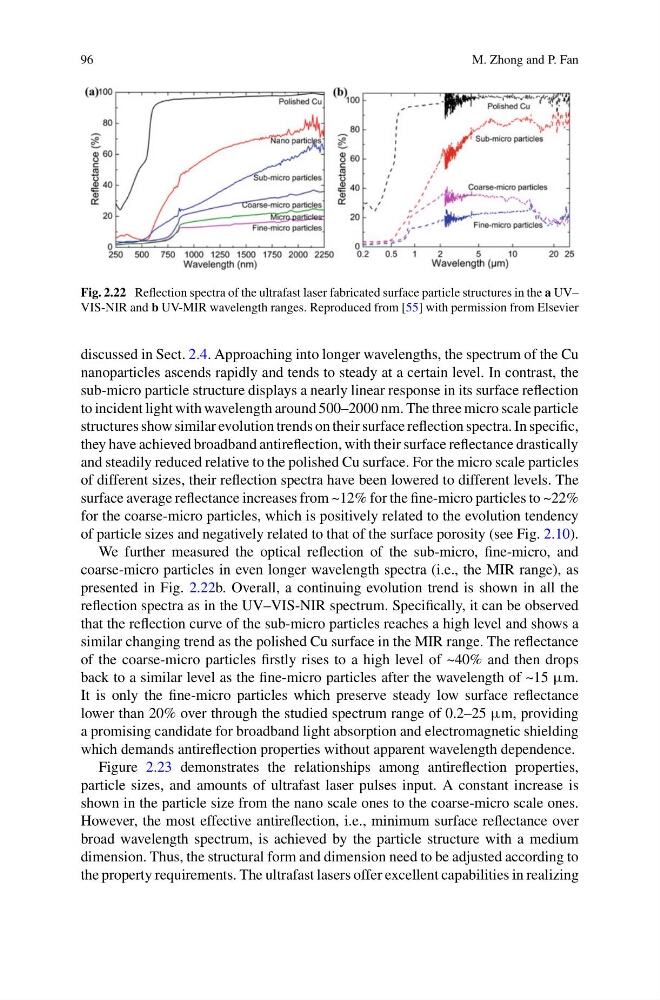
Fig. 2.22 Reflection spectra of the ultrafast laser fabricated surface particle structures in the a UV–
VIS-NIR and b UV-MIR wavelength ranges. Reproduced from [55] with permission from Elsevier
discussed in Sect. 2.4. Approaching into longer wavelengths, the spectrum of the Cu
nanoparticles ascends rapidly and tends to steady at a certain level. In contrast, the
sub-micro particle structure displays a nearly linear response in its surface reflection
to incident light with wavelength around 500–2000 nm. The three micro scale particle
structures show similar evolution trends on their surface reflection spectra. In specific,
they have achieved broadband antireflection, with their surface reflectance drastically
and steadily reduced relative to the polished Cu surface. For the micro scale particles
of different sizes, their reflection spectra have been lowered to different levels. The
surface average reflectance increases from ~12% for the fine-micro particles to ~22%
for the coarse-micro particles, which is positively related to the evolution tendency
of particle sizes and negatively related to that of the surface porosity (see Fig. 2.10).
We further measured the optical reflection of the sub-micro, fine-micro, and
coarse-micro particles in even longer wavelength spectra (i.e., the MIR range), as
presented in Fig. 2.22b. Overall, a continuing evolution trend is shown in all the
reflection spectra as in the UV–VIS-NIR spectrum. Specifically, it can be observed
that the reflection curve of the sub-micro particles reaches a high level and shows a
similar changing trend as the polished Cu surface in the MIR range. The reflectance
of the coarse-micro particles firstly rises to a high level of ~40% and then drops
back to a similar level as the fine-micro particles after the wavelength of ~15 µm.
It is only the fine-micro particles which preserve steady low surface reflectance
lower than 20% over through the studied spectrum range of 0.2–25 µm, providing
a promising candidate for broadband light absorption and electromagnetic shielding
which demands antireflection properties without apparent wavelength dependence.
Figure 2.23 demonstrates the relationships among antireflection properties,
particle sizes, and amounts of ultrafast laser pulses input. A constant increase is
shown in the particle size from the nano scale ones to the coarse-micro scale ones.
However, the most effective antireflection, i.e., minimum surface reflectance over
broad wavelength spectrum, is achieved by the particle structure with a medium
dimension. Thus, the structural form and dimension need to be adjusted according to
the property requirements. The ultrafast lasers offer excellent capabilities in realizing
M. Zhong and P. Fan
Fig. 2.22 Reflection spectra of the ultrafast laser fabricated surface particle structures in the a UV–
VIS-NIR and b UV-MIR wavelength ranges. Reproduced from [55] with permission from Elsevier
discussed in Sect. 2.4. Approaching into longer wavelengths, the spectrum of the Cu
nanoparticles ascends rapidly and tends to steady at a certain level. In contrast, the
sub-micro particle structure displays a nearly linear response in its surface reflection
to incident light with wavelength around 500–2000 nm. The three micro scale particle
structures show similar evolution trends on their surface reflection spectra. In specific,
they have achieved broadband antireflection, with their surface reflectance drastically
and steadily reduced relative to the polished Cu surface. For the micro scale particles
of different sizes, their reflection spectra have been lowered to different levels. The
surface average reflectance increases from ~12% for the fine-micro particles to ~22%
for the coarse-micro particles, which is positively related to the evolution tendency
of particle sizes and negatively related to that of the surface porosity (see Fig. 2.10).
We further measured the optical reflection of the sub-micro, fine-micro, and
coarse-micro particles in even longer wavelength spectra (i.e., the MIR range), as
presented in Fig. 2.22b. Overall, a continuing evolution trend is shown in all the
reflection spectra as in the UV–VIS-NIR spectrum. Specifically, it can be observed
that the reflection curve of the sub-micro particles reaches a high level and shows a
similar changing trend as the polished Cu surface in the MIR range. The reflectance
of the coarse-micro particles firstly rises to a high level of ~40% and then drops
back to a similar level as the fine-micro particles after the wavelength of ~15 µm.
It is only the fine-micro particles which preserve steady low surface reflectance
lower than 20% over through the studied spectrum range of 0.2–25 µm, providing
a promising candidate for broadband light absorption and electromagnetic shielding
which demands antireflection properties without apparent wavelength dependence.
Figure 2.23 demonstrates the relationships among antireflection properties,
particle sizes, and amounts of ultrafast laser pulses input. A constant increase is
shown in the particle size from the nano scale ones to the coarse-micro scale ones.
However, the most effective antireflection, i.e., minimum surface reflectance over
broad wavelength spectrum, is achieved by the particle structure with a medium
dimension. Thus, the structural form and dimension need to be adjusted according to
the property requirements. The ultrafast lasers offer excellent capabilities in realizing