

3.3 Advanced Simulation Framework
33
Clogged channels
Trapped droplet
Δ
P
P b
f
Δ
Δ P acting
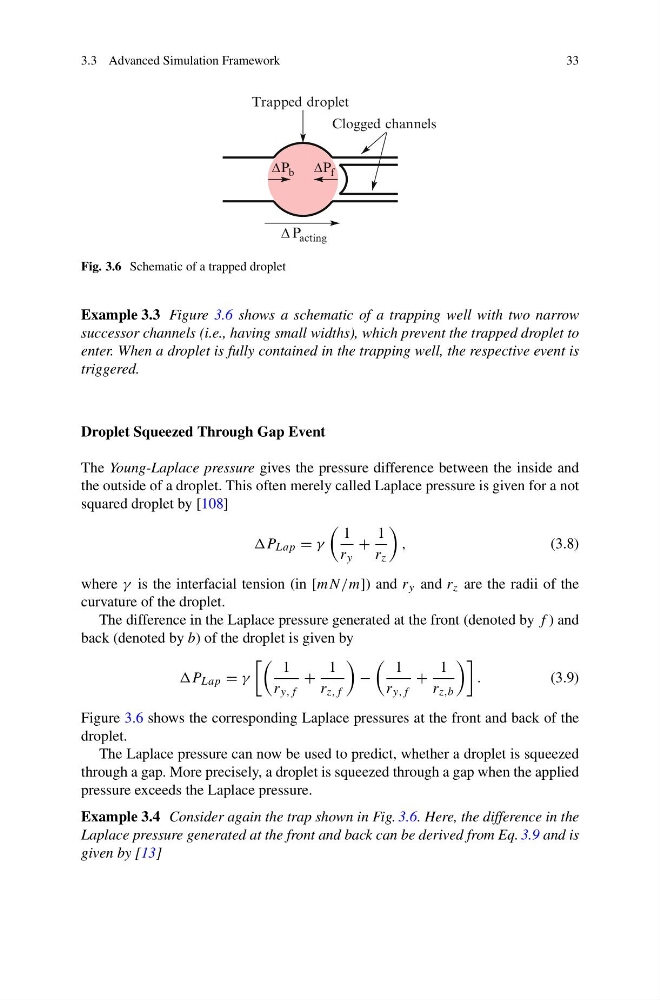
Fig. 3.6 Schematic of a trapped droplet
Example 3.3 Figure 3.6 shows a schematic of a trapping well with two narrow
successor channels (i.e., having small widths), which prevent the trapped droplet to
enter. When a droplet is fully contained in the trapping well, the respective event is
triggered.
Droplet Squeezed Through Gap Event
The Young-Laplace pressure gives the pressure difference between the inside and
the outside of a droplet. This often merely called Laplace pressure is given for a not
squared droplet by [108]
P Lap = γ
1
r y
+
1
r z
,
(3.8)
where γ is the interfacial tension (in [mN/m]) and r y and r z are the radii of the
curvature of the droplet.
The difference in the Laplace pressure generated at the front (denoted by f ) and
back (denoted by b) of the droplet is given by
P Lap = γ
1
r y,f
+
1
r z,f
−
1
r y,f
+
1
r z,b
.
(3.9)
Figure 3.6 shows the corresponding Laplace pressures at the front and back of the
droplet.
The Laplace pressure can now be used to predict, whether a droplet is squeezed
through a gap. More precisely, a droplet is squeezed through a gap when the applied
pressure exceeds the Laplace pressure.
Example 3.4 Consider again the trap shown in Fig. 3.6. Here, the difference in the
Laplace pressure generated at the front and back can be derived from Eq. 3.9 and is
given by [13]
33
Clogged channels
Trapped droplet
Δ
P
P b
f
Δ
Δ P acting
Fig. 3.6 Schematic of a trapped droplet
Example 3.3 Figure 3.6 shows a schematic of a trapping well with two narrow
successor channels (i.e., having small widths), which prevent the trapped droplet to
enter. When a droplet is fully contained in the trapping well, the respective event is
triggered.
Droplet Squeezed Through Gap Event
The Young-Laplace pressure gives the pressure difference between the inside and
the outside of a droplet. This often merely called Laplace pressure is given for a not
squared droplet by [108]
P Lap = γ
1
r y
+
1
r z
,
(3.8)
where γ is the interfacial tension (in [mN/m]) and r y and r z are the radii of the
curvature of the droplet.
The difference in the Laplace pressure generated at the front (denoted by f ) and
back (denoted by b) of the droplet is given by
P Lap = γ
1
r y,f
+
1
r z,f
−
1
r y,f
+
1
r z,b
.
(3.9)
Figure 3.6 shows the corresponding Laplace pressures at the front and back of the
droplet.
The Laplace pressure can now be used to predict, whether a droplet is squeezed
through a gap. More precisely, a droplet is squeezed through a gap when the applied
pressure exceeds the Laplace pressure.
Example 3.4 Consider again the trap shown in Fig. 3.6. Here, the difference in the
Laplace pressure generated at the front and back can be derived from Eq. 3.9 and is
given by [13]