

3.2 One-Dimensional Analysis Model
25
l
P [mbar]
Q [μ l/min]
h
w
Δ
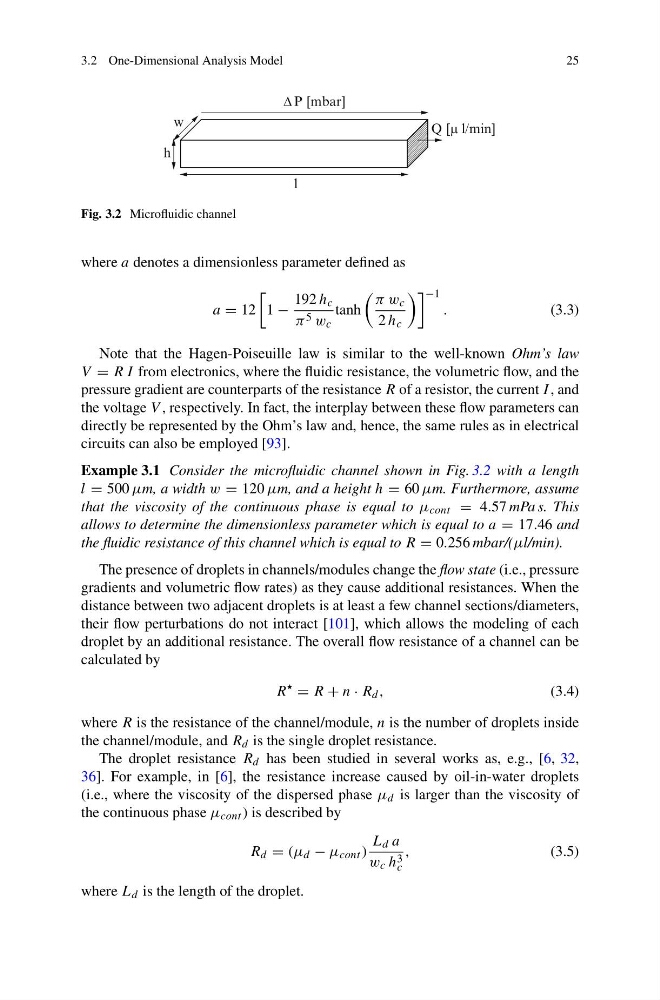
Fig. 3.2 Microfluidic channel
where a denotes a dimensionless parameter defined as
a = 12
1 −
192 h c
π 5 w c
tanh
π w c
2 h c
−1
.
(3.3)
Note that the Hagen-Poiseuille law is similar to the well-known Ohm’s law
V = R I from electronics, where the fluidic resistance, the volumetric flow, and the
pressure gradient are counterparts of the resistance R of a resistor, the current I , and
the voltage V , respectively. In fact, the interplay between these flow parameters can
directly be represented by the Ohm’s law and, hence, the same rules as in electrical
circuits can also be employed [93].
Example 3.1 Consider the microfluidic channel shown in Fig. 3.2 with a length
l = 500 μm, a width w = 120 μm, and a height h = 60 μm. Furthermore, assume
that the viscosity of the continuous phase is equal to μ cont = 4.57 mPa s. This
allows to determine the dimensionless parameter which is equal to a = 17.46 and
the fluidic resistance of this channel which is equal to R = 0.256 mbar/(μl/min).
The presence of droplets in channels/modules change the flow state (i.e., pressure
gradients and volumetric flow rates) as they cause additional resistances. When the
distance between two adjacent droplets is at least a few channel sections/diameters,
their flow perturbations do not interact [101], which allows the modeling of each
droplet by an additional resistance. The overall flow resistance of a channel can be
calculated by
R
= R + n · R d ,
(3.4)
where R is the resistance of the channel/module, n is the number of droplets inside
the channel/module, and R d is the single droplet resistance.
The droplet resistance R d has been studied in several works as, e.g., [6, 32,
36]. For example, in [6], the resistance increase caused by oil-in-water droplets
(i.e., where the viscosity of the dispersed phase μ d is larger than the viscosity of
the continuous phase μ cont ) is described by
R d = (μ d − μ cont )
L d a
w c h 3
c
,
(3.5)
where L d is the length of the droplet.
25
l
P [mbar]
Q [μ l/min]
h
w
Δ
Fig. 3.2 Microfluidic channel
where a denotes a dimensionless parameter defined as
a = 12
1 −
192 h c
π 5 w c
tanh
π w c
2 h c
−1
.
(3.3)
Note that the Hagen-Poiseuille law is similar to the well-known Ohm’s law
V = R I from electronics, where the fluidic resistance, the volumetric flow, and the
pressure gradient are counterparts of the resistance R of a resistor, the current I , and
the voltage V , respectively. In fact, the interplay between these flow parameters can
directly be represented by the Ohm’s law and, hence, the same rules as in electrical
circuits can also be employed [93].
Example 3.1 Consider the microfluidic channel shown in Fig. 3.2 with a length
l = 500 μm, a width w = 120 μm, and a height h = 60 μm. Furthermore, assume
that the viscosity of the continuous phase is equal to μ cont = 4.57 mPa s. This
allows to determine the dimensionless parameter which is equal to a = 17.46 and
the fluidic resistance of this channel which is equal to R = 0.256 mbar/(μl/min).
The presence of droplets in channels/modules change the flow state (i.e., pressure
gradients and volumetric flow rates) as they cause additional resistances. When the
distance between two adjacent droplets is at least a few channel sections/diameters,
their flow perturbations do not interact [101], which allows the modeling of each
droplet by an additional resistance. The overall flow resistance of a channel can be
calculated by
R
= R + n · R d ,
(3.4)
where R is the resistance of the channel/module, n is the number of droplets inside
the channel/module, and R d is the single droplet resistance.
The droplet resistance R d has been studied in several works as, e.g., [6, 32,
36]. For example, in [6], the resistance increase caused by oil-in-water droplets
(i.e., where the viscosity of the dispersed phase μ d is larger than the viscosity of
the continuous phase μ cont ) is described by
R d = (μ d − μ cont )
L d a
w c h 3
c
,
(3.5)
where L d is the length of the droplet.