

8 The sine-Gordon Equation of a Dislocation
73
d
dt
m α
d
dt
q α
=
β=α±1
F βα − D m sin
2π
a
q α
,
F βα = −F αβ .
⎫
⎪ ⎬
⎪ ⎭
(83)
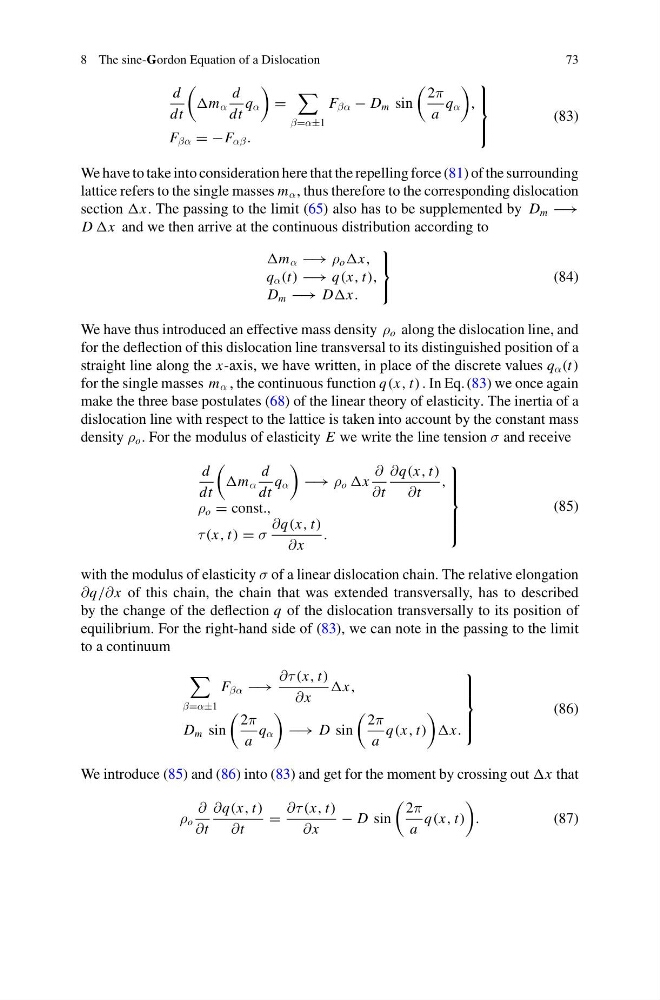
We have to take into consideration here that the repelling force (81) of the surrounding
lattice refers to the single masses m α , thus therefore to the corresponding dislocation
section x. The passing to the limit (65) also has to be supplemented by D m −→
D x and we then arrive at the continuous distribution according to
m α −→ ρ o x,
q α (t) −→ q(x, t),
D m −→ Dx.
⎫
⎬
⎭
(84)
We have thus introduced an effective mass density ρ o along the dislocation line, and
for the deflection of this dislocation line transversal to its distinguished position of a
straight line along the x-axis, we have written, in place of the discrete values q α (t)
for the single masses m α , the continuous function q(x, t) . In Eq. (83) we once again
make the three base postulates (68) of the linear theory of elasticity. The inertia of a
dislocation line with respect to the lattice is taken into account by the constant mass
density ρ o . For the modulus of elasticity E we write the line tension σ and receive
d
dt
m α
d
dt
q α
−→ ρ o x
∂
∂t
∂q(x, t)
∂t
,
ρ o = const.,
τ (x, t) = σ
∂q(x, t)
∂x
.
⎫
⎪ ⎪ ⎪ ⎬
⎪ ⎪ ⎪ ⎭
(85)
with the modulus of elasticity σ of a linear dislocation chain. The relative elongation
∂q/∂x of this chain, the chain that was extended transversally, has to described
by the change of the deflection q of the dislocation transversally to its position of
equilibrium. For the right-hand side of (83), we can note in the passing to the limit
to a continuum
β=α±1
F βα −→
∂τ (x, t)
∂x
x,
D m sin
2π
a
q α
−→ D sin
2π
a
q(x, t)
x.
⎫
⎪ ⎪ ⎬
⎪ ⎪ ⎭
(86)
We introduce (85) and (86) into (83) and get for the moment by crossing out x that
ρ o
∂
∂t
∂q(x, t)
∂t
=
∂τ (x, t)
∂x
− D sin
2π
a
q(x, t)
.
(87)
73
d
dt
m α
d
dt
q α
=
β=α±1
F βα − D m sin
2π
a
q α
,
F βα = −F αβ .
⎫
⎪ ⎬
⎪ ⎭
(83)
We have to take into consideration here that the repelling force (81) of the surrounding
lattice refers to the single masses m α , thus therefore to the corresponding dislocation
section x. The passing to the limit (65) also has to be supplemented by D m −→
D x and we then arrive at the continuous distribution according to
m α −→ ρ o x,
q α (t) −→ q(x, t),
D m −→ Dx.
⎫
⎬
⎭
(84)
We have thus introduced an effective mass density ρ o along the dislocation line, and
for the deflection of this dislocation line transversal to its distinguished position of a
straight line along the x-axis, we have written, in place of the discrete values q α (t)
for the single masses m α , the continuous function q(x, t) . In Eq. (83) we once again
make the three base postulates (68) of the linear theory of elasticity. The inertia of a
dislocation line with respect to the lattice is taken into account by the constant mass
density ρ o . For the modulus of elasticity E we write the line tension σ and receive
d
dt
m α
d
dt
q α
−→ ρ o x
∂
∂t
∂q(x, t)
∂t
,
ρ o = const.,
τ (x, t) = σ
∂q(x, t)
∂x
.
⎫
⎪ ⎪ ⎪ ⎬
⎪ ⎪ ⎪ ⎭
(85)
with the modulus of elasticity σ of a linear dislocation chain. The relative elongation
∂q/∂x of this chain, the chain that was extended transversally, has to described
by the change of the deflection q of the dislocation transversally to its position of
equilibrium. For the right-hand side of (83), we can note in the passing to the limit
to a continuum
β=α±1
F βα −→
∂τ (x, t)
∂x
x,
D m sin
2π
a
q α
−→ D sin
2π
a
q(x, t)
x.
⎫
⎪ ⎪ ⎬
⎪ ⎪ ⎭
(86)
We introduce (85) and (86) into (83) and get for the moment by crossing out x that
ρ o
∂
∂t
∂q(x, t)
∂t
=
∂τ (x, t)
∂x
− D sin
2π
a
q(x, t)
.
(87)