

72
8 The sine-Gordon Equation of a Dislocation
of dislocations. There we will also try to combine this with C. F. v. Weizsäcker’s
[98] theory of ultimate alternatives (“Uralternatives”).
An external experimentalist will declare the inertia of a dislocation in reference to
the lattice as an effective mass. He will also declare the forces between such effective
masses as so-called configuration forces. For the observer in the centre of the crystal,
where we will also position ourselves, such a notation makes no sense. We will thus,
in the view of the Newtonian equations (79) speak of the masses of the dislocations
and the forces between them.
In the following we will concern ourselves with the motions q α perpendicular to
the dislocation line. The elastic displacements of atoms in the vicinity of a dislocation,
that are always produced as a reaction to the presence of a dislocation will be ignored.
2
If all q α move a distance of 10
−8 cm simultaneously then the dislocation has
moved one lattice parameter. This would be the assumed elementary step as shown
in the dislocation model of a plastic deformation in the previous Chap. 7. As in the
discussion of the critical shear modulus, cf. (74), we assume that once again a sine
function is responsible for the dependency of the total force of the surrounding lattice
to the displacements q α of the masses m α . For small deflections q α , the lattice acts
like an elastic spring on the dislocation, a spring that forces the dislocation mass m α
with the force constant D m back into its position of equilibrium. For larger q α this
force decreases so that it then disappears in the centre position of the dislocation at
q α = a/2 between both positions of equilibrium q α = 0 and q α = a . For the second
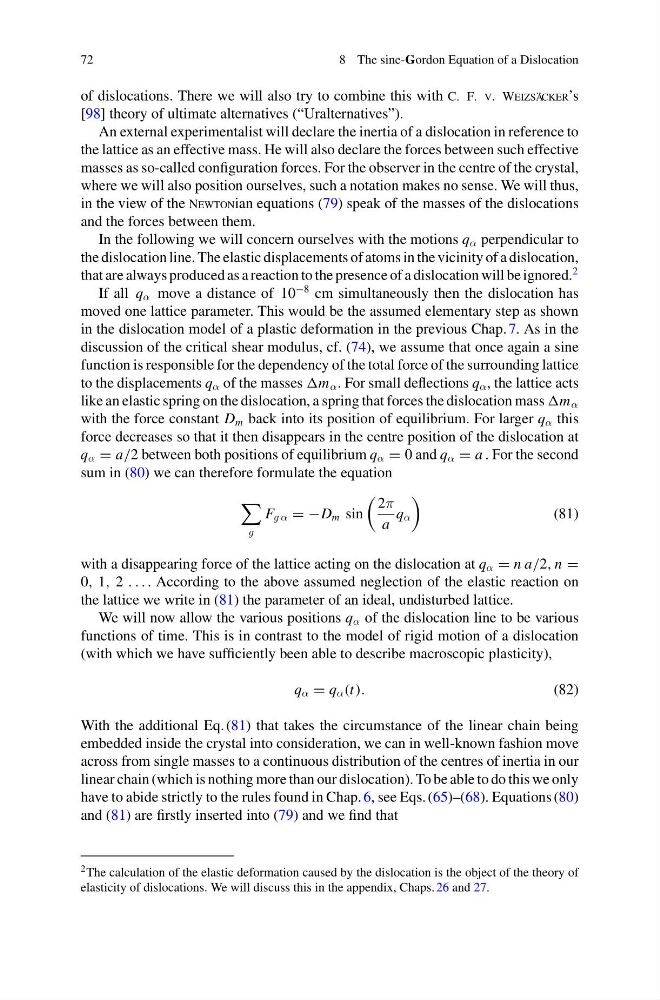
sum in (80) we can therefore formulate the equation
g
F g α = −D m sin
2π
a
q α
(81)
with a disappearing force of the lattice acting on the dislocation at q α = n a/2, n =
0, 1, 2 . . . . According to the above assumed neglection of the elastic reaction on
the lattice we write in (81) the parameter of an ideal, undisturbed lattice.
We will now allow the various positions q α of the dislocation line to be various
functions of time. This is in contrast to the model of rigid motion of a dislocation
(with which we have sufficiently been able to describe macroscopic plasticity),
q α = q α (t).
(82)
With the additional Eq. (81) that takes the circumstance of the linear chain being
embedded inside the crystal into consideration, we can in well-known fashion move
across from single masses to a continuous distribution of the centres of inertia in our
linear chain (which is nothing more than our dislocation). To be able to do this we only
have to abide strictly to the rules found in Chap. 6, see Eqs. (65)–(68). Equations (80)
and (81) are firstly inserted into (79) and we find that
2 The calculation of the elastic deformation caused by the dislocation is the object of the theory of
elasticity of dislocations. We will discuss this in the appendix, Chaps. 26 and 27.
8 The sine-Gordon Equation of a Dislocation
of dislocations. There we will also try to combine this with C. F. v. Weizsäcker’s
[98] theory of ultimate alternatives (“Uralternatives”).
An external experimentalist will declare the inertia of a dislocation in reference to
the lattice as an effective mass. He will also declare the forces between such effective
masses as so-called configuration forces. For the observer in the centre of the crystal,
where we will also position ourselves, such a notation makes no sense. We will thus,
in the view of the Newtonian equations (79) speak of the masses of the dislocations
and the forces between them.
In the following we will concern ourselves with the motions q α perpendicular to
the dislocation line. The elastic displacements of atoms in the vicinity of a dislocation,
that are always produced as a reaction to the presence of a dislocation will be ignored.
2
If all q α move a distance of 10
−8 cm simultaneously then the dislocation has
moved one lattice parameter. This would be the assumed elementary step as shown
in the dislocation model of a plastic deformation in the previous Chap. 7. As in the
discussion of the critical shear modulus, cf. (74), we assume that once again a sine
function is responsible for the dependency of the total force of the surrounding lattice
to the displacements q α of the masses m α . For small deflections q α , the lattice acts
like an elastic spring on the dislocation, a spring that forces the dislocation mass m α
with the force constant D m back into its position of equilibrium. For larger q α this
force decreases so that it then disappears in the centre position of the dislocation at
q α = a/2 between both positions of equilibrium q α = 0 and q α = a . For the second
sum in (80) we can therefore formulate the equation
g
F g α = −D m sin
2π
a
q α
(81)
with a disappearing force of the lattice acting on the dislocation at q α = n a/2, n =
0, 1, 2 . . . . According to the above assumed neglection of the elastic reaction on
the lattice we write in (81) the parameter of an ideal, undisturbed lattice.
We will now allow the various positions q α of the dislocation line to be various
functions of time. This is in contrast to the model of rigid motion of a dislocation
(with which we have sufficiently been able to describe macroscopic plasticity),
q α = q α (t).
(82)
With the additional Eq. (81) that takes the circumstance of the linear chain being
embedded inside the crystal into consideration, we can in well-known fashion move
across from single masses to a continuous distribution of the centres of inertia in our
linear chain (which is nothing more than our dislocation). To be able to do this we only
have to abide strictly to the rules found in Chap. 6, see Eqs. (65)–(68). Equations (80)
and (81) are firstly inserted into (79) and we find that
2 The calculation of the elastic deformation caused by the dislocation is the object of the theory of
elasticity of dislocations. We will discuss this in the appendix, Chaps. 26 and 27.