

64
7 The Crystalline Solid—Dislocations
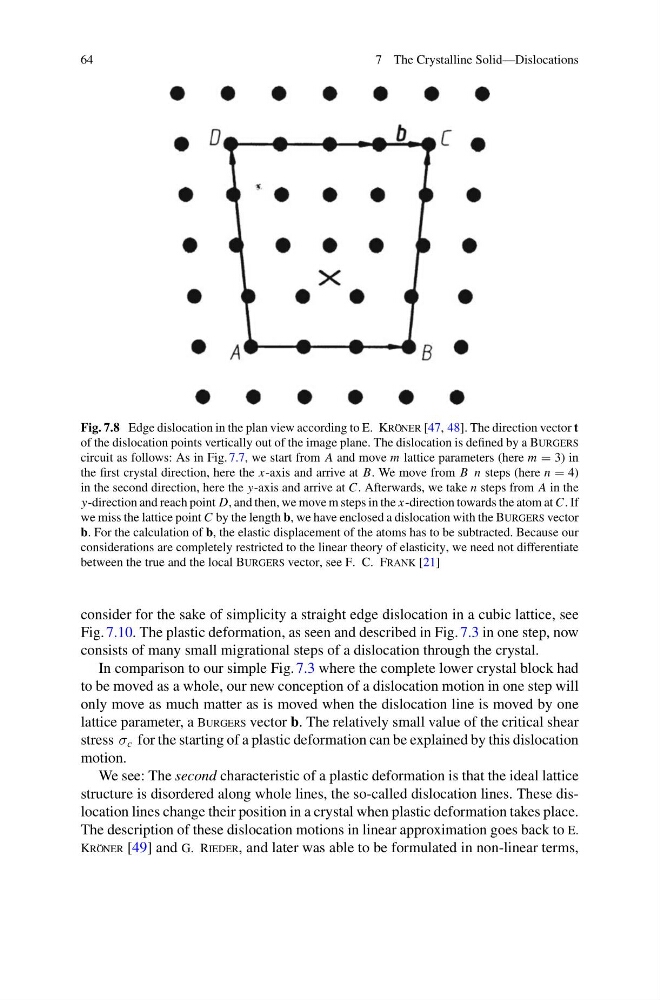
Fig. 7.8 Edge dislocation in the plan view according to E. Kröner [47, 48]. The direction vector t
of the dislocation points vertically out of the image plane. The dislocation is defined by a Burgers
circuit as follows: As in Fig. 7.7, we start from A and move m lattice parameters (here m = 3) in
the first crystal direction, here the x-axis and arrive at B. We move from B n steps (here n = 4)
in the second direction, here the y-axis and arrive at C. Afterwards, we take n steps from A in the
y-direction and reach point D, and then, we move m steps in the x-direction towards the atom at C. If
we miss the lattice point C by the length b, we have enclosed a dislocation with the Burgers vector
b. For the calculation of b, the elastic displacement of the atoms has to be subtracted. Because our
considerations are completely restricted to the linear theory of elasticity, we need not differentiate
between the true and the local Burgers vector, see F. C. Frank [21]
consider for the sake of simplicity a straight edge dislocation in a cubic lattice, see
Fig. 7.10. The plastic deformation, as seen and described in Fig. 7.3 in one step, now
consists of many small migrational steps of a dislocation through the crystal.
In comparison to our simple Fig. 7.3 where the complete lower crystal block had
to be moved as a whole, our new conception of a dislocation motion in one step will
only move as much matter as is moved when the dislocation line is moved by one
lattice parameter, a Burgers vector b. The relatively small value of the critical shear
stress σ c for the starting of a plastic deformation can be explained by this dislocation
motion.
We see: The second characteristic of a plastic deformation is that the ideal lattice
structure is disordered along whole lines, the so-called dislocation lines. These dislocation lines change their position in a crystal when plastic deformation takes place.
The description of these dislocation motions in linear approximation goes back to E.
Kröner [49] and G. Rieder, and later was able to be formulated in non-linear terms,
7 The Crystalline Solid—Dislocations
Fig. 7.8 Edge dislocation in the plan view according to E. Kröner [47, 48]. The direction vector t
of the dislocation points vertically out of the image plane. The dislocation is defined by a Burgers
circuit as follows: As in Fig. 7.7, we start from A and move m lattice parameters (here m = 3) in
the first crystal direction, here the x-axis and arrive at B. We move from B n steps (here n = 4)
in the second direction, here the y-axis and arrive at C. Afterwards, we take n steps from A in the
y-direction and reach point D, and then, we move m steps in the x-direction towards the atom at C. If
we miss the lattice point C by the length b, we have enclosed a dislocation with the Burgers vector
b. For the calculation of b, the elastic displacement of the atoms has to be subtracted. Because our
considerations are completely restricted to the linear theory of elasticity, we need not differentiate
between the true and the local Burgers vector, see F. C. Frank [21]
consider for the sake of simplicity a straight edge dislocation in a cubic lattice, see
Fig. 7.10. The plastic deformation, as seen and described in Fig. 7.3 in one step, now
consists of many small migrational steps of a dislocation through the crystal.
In comparison to our simple Fig. 7.3 where the complete lower crystal block had
to be moved as a whole, our new conception of a dislocation motion in one step will
only move as much matter as is moved when the dislocation line is moved by one
lattice parameter, a Burgers vector b. The relatively small value of the critical shear
stress σ c for the starting of a plastic deformation can be explained by this dislocation
motion.
We see: The second characteristic of a plastic deformation is that the ideal lattice
structure is disordered along whole lines, the so-called dislocation lines. These dislocation lines change their position in a crystal when plastic deformation takes place.
The description of these dislocation motions in linear approximation goes back to E.
Kröner [49] and G. Rieder, and later was able to be formulated in non-linear terms,