

52
6 Lattice and the Continuum
Within the linearised theory of elasticity, we also presume that the factor of proportionality E of Hooke’s law as well as the mass density ρ is a constant in space and
time. Because we have limited our considerations to monocrystalline solids, whose
structures will be dealt with in the next chapter, we do not have to consider viscose
material properties, where stress is also dependent upon the strain rate.
When we apply the linearised theory of elasticity (68) on Eq.(67), due to the
constancy of E and ρ, we immediately discover our wave equation (61),
∂
2
∂x 2 s(x, t) −
1
c 2
∂
2
∂t 2 s(x, t) = 0 ,
c =
E
ρ
.
⎫
⎪ ⎪ ⎬
⎪ ⎪ ⎭
(61)
Due to the fact that we have considered longitudinal displacements, the quantity c in
(61) is the longitudinal sound velocity. See also the second footnote in Chap. 5.
(b) Transversal oscillations:
In this case, we maintain the continuum, or rather the linear chain in its one dimensionality, but we now presume that the displacements q i (t) or rather s = s(x, t) take
place perpendicular to the line direction. In other words, we consider the transversal
oscillations of a one- dimensional system. Instead of a rod, we will use as an example an oscillating string. We immediately notice that compared to the longitudinal
oscillations of a rod, we need a supplementary condition. If we take the string, hold
it at both ends and put it on a table, it cannot perform a small harmonic oscillation.
We would have to produce a very large transversal deflection of the string in order to
be able to produce an oscillation. Luckily, we are not interested in such oscillations
with very large transversal amplitudes s, because they are mathematically harder
and therefore more complicated to understand. This is however different if the string
is stretched, as for example in the case of a violin or a guitar. Then, every small
excitation leading to a starting deflection leads to harmonic oscillations that we can
hear as tones. We now want to show that all the equations in this chapter remain valid
for these transversal oscillations, as long as we presume that a tension σ is already
present in the direction of the line when the string is in a state of rest; in other words,
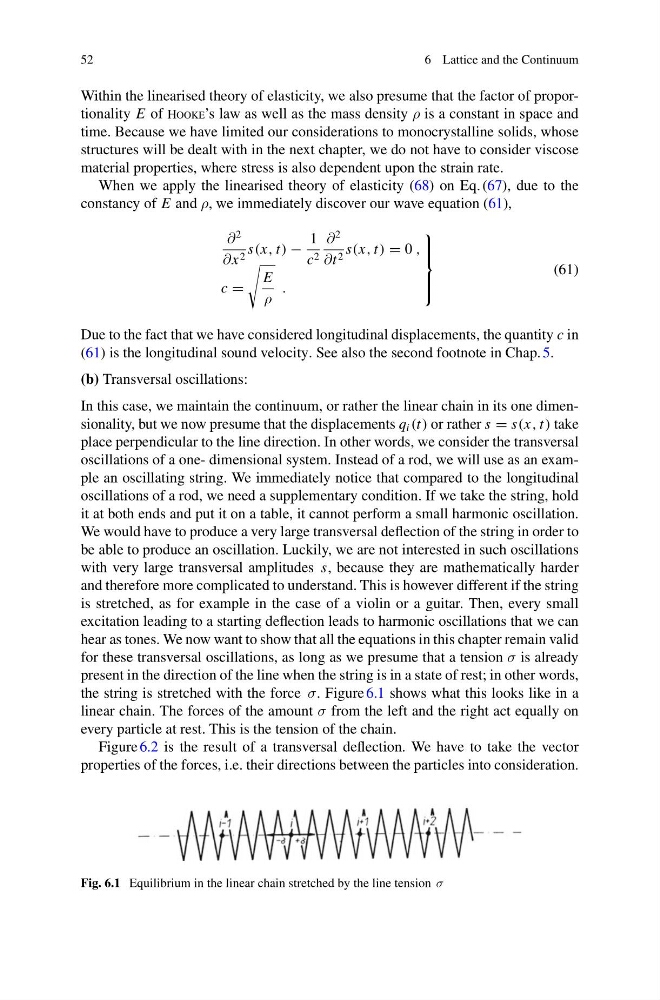
the string is stretched with the force σ. Figure 6.1 shows what this looks like in a
linear chain. The forces of the amount σ from the left and the right act equally on
every particle at rest. This is the tension of the chain.
Figure 6.2 is the result of a transversal deflection. We have to take the vector
properties of the forces, i.e. their directions between the particles into consideration.
Fig. 6.1 Equilibrium in the linear chain stretched by the line tension σ
6 Lattice and the Continuum
Within the linearised theory of elasticity, we also presume that the factor of proportionality E of Hooke’s law as well as the mass density ρ is a constant in space and
time. Because we have limited our considerations to monocrystalline solids, whose
structures will be dealt with in the next chapter, we do not have to consider viscose
material properties, where stress is also dependent upon the strain rate.
When we apply the linearised theory of elasticity (68) on Eq.(67), due to the
constancy of E and ρ, we immediately discover our wave equation (61),
∂
2
∂x 2 s(x, t) −
1
c 2
∂
2
∂t 2 s(x, t) = 0 ,
c =
E
ρ
.
⎫
⎪ ⎪ ⎬
⎪ ⎪ ⎭
(61)
Due to the fact that we have considered longitudinal displacements, the quantity c in
(61) is the longitudinal sound velocity. See also the second footnote in Chap. 5.
(b) Transversal oscillations:
In this case, we maintain the continuum, or rather the linear chain in its one dimensionality, but we now presume that the displacements q i (t) or rather s = s(x, t) take
place perpendicular to the line direction. In other words, we consider the transversal
oscillations of a one- dimensional system. Instead of a rod, we will use as an example an oscillating string. We immediately notice that compared to the longitudinal
oscillations of a rod, we need a supplementary condition. If we take the string, hold
it at both ends and put it on a table, it cannot perform a small harmonic oscillation.
We would have to produce a very large transversal deflection of the string in order to
be able to produce an oscillation. Luckily, we are not interested in such oscillations
with very large transversal amplitudes s, because they are mathematically harder
and therefore more complicated to understand. This is however different if the string
is stretched, as for example in the case of a violin or a guitar. Then, every small
excitation leading to a starting deflection leads to harmonic oscillations that we can
hear as tones. We now want to show that all the equations in this chapter remain valid
for these transversal oscillations, as long as we presume that a tension σ is already
present in the direction of the line when the string is in a state of rest; in other words,
the string is stretched with the force σ. Figure 6.1 shows what this looks like in a
linear chain. The forces of the amount σ from the left and the right act equally on
every particle at rest. This is the tension of the chain.
Figure 6.2 is the result of a transversal deflection. We have to take the vector
properties of the forces, i.e. their directions between the particles into consideration.
Fig. 6.1 Equilibrium in the linear chain stretched by the line tension σ