

4 Where Does the Wave Equation Come From?
33
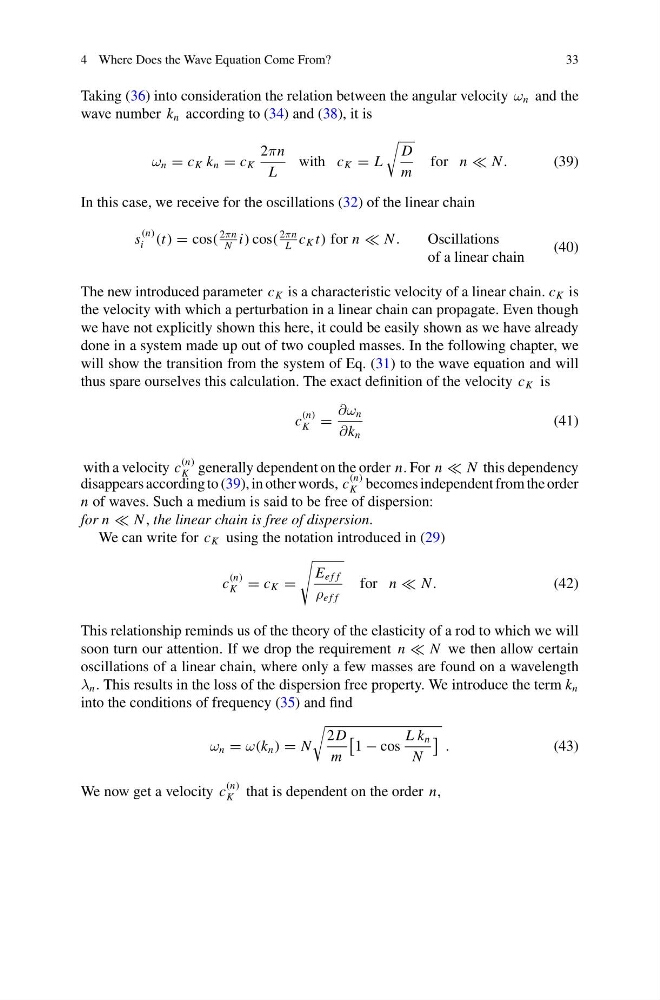
Taking (36) into consideration the relation between the angular velocity ω n and the
wave number k n according to (34) and (38), it is
ω n = c K k n = c K
2πn
L
with c K = L
D
m
for n N .
(39)
In this case, we receive for the oscillations (32) of the linear chain
s
(n)
i (t) = cos(
2πn
N
i) cos(
2πn
L
c K t) for n N .
Oscillations
of a linear chain
(40)
The new introduced parameter c K is a characteristic velocity of a linear chain. c K is
the velocity with which a perturbation in a linear chain can propagate. Even though
we have not explicitly shown this here, it could be easily shown as we have already
done in a system made up out of two coupled masses. In the following chapter, we
will show the transition from the system of Eq. (31) to the wave equation and will
thus spare ourselves this calculation. The exact definition of the velocity c K is
c
(n)
K =
∂ω n
∂k n
(41)
with a velocity c
(n)
K generally dependent on the order n. For n N this dependency
disappears according to (39), in other words, c
(n)
K becomes independent from the order
n of waves. Such a medium is said to be free of dispersion:
for n N , the linear chain is free of dispersion.
We can write for c K using the notation introduced in (29)
c
(n)
K = c K =
E e f f
ρ e f f
for n N .
(42)
This relationship reminds us of the theory of the elasticity of a rod to which we will
soon turn our attention. If we drop the requirement n N we then allow certain
oscillations of a linear chain, where only a few masses are found on a wavelength
λ n . This results in the loss of the dispersion free property. We introduce the term k n
into the conditions of frequency (35) and find
ω n = ω(k n ) = N
2D
m
1 − cos
L k n
N
.
(43)
We now get a velocity c
(n)
K that is dependent on the order n,
33
Taking (36) into consideration the relation between the angular velocity ω n and the
wave number k n according to (34) and (38), it is
ω n = c K k n = c K
2πn
L
with c K = L
D
m
for n N .
(39)
In this case, we receive for the oscillations (32) of the linear chain
s
(n)
i (t) = cos(
2πn
N
i) cos(
2πn
L
c K t) for n N .
Oscillations
of a linear chain
(40)
The new introduced parameter c K is a characteristic velocity of a linear chain. c K is
the velocity with which a perturbation in a linear chain can propagate. Even though
we have not explicitly shown this here, it could be easily shown as we have already
done in a system made up out of two coupled masses. In the following chapter, we
will show the transition from the system of Eq. (31) to the wave equation and will
thus spare ourselves this calculation. The exact definition of the velocity c K is
c
(n)
K =
∂ω n
∂k n
(41)
with a velocity c
(n)
K generally dependent on the order n. For n N this dependency
disappears according to (39), in other words, c
(n)
K becomes independent from the order
n of waves. Such a medium is said to be free of dispersion:
for n N , the linear chain is free of dispersion.
We can write for c K using the notation introduced in (29)
c
(n)
K = c K =
E e f f
ρ e f f
for n N .
(42)
This relationship reminds us of the theory of the elasticity of a rod to which we will
soon turn our attention. If we drop the requirement n N we then allow certain
oscillations of a linear chain, where only a few masses are found on a wavelength
λ n . This results in the loss of the dispersion free property. We introduce the term k n
into the conditions of frequency (35) and find
ω n = ω(k n ) = N
2D
m
1 − cos
L k n
N
.
(43)
We now get a velocity c
(n)
K that is dependent on the order n,