

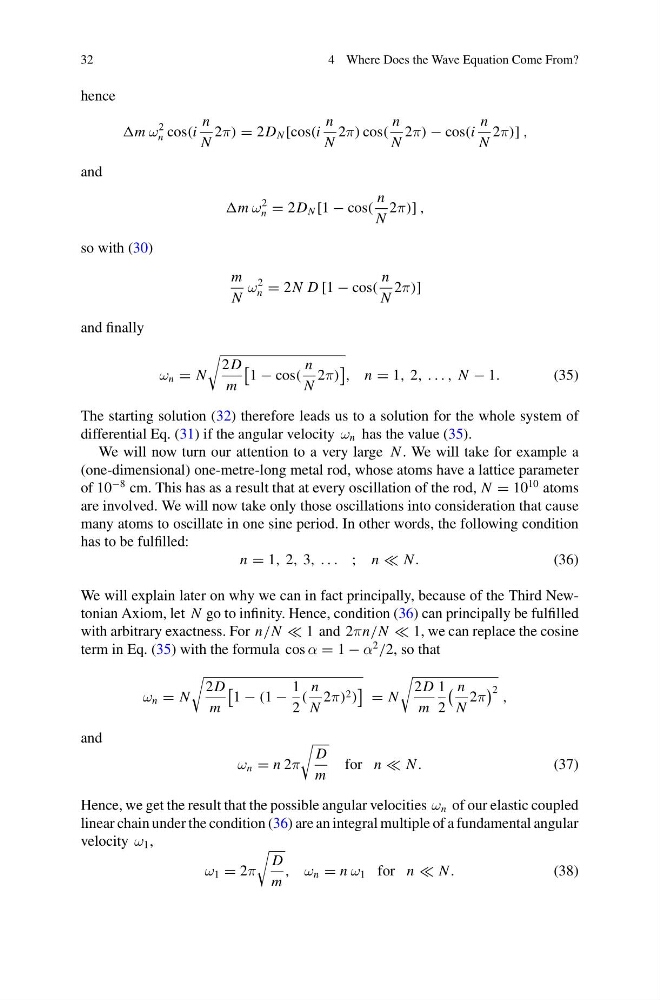
32
4 Where Does the Wave Equation Come From?
hence
m ω
2
n cos(i
n
N
2π) = 2D N [cos(i
n
N
2π) cos(
n
N
2π) − cos(i
n
N
2π)] ,
and
m ω
2
n = 2D N [1 − cos(
n
N
2π)] ,
so with (30)
m
N
ω
2
n = 2N D [1 − cos(
n
N
2π)]
and finally
ω n = N
2D
m
1 − cos(
n
N
2π)
, n = 1, 2, . . . , N − 1.
(35)
The starting solution (32) therefore leads us to a solution for the whole system of
differential Eq. (31) if the angular velocity ω n has the value (35).
We will now turn our attention to a very large N . We will take for example a
(one-dimensional) one-metre-long metal rod, whose atoms have a lattice parameter
of 10
−8 cm. This has as a result that at every oscillation of the rod, N = 10
10 atoms
are involved. We will now take only those oscillations into consideration that cause
many atoms to oscillate in one sine period. In other words, the following condition
has to be fulfilled:
n = 1, 2, 3, . . . ; n N .
(36)
We will explain later on why we can in fact principally, because of the Third Newtonian Axiom, let N go to infinity. Hence, condition (36) can principally be fulfilled
with arbitrary exactness. For n/N 1 and 2πn/N 1, we can replace the cosine
term in Eq. (35) with the formula cos α = 1 − α
2
/2, so that
ω n = N
2D
m
1 − (1 −
1
2
(
n
N
2π) 2 )
= N
2D
m
1
2
n
N
2π
2 ,
and
ω n = n 2π
D
m
for n N .
(37)
Hence, we get the result that the possible angular velocities ω n of our elastic coupled
linear chain under the condition (36) are an integral multiple of a fundamental angular
velocity ω 1 ,
ω 1 = 2π
D
m
, ω n = n ω 1 for n N .
(38)
4 Where Does the Wave Equation Come From?
hence
m ω
2
n cos(i
n
N
2π) = 2D N [cos(i
n
N
2π) cos(
n
N
2π) − cos(i
n
N
2π)] ,
and
m ω
2
n = 2D N [1 − cos(
n
N
2π)] ,
so with (30)
m
N
ω
2
n = 2N D [1 − cos(
n
N
2π)]
and finally
ω n = N
2D
m
1 − cos(
n
N
2π)
, n = 1, 2, . . . , N − 1.
(35)
The starting solution (32) therefore leads us to a solution for the whole system of
differential Eq. (31) if the angular velocity ω n has the value (35).
We will now turn our attention to a very large N . We will take for example a
(one-dimensional) one-metre-long metal rod, whose atoms have a lattice parameter
of 10
−8 cm. This has as a result that at every oscillation of the rod, N = 10
10 atoms
are involved. We will now take only those oscillations into consideration that cause
many atoms to oscillate in one sine period. In other words, the following condition
has to be fulfilled:
n = 1, 2, 3, . . . ; n N .
(36)
We will explain later on why we can in fact principally, because of the Third Newtonian Axiom, let N go to infinity. Hence, condition (36) can principally be fulfilled
with arbitrary exactness. For n/N 1 and 2πn/N 1, we can replace the cosine
term in Eq. (35) with the formula cos α = 1 − α
2
/2, so that
ω n = N
2D
m
1 − (1 −
1
2
(
n
N
2π) 2 )
= N
2D
m
1
2
n
N
2π
2 ,
and
ω n = n 2π
D
m
for n N .
(37)
Hence, we get the result that the possible angular velocities ω n of our elastic coupled
linear chain under the condition (36) are an integral multiple of a fundamental angular
velocity ω 1 ,
ω 1 = 2π
D
m
, ω n = n ω 1 for n N .
(38)