

326
30 On the Causality Problem: Particle–Tachyon Collisions
particle would have a positive energy. A particle at rest with E o = m o c
2
o cannot
however emit energy without changing its restmass. This is different for tachyons.
Tachyons can have negative energy. Using the same notation as above, the following
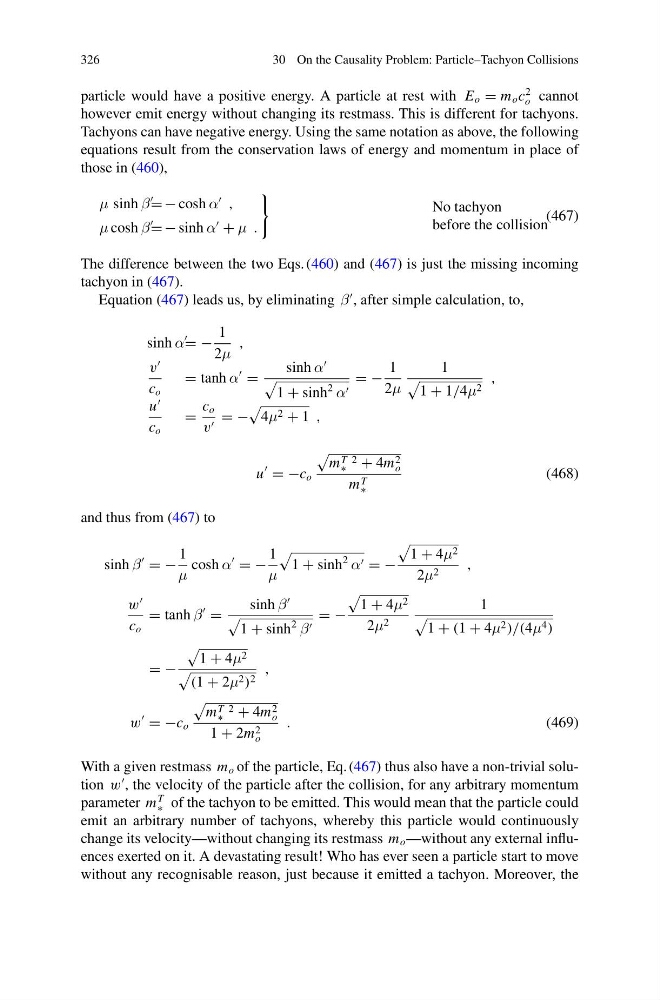
equations result from the conservation laws of energy and momentum in place of
those in (460),
μ sinh β
= − cosh α
,
μ cosh β
= − sinh α
+ μ .
No tachyon
before the collision
(467)
The difference between the two Eqs. (460) and (467) is just the missing incoming
tachyon in (467).
Equation (467) leads us, by eliminating β
, after simple calculation, to,
sinh α
= −
1
2μ
,
v
c o
= tanh α
=
sinh α
1 + sinh
2
α
= −
1
2μ
1
1 + 1/4μ 2
,
u
c o
=
c o
v = −
4μ 2 + 1 ,
u
= −c o
m T
∗
2 + 4m 2
o
m T
∗
(468)
and thus from (467) to
sinh β
= −
1
μ
cosh α
= −
1
μ
1 + sinh
2
α = −
1 + 4μ 2
2μ 2
,
w
c o
= tanh β
=
sinh β
1 + sinh
2
β
= −
1 + 4μ 2
2μ 2
1
1 + (1 + 4μ 2 )/(4μ 4 )
= −
1 + 4μ 2
(1 + 2μ 2 ) 2
,
w
= −c o
m T
∗
2 + 4m 2
o
1 + 2m 2
o
.
(469)
With a given restmass m o of the particle, Eq. (467) thus also have a non-trivial solution w
, the velocity of the particle after the collision, for any arbitrary momentum
parameter m
T
∗ of the tachyon to be emitted. This would mean that the particle could
emit an arbitrary number of tachyons, whereby this particle would continuously
change its velocity—without changing its restmass m o —without any external influences exerted on it. A devastating result! Who has ever seen a particle start to move
without any recognisable reason, just because it emitted a tachyon. Moreover, the
30 On the Causality Problem: Particle–Tachyon Collisions
particle would have a positive energy. A particle at rest with E o = m o c
2
o cannot
however emit energy without changing its restmass. This is different for tachyons.
Tachyons can have negative energy. Using the same notation as above, the following
equations result from the conservation laws of energy and momentum in place of
those in (460),
μ sinh β
= − cosh α
,
μ cosh β
= − sinh α
+ μ .
No tachyon
before the collision
(467)
The difference between the two Eqs. (460) and (467) is just the missing incoming
tachyon in (467).
Equation (467) leads us, by eliminating β
, after simple calculation, to,
sinh α
= −
1
2μ
,
v
c o
= tanh α
=
sinh α
1 + sinh
2
α
= −
1
2μ
1
1 + 1/4μ 2
,
u
c o
=
c o
v = −
4μ 2 + 1 ,
u
= −c o
m T
∗
2 + 4m 2
o
m T
∗
(468)
and thus from (467) to
sinh β
= −
1
μ
cosh α
= −
1
μ
1 + sinh
2
α = −
1 + 4μ 2
2μ 2
,
w
c o
= tanh β
=
sinh β
1 + sinh
2
β
= −
1 + 4μ 2
2μ 2
1
1 + (1 + 4μ 2 )/(4μ 4 )
= −
1 + 4μ 2
(1 + 2μ 2 ) 2
,
w
= −c o
m T
∗
2 + 4m 2
o
1 + 2m 2
o
.
(469)
With a given restmass m o of the particle, Eq. (467) thus also have a non-trivial solution w
, the velocity of the particle after the collision, for any arbitrary momentum
parameter m
T
∗ of the tachyon to be emitted. This would mean that the particle could
emit an arbitrary number of tachyons, whereby this particle would continuously
change its velocity—without changing its restmass m o —without any external influences exerted on it. A devastating result! Who has ever seen a particle start to move
without any recognisable reason, just because it emitted a tachyon. Moreover, the