

30 On the Causality Problem: Particle–Tachyon Collisions
325
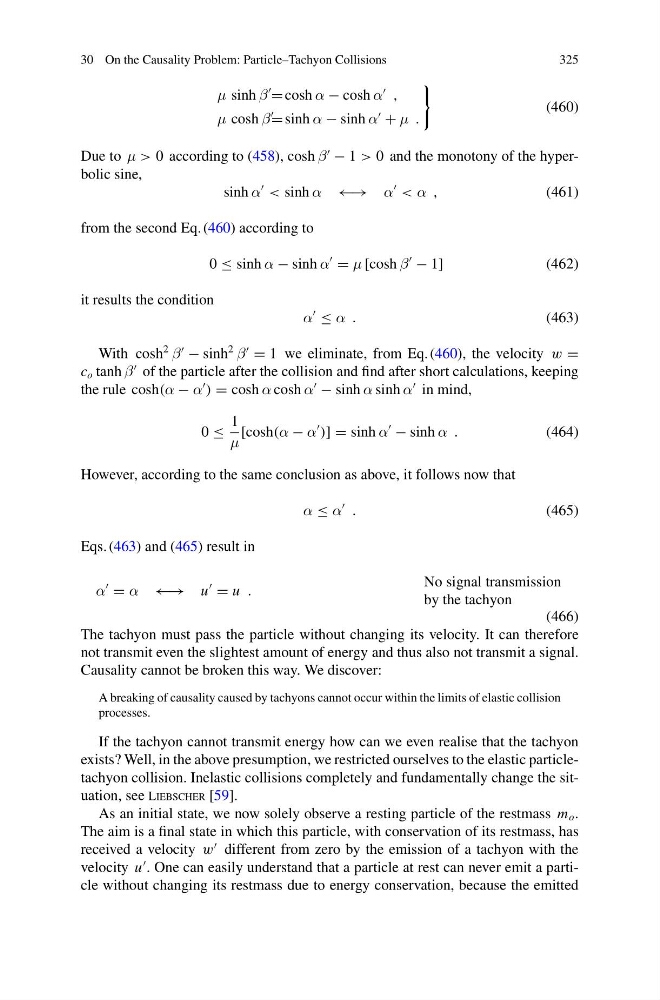
μ sinh β
= cosh α − cosh α
,
μ cosh β
= sinh α − sinh α
+ μ .
(460)
Due to μ > 0 according to (458), cosh β
− 1 > 0 and the monotony of the hyperbolic sine,
sinh α
< sinh α ←→ α
< α ,
(461)
from the second Eq. (460) according to
0 ≤ sinh α − sinh α
= μ [cosh β
− 1]
(462)
it results the condition
α
≤ α .
(463)
With cosh
2
β
− sinh
2
β
= 1 we eliminate, from Eq. (460), the velocity w =
c o tanh β
of the particle after the collision and find after short calculations, keeping
the rule cosh(α − α
) = cosh α cosh α
− sinh α sinh α
in mind,
0 ≤
1
μ
[cosh(α − α
)] = sinh α
− sinh α .
(464)
However, according to the same conclusion as above, it follows now that
α ≤ α
.
(465)
Eqs. (463) and (465) result in
α
= α ←→ u
= u .
No signal transmission
by the tachyon
(466)
The tachyon must pass the particle without changing its velocity. It can therefore
not transmit even the slightest amount of energy and thus also not transmit a signal.
Causality cannot be broken this way. We discover:
A breaking of causality caused by tachyons cannot occur within the limits of elastic collision
processes.
If the tachyon cannot transmit energy how can we even realise that the tachyon
exists? Well, in the above presumption, we restricted ourselves to the elastic particletachyon collision. Inelastic collisions completely and fundamentally change the situation, see Liebscher [59].
As an initial state, we now solely observe a resting particle of the restmass m o .
The aim is a final state in which this particle, with conservation of its restmass, has
received a velocity w
different from zero by the emission of a tachyon with the
velocity u
. One can easily understand that a particle at rest can never emit a particle without changing its restmass due to energy conservation, because the emitted
325
μ sinh β
= cosh α − cosh α
,
μ cosh β
= sinh α − sinh α
+ μ .
(460)
Due to μ > 0 according to (458), cosh β
− 1 > 0 and the monotony of the hyperbolic sine,
sinh α
< sinh α ←→ α
< α ,
(461)
from the second Eq. (460) according to
0 ≤ sinh α − sinh α
= μ [cosh β
− 1]
(462)
it results the condition
α
≤ α .
(463)
With cosh
2
β
− sinh
2
β
= 1 we eliminate, from Eq. (460), the velocity w =
c o tanh β
of the particle after the collision and find after short calculations, keeping
the rule cosh(α − α
) = cosh α cosh α
− sinh α sinh α
in mind,
0 ≤
1
μ
[cosh(α − α
)] = sinh α
− sinh α .
(464)
However, according to the same conclusion as above, it follows now that
α ≤ α
.
(465)
Eqs. (463) and (465) result in
α
= α ←→ u
= u .
No signal transmission
by the tachyon
(466)
The tachyon must pass the particle without changing its velocity. It can therefore
not transmit even the slightest amount of energy and thus also not transmit a signal.
Causality cannot be broken this way. We discover:
A breaking of causality caused by tachyons cannot occur within the limits of elastic collision
processes.
If the tachyon cannot transmit energy how can we even realise that the tachyon
exists? Well, in the above presumption, we restricted ourselves to the elastic particletachyon collision. Inelastic collisions completely and fundamentally change the situation, see Liebscher [59].
As an initial state, we now solely observe a resting particle of the restmass m o .
The aim is a final state in which this particle, with conservation of its restmass, has
received a velocity w
different from zero by the emission of a tachyon with the
velocity u
. One can easily understand that a particle at rest can never emit a particle without changing its restmass due to energy conservation, because the emitted