

288
26 Eigen Stresses and Dislocations
v i +
μ + λ
μ
v r , ri −
ρ
μ
∂
2
∂t 2 v i = −J ir , r −J ri , r −
λ
μ
J rr , i .
(390)
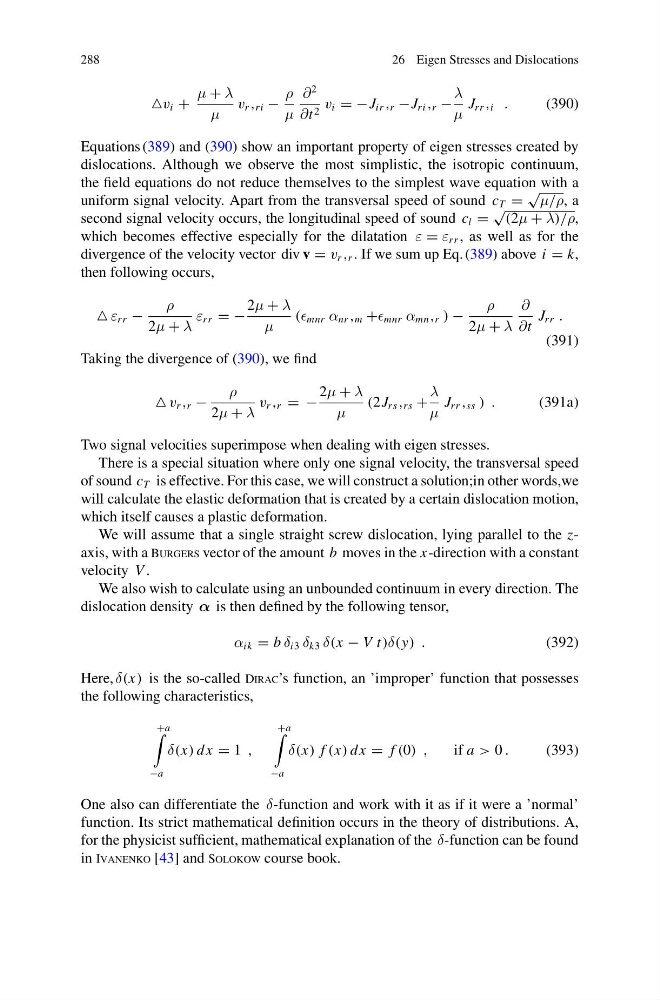
Equations (389) and (390) show an important property of eigen stresses created by
dislocations. Although we observe the most simplistic, the isotropic continuum,
the field equations do not reduce themselves to the simplest wave equation with a
uniform signal velocity. Apart from the transversal speed of sound c T =
√
μ/ρ, a
second signal velocity occurs, the longitudinal speed of sound c l =
√ (2μ + λ)/ρ,
which becomes effective especially for the dilatation ε = ε rr , as well as for the
divergence of the velocity vector div v = v r , r . If we sum up Eq. (389) above i = k,
then following occurs,
ε rr −
ρ
2μ + λ
ε rr = −
2μ + λ
μ
( mnr α nr , m + mnr α mn , r ) −
ρ
2μ + λ
∂
∂t
J rr .
(391)
Taking the divergence of (390), we find
v r , r −
ρ
2μ + λ
v r , r = −
2μ + λ
μ
(2J rs , rs +
λ
μ
J rr , ss ) .
(391a)
Two signal velocities superimpose when dealing with eigen stresses.
There is a special situation where only one signal velocity, the transversal speed
of sound c T is effective. For this case, we will construct a solution;in other words,we
will calculate the elastic deformation that is created by a certain dislocation motion,
which itself causes a plastic deformation.
We will assume that a single straight screw dislocation, lying parallel to the zaxis, with a Burgers vector of the amount b moves in the x-direction with a constant
velocity V .
We also wish to calculate using an unbounded continuum in every direction. The
dislocation density α is then defined by the following tensor,
α ik = b δ i3 δ k3 δ(x − V t)δ(y) .
(392)
Here, δ(x) is the so-called Dirac’s function, an ’improper’ function that possesses
the following characteristics,
+a
−a
δ(x) dx = 1 ,
+a
−a
δ(x) f (x) dx = f (0) ,
if a > 0 .
(393)
One also can differentiate the δ-function and work with it as if it were a ’normal’
function. Its strict mathematical definition occurs in the theory of distributions. A,
for the physicist sufficient, mathematical explanation of the δ-function can be found
in Ivanenko [43] and Solokow course book.
26 Eigen Stresses and Dislocations
v i +
μ + λ
μ
v r , ri −
ρ
μ
∂
2
∂t 2 v i = −J ir , r −J ri , r −
λ
μ
J rr , i .
(390)
Equations (389) and (390) show an important property of eigen stresses created by
dislocations. Although we observe the most simplistic, the isotropic continuum,
the field equations do not reduce themselves to the simplest wave equation with a
uniform signal velocity. Apart from the transversal speed of sound c T =
√
μ/ρ, a
second signal velocity occurs, the longitudinal speed of sound c l =
√ (2μ + λ)/ρ,
which becomes effective especially for the dilatation ε = ε rr , as well as for the
divergence of the velocity vector div v = v r , r . If we sum up Eq. (389) above i = k,
then following occurs,
ε rr −
ρ
2μ + λ
ε rr = −
2μ + λ
μ
( mnr α nr , m + mnr α mn , r ) −
ρ
2μ + λ
∂
∂t
J rr .
(391)
Taking the divergence of (390), we find
v r , r −
ρ
2μ + λ
v r , r = −
2μ + λ
μ
(2J rs , rs +
λ
μ
J rr , ss ) .
(391a)
Two signal velocities superimpose when dealing with eigen stresses.
There is a special situation where only one signal velocity, the transversal speed
of sound c T is effective. For this case, we will construct a solution;in other words,we
will calculate the elastic deformation that is created by a certain dislocation motion,
which itself causes a plastic deformation.
We will assume that a single straight screw dislocation, lying parallel to the zaxis, with a Burgers vector of the amount b moves in the x-direction with a constant
velocity V .
We also wish to calculate using an unbounded continuum in every direction. The
dislocation density α is then defined by the following tensor,
α ik = b δ i3 δ k3 δ(x − V t)δ(y) .
(392)
Here, δ(x) is the so-called Dirac’s function, an ’improper’ function that possesses
the following characteristics,
+a
−a
δ(x) dx = 1 ,
+a
−a
δ(x) f (x) dx = f (0) ,
if a > 0 .
(393)
One also can differentiate the δ-function and work with it as if it were a ’normal’
function. Its strict mathematical definition occurs in the theory of distributions. A,
for the physicist sufficient, mathematical explanation of the δ-function can be found
in Ivanenko [43] and Solokow course book.