

25 Elastic Displacements and Waves
267
does not in fact have to be fulfilled. If this assumption is however valid, then we are
dealing with a space-dependent vector s = s(x, t) that describes the displacements
of the points x o and x of V . The absolute elastic displacement s = s(x, t) at x
and the corresponding displacement s o = s(x o , t) at x o allows a Taylor expansion
or every component of s if we are dealing with small x = x − x o (small V ),
s x = s ox +
∂s x
∂x
x +
∂s x
∂ y
y +
∂s x
∂z
z ,
s y = s oy +
∂s y
∂x
x +
∂s y
∂ y
y +
∂s y
∂z
z ,
s z = s oz +
∂s z
∂x
x +
∂s z
∂ y
y +
∂s z
∂z
z .
⎫
⎪ ⎪ ⎪ ⎪ ⎪ ⎬
⎪ ⎪ ⎪ ⎪ ⎪ ⎭
(329)
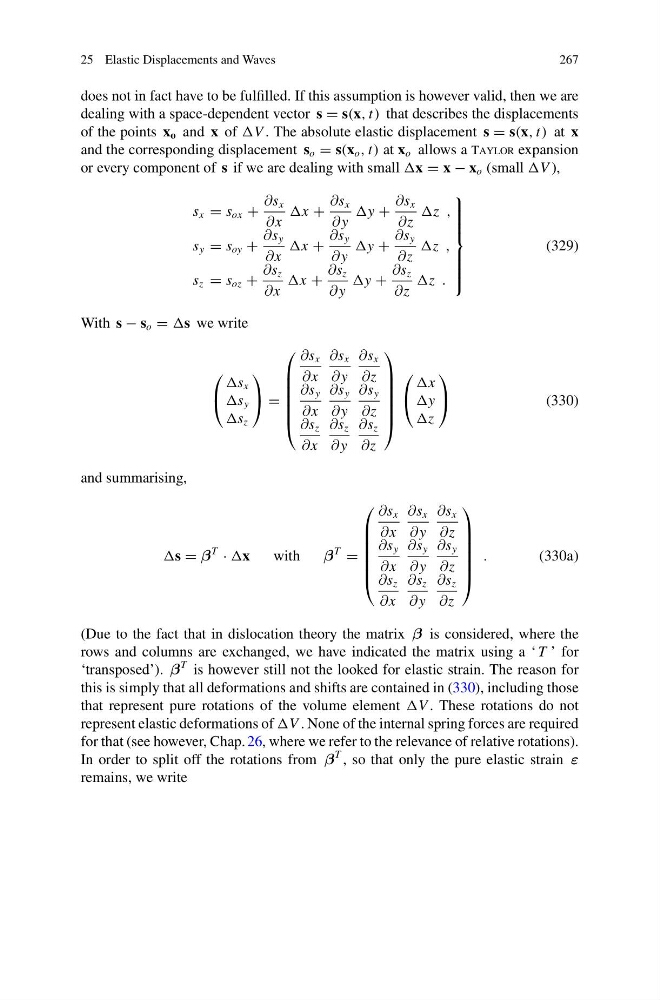
With s − s o = s we write
⎛
⎝
s x
s y
s z
⎞
⎠ =
⎛
⎜
⎜
⎜
⎜
⎜
⎝
∂s x
∂x
∂s x
∂ y
∂s x
∂z
∂s y
∂x
∂s y
∂ y
∂s y
∂z
∂s z
∂x
∂s z
∂ y
∂s z
∂z
⎞
⎟
⎟
⎟
⎟
⎟
⎠
⎛
⎝
x
y
z
⎞
⎠
(330)
and summarising,
s = β
T
· x
with
β
T
=
⎛
⎜
⎜
⎜
⎜
⎜
⎝
∂s x
∂x
∂s x
∂ y
∂s x
∂z
∂s y
∂x
∂s y
∂ y
∂s y
∂z
∂s z
∂x
∂s z
∂ y
∂s z
∂z
⎞
⎟
⎟
⎟
⎟
⎟
⎠
.
(330a)
(Due to the fact that in dislocation theory the matrix β is considered, where the
rows and columns are exchanged, we have indicated the matrix using a ‘ T ’ for
‘transposed’). β
T is however still not the looked for elastic strain. The reason for
this is simply that all deformations and shifts are contained in (330), including those
that represent pure rotations of the volume element V . These rotations do not
represent elastic deformations of V . None of the internal spring forces are required
for that (see however, Chap. 26, where we refer to the relevance of relative rotations).
In order to split off the rotations from β
T , so that only the pure elastic strain ε
remains, we write
267
does not in fact have to be fulfilled. If this assumption is however valid, then we are
dealing with a space-dependent vector s = s(x, t) that describes the displacements
of the points x o and x of V . The absolute elastic displacement s = s(x, t) at x
and the corresponding displacement s o = s(x o , t) at x o allows a Taylor expansion
or every component of s if we are dealing with small x = x − x o (small V ),
s x = s ox +
∂s x
∂x
x +
∂s x
∂ y
y +
∂s x
∂z
z ,
s y = s oy +
∂s y
∂x
x +
∂s y
∂ y
y +
∂s y
∂z
z ,
s z = s oz +
∂s z
∂x
x +
∂s z
∂ y
y +
∂s z
∂z
z .
⎫
⎪ ⎪ ⎪ ⎪ ⎪ ⎬
⎪ ⎪ ⎪ ⎪ ⎪ ⎭
(329)
With s − s o = s we write
⎛
⎝
s x
s y
s z
⎞
⎠ =
⎛
⎜
⎜
⎜
⎜
⎜
⎝
∂s x
∂x
∂s x
∂ y
∂s x
∂z
∂s y
∂x
∂s y
∂ y
∂s y
∂z
∂s z
∂x
∂s z
∂ y
∂s z
∂z
⎞
⎟
⎟
⎟
⎟
⎟
⎠
⎛
⎝
x
y
z
⎞
⎠
(330)
and summarising,
s = β
T
· x
with
β
T
=
⎛
⎜
⎜
⎜
⎜
⎜
⎝
∂s x
∂x
∂s x
∂ y
∂s x
∂z
∂s y
∂x
∂s y
∂ y
∂s y
∂z
∂s z
∂x
∂s z
∂ y
∂s z
∂z
⎞
⎟
⎟
⎟
⎟
⎟
⎠
.
(330a)
(Due to the fact that in dislocation theory the matrix β is considered, where the
rows and columns are exchanged, we have indicated the matrix using a ‘ T ’ for
‘transposed’). β
T is however still not the looked for elastic strain. The reason for
this is simply that all deformations and shifts are contained in (330), including those
that represent pure rotations of the volume element V . These rotations do not
represent elastic deformations of V . None of the internal spring forces are required
for that (see however, Chap. 26, where we refer to the relevance of relative rotations).
In order to split off the rotations from β
T , so that only the pure elastic strain ε
remains, we write