

25 Elastic Displacements and Waves
265
The stress tensor σ is symmetrical,
σ xy = σ yx ,
σ xz = σ zx ,
σ yz = σ zy .
⎫
⎬
⎭
(321)
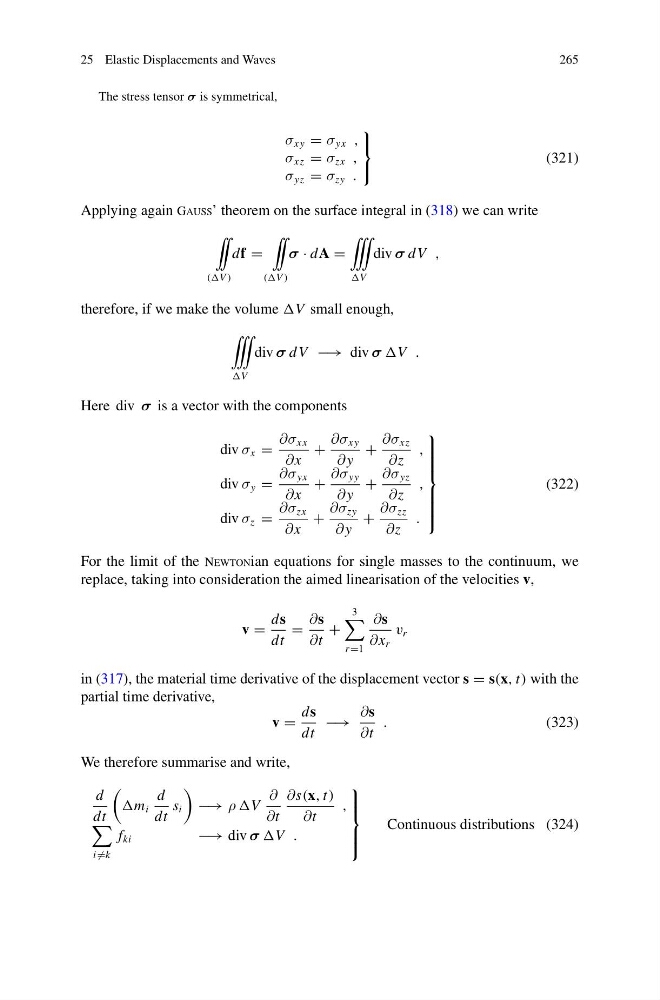
Applying again Gauss’ theorem on the surface integral in (318) we can write
((V )
df =
((V )
σ · dA =
V
div σ dV ,
therefore, if we make the volume V small enough,
V
div σ dV −→ div σ V .
Here div σ is a vector with the components
div σ x =
∂σ xx
∂x
+
∂σ xy
∂ y
+
∂σ xz
∂z
,
div σ y =
∂σ yx
∂x
+
∂σ yy
∂ y
+
∂σ yz
∂z
,
div σ z =
∂σ zx
∂x
+
∂σ zy
∂ y
+
∂σ zz
∂z
.
⎫
⎪ ⎪ ⎪ ⎪ ⎪ ⎬
⎪ ⎪ ⎪ ⎪ ⎪ ⎭
(322)
For the limit of the Newtonian equations for single masses to the continuum, we
replace, taking into consideration the aimed linearisation of the velocities v,
v =
ds
dt
=
∂s
∂t
+
3
r =1
∂s
∂x r
v r
in (317), the material time derivative of the displacement vector s = s(x, t) with the
partial time derivative,
v =
ds
dt
−→
∂s
∂t
.
(323)
We therefore summarise and write,
d
dt
m i
d
dt
s i
−→ ρ V
∂
∂t
∂s(x, t)
∂t
,
i =k
f ki
−→ div σ V .
⎫
⎪ ⎪ ⎬
⎪ ⎪ ⎭
Continuous distributions (324)
265
The stress tensor σ is symmetrical,
σ xy = σ yx ,
σ xz = σ zx ,
σ yz = σ zy .
⎫
⎬
⎭
(321)
Applying again Gauss’ theorem on the surface integral in (318) we can write
((V )
df =
((V )
σ · dA =
V
div σ dV ,
therefore, if we make the volume V small enough,
V
div σ dV −→ div σ V .
Here div σ is a vector with the components
div σ x =
∂σ xx
∂x
+
∂σ xy
∂ y
+
∂σ xz
∂z
,
div σ y =
∂σ yx
∂x
+
∂σ yy
∂ y
+
∂σ yz
∂z
,
div σ z =
∂σ zx
∂x
+
∂σ zy
∂ y
+
∂σ zz
∂z
.
⎫
⎪ ⎪ ⎪ ⎪ ⎪ ⎬
⎪ ⎪ ⎪ ⎪ ⎪ ⎭
(322)
For the limit of the Newtonian equations for single masses to the continuum, we
replace, taking into consideration the aimed linearisation of the velocities v,
v =
ds
dt
=
∂s
∂t
+
3
r =1
∂s
∂x r
v r
in (317), the material time derivative of the displacement vector s = s(x, t) with the
partial time derivative,
v =
ds
dt
−→
∂s
∂t
.
(323)
We therefore summarise and write,
d
dt
m i
d
dt
s i
−→ ρ V
∂
∂t
∂s(x, t)
∂t
,
i =k
f ki
−→ div σ V .
⎫
⎪ ⎪ ⎬
⎪ ⎪ ⎭
Continuous distributions (324)