

25 Elastic Displacements and Waves
263
∂
∂t
ρ +
3
r =1
∂
∂x r
(ρ v r ) = 0 .
(315a)
The last equation is called continuity equation and simply means that no particles
disappear during their motion.
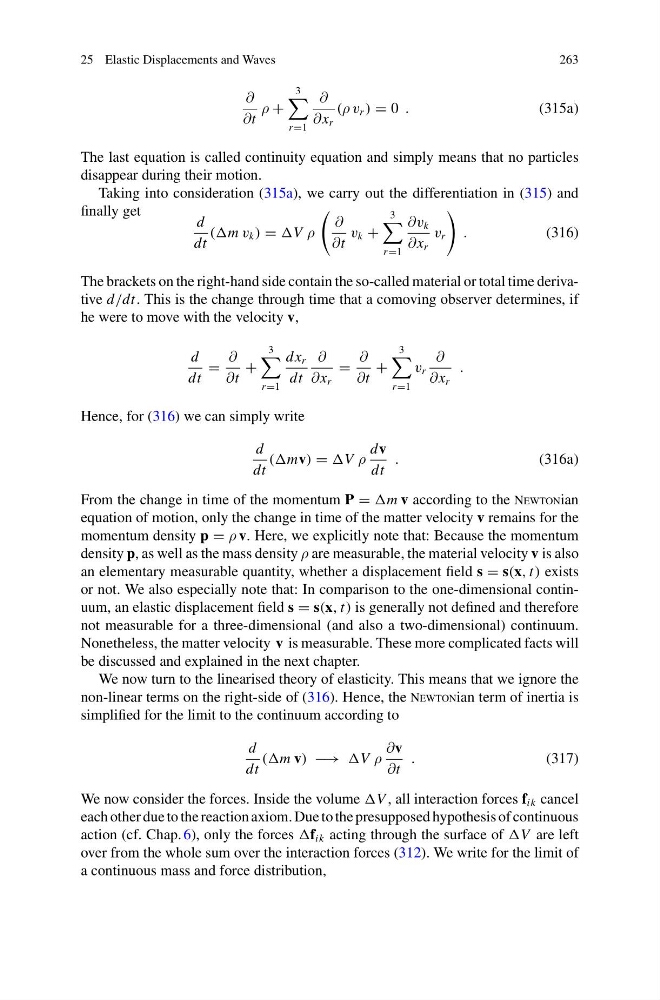
Taking into consideration (315a), we carry out the differentiation in (315) and
finally get
d
dt
((m v k ) = V ρ
∂
∂t
v k +
3
r =1
∂v k
∂x r
v r
.
(316)
The brackets on the right-hand side contain the so-called material or total time derivative d/dt. This is the change through time that a comoving observer determines, if
he were to move with the velocity v,
d
dt
=
∂
∂t
+
3
r =1
dx r
dt
∂
∂x r
=
∂
∂t
+
3
r =1
v r
∂
∂x r
.
Hence, for (316) we can simply write
d
dt
((mv) = V ρ
dv
dt
.
(316a)
From the change in time of the momentum P = m v according to the Newtonian
equation of motion, only the change in time of the matter velocity v remains for the
momentum density p = ρ v. Here, we explicitly note that: Because the momentum
density p, as well as the mass density ρ are measurable, the material velocity v is also
an elementary measurable quantity, whether a displacement field s = s(x, t) exists
or not. We also especially note that: In comparison to the one-dimensional continuum, an elastic displacement field s = s(x, t) is generally not defined and therefore
not measurable for a three-dimensional (and also a two-dimensional) continuum.
Nonetheless, the matter velocity v is measurable. These more complicated facts will
be discussed and explained in the next chapter.
We now turn to the linearised theory of elasticity. This means that we ignore the
non-linear terms on the right-side of (316). Hence, the Newtonian term of inertia is
simplified for the limit to the continuum according to
d
dt
((m v) −→ V ρ
∂v
∂t
.
(317)
We now consider the forces. Inside the volume V , all interaction forces f ik cancel
each other due to the reaction axiom. Due to the presupposed hypothesis of continuous
action (cf. Chap. 6), only the forces f ik acting through the surface of V are left
over from the whole sum over the interaction forces (312). We write for the limit of
a continuous mass and force distribution,
263
∂
∂t
ρ +
3
r =1
∂
∂x r
(ρ v r ) = 0 .
(315a)
The last equation is called continuity equation and simply means that no particles
disappear during their motion.
Taking into consideration (315a), we carry out the differentiation in (315) and
finally get
d
dt
((m v k ) = V ρ
∂
∂t
v k +
3
r =1
∂v k
∂x r
v r
.
(316)
The brackets on the right-hand side contain the so-called material or total time derivative d/dt. This is the change through time that a comoving observer determines, if
he were to move with the velocity v,
d
dt
=
∂
∂t
+
3
r =1
dx r
dt
∂
∂x r
=
∂
∂t
+
3
r =1
v r
∂
∂x r
.
Hence, for (316) we can simply write
d
dt
((mv) = V ρ
dv
dt
.
(316a)
From the change in time of the momentum P = m v according to the Newtonian
equation of motion, only the change in time of the matter velocity v remains for the
momentum density p = ρ v. Here, we explicitly note that: Because the momentum
density p, as well as the mass density ρ are measurable, the material velocity v is also
an elementary measurable quantity, whether a displacement field s = s(x, t) exists
or not. We also especially note that: In comparison to the one-dimensional continuum, an elastic displacement field s = s(x, t) is generally not defined and therefore
not measurable for a three-dimensional (and also a two-dimensional) continuum.
Nonetheless, the matter velocity v is measurable. These more complicated facts will
be discussed and explained in the next chapter.
We now turn to the linearised theory of elasticity. This means that we ignore the
non-linear terms on the right-side of (316). Hence, the Newtonian term of inertia is
simplified for the limit to the continuum according to
d
dt
((m v) −→ V ρ
∂v
∂t
.
(317)
We now consider the forces. Inside the volume V , all interaction forces f ik cancel
each other due to the reaction axiom. Due to the presupposed hypothesis of continuous
action (cf. Chap. 6), only the forces f ik acting through the surface of V are left
over from the whole sum over the interaction forces (312). We write for the limit of
a continuous mass and force distribution,