

262
25 Elastic Displacements and Waves
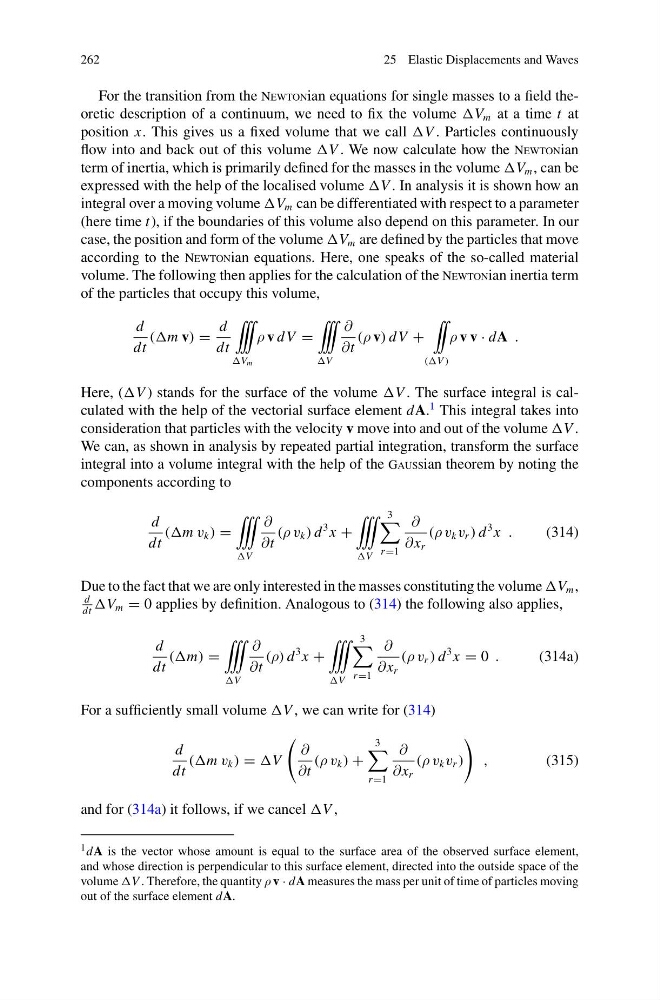
For the transition from the Newtonian equations for single masses to a field theoretic description of a continuum, we need to fix the volume V m at a time t at
position x. This gives us a fixed volume that we call V . Particles continuously
flow into and back out of this volume V . We now calculate how the Newtonian
term of inertia, which is primarily defined for the masses in the volume V m , can be
expressed with the help of the localised volume V . In analysis it is shown how an
integral over a moving volume V m can be differentiated with respect to a parameter
(here time t), if the boundaries of this volume also depend on this parameter. In our
case, the position and form of the volume V m are defined by the particles that move
according to the Newtonian equations. Here, one speaks of the so-called material
volume. The following then applies for the calculation of the Newtonian inertia term
of the particles that occupy this volume,
d
dt
((m v) =
d
dt
V m
ρ v dV =
V
∂
∂t
(ρ v) dV +
((V )
ρ v v · dA .
Here, (V ) stands for the surface of the volume V . The surface integral is calculated with the help of the vectorial surface element dA.
1 This integral takes into
consideration that particles with the velocity v move into and out of the volume V .
We can, as shown in analysis by repeated partial integration, transform the surface
integral into a volume integral with the help of the Gaussian theorem by noting the
components according to
d
dt
((m v k ) =
V
∂
∂t
(ρ v k ) d
3 x +
V
3
r =1
∂
∂x r
(ρ v k v r ) d
3 x .
(314)
Due to the fact that we are only interested in the masses constituting the volume V m ,
d
dt
V m = 0 applies by definition. Analogous to (314) the following also applies,
d
dt
((m) =
V
∂
∂t
(ρ) d
3 x +
V
3
r =1
∂
∂x r
(ρ v r ) d
3 x = 0 .
(314a)
For a sufficiently small volume V , we can write for (314)
d
dt
((m v k ) = V
∂
∂t
(ρ v k ) +
3
r =1
∂
∂x r
(ρ v k v r )
,
(315)
and for (314a) it follows, if we cancel V ,
1 dA is the vector whose amount is equal to the surface area of the observed surface element,
and whose direction is perpendicular to this surface element, directed into the outside space of the
volume V . Therefore, the quantity ρ v · dA measures the mass per unit of time of particles moving
out of the surface element dA.
25 Elastic Displacements and Waves
For the transition from the Newtonian equations for single masses to a field theoretic description of a continuum, we need to fix the volume V m at a time t at
position x. This gives us a fixed volume that we call V . Particles continuously
flow into and back out of this volume V . We now calculate how the Newtonian
term of inertia, which is primarily defined for the masses in the volume V m , can be
expressed with the help of the localised volume V . In analysis it is shown how an
integral over a moving volume V m can be differentiated with respect to a parameter
(here time t), if the boundaries of this volume also depend on this parameter. In our
case, the position and form of the volume V m are defined by the particles that move
according to the Newtonian equations. Here, one speaks of the so-called material
volume. The following then applies for the calculation of the Newtonian inertia term
of the particles that occupy this volume,
d
dt
((m v) =
d
dt
V m
ρ v dV =
V
∂
∂t
(ρ v) dV +
((V )
ρ v v · dA .
Here, (V ) stands for the surface of the volume V . The surface integral is calculated with the help of the vectorial surface element dA.
1 This integral takes into
consideration that particles with the velocity v move into and out of the volume V .
We can, as shown in analysis by repeated partial integration, transform the surface
integral into a volume integral with the help of the Gaussian theorem by noting the
components according to
d
dt
((m v k ) =
V
∂
∂t
(ρ v k ) d
3 x +
V
3
r =1
∂
∂x r
(ρ v k v r ) d
3 x .
(314)
Due to the fact that we are only interested in the masses constituting the volume V m ,
d
dt
V m = 0 applies by definition. Analogous to (314) the following also applies,
d
dt
((m) =
V
∂
∂t
(ρ) d
3 x +
V
3
r =1
∂
∂x r
(ρ v r ) d
3 x = 0 .
(314a)
For a sufficiently small volume V , we can write for (314)
d
dt
((m v k ) = V
∂
∂t
(ρ v k ) +
3
r =1
∂
∂x r
(ρ v k v r )
,
(315)
and for (314a) it follows, if we cancel V ,
1 dA is the vector whose amount is equal to the surface area of the observed surface element,
and whose direction is perpendicular to this surface element, directed into the outside space of the
volume V . Therefore, the quantity ρ v · dA measures the mass per unit of time of particles moving
out of the surface element dA.