

17 The Twin Paradox
187
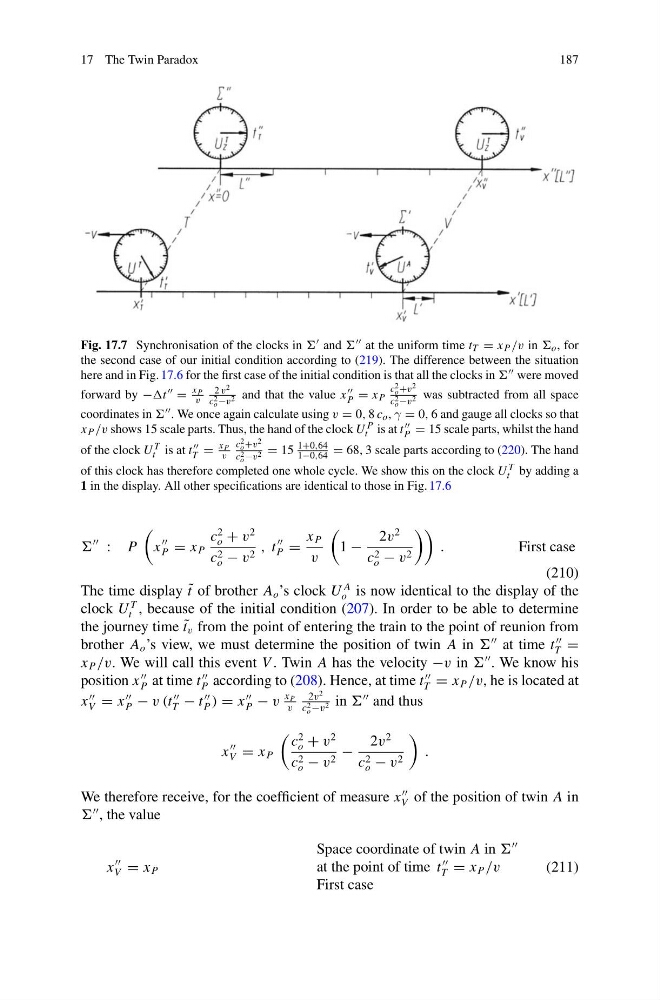
Fig. 17.7 Synchronisation of the clocks in and at the uniform time t T = x P /v in o , for
the second case of our initial condition according to (219). The difference between the situation
here and in Fig. 17.6 for the first case of the initial condition is that all the clocks in were moved
forward by −t =
x P
v
2 v 2
c 2
o −v 2 and that the value x
P = x P
c 2
o +v 2
c 2
o −v 2 was subtracted from all space
coordinates in . We once again calculate using v = 0, 8 c o , γ = 0, 6 and gauge all clocks so that
x P /v shows 15 scale parts. Thus, the hand of the clock U P
t is at t
P = 15 scale parts, whilst the hand
of the clock U T
t is at t
T =
x P
v
c 2
o +v 2
c 2
o −v 2 = 15
1+0,64
1−0,64 = 68, 3 scale parts according to (220). The hand
of this clock has therefore completed one whole cycle. We show this on the clock U T
t by adding a
1 in the display. All other specifications are identical to those in Fig. 17.6
: P
x
P = x P
c
2
o + v
2
c 2
o − v 2 , t
P =
x P
v
1 −
2v
2
c 2
o − v 2
.
First case
(210)
The time display ˜
t of brother A o ’s clock U
A
o is now identical to the display of the
clock U
T
t , because of the initial condition (207). In order to be able to determine
the journey time ˜
t v from the point of entering the train to the point of reunion from
brother A o ’s view, we must determine the position of twin A in
at time t
T =
x P /v. We will call this event V . Twin A has the velocity −v in
. We know his
position x
P at time t
P according to (208). Hence, at time t
T = x P /v, he is located at
x
V = x
P − v (t
T − t
P ) = x
P − v
x P
v
2v
2
c 2
o −v 2 in
and thus
x
V = x P
c
2
o + v
2
c 2
o − v 2 −
2v
2
c 2
o − v 2
.
We therefore receive, for the coefficient of measure x
V of the position of twin A in
, the value
x
V = x P
Space coordinate of twin A in
at the point of time t
T = x P /v
First case
(211)
187
Fig. 17.7 Synchronisation of the clocks in and at the uniform time t T = x P /v in o , for
the second case of our initial condition according to (219). The difference between the situation
here and in Fig. 17.6 for the first case of the initial condition is that all the clocks in were moved
forward by −t =
x P
v
2 v 2
c 2
o −v 2 and that the value x
P = x P
c 2
o +v 2
c 2
o −v 2 was subtracted from all space
coordinates in . We once again calculate using v = 0, 8 c o , γ = 0, 6 and gauge all clocks so that
x P /v shows 15 scale parts. Thus, the hand of the clock U P
t is at t
P = 15 scale parts, whilst the hand
of the clock U T
t is at t
T =
x P
v
c 2
o +v 2
c 2
o −v 2 = 15
1+0,64
1−0,64 = 68, 3 scale parts according to (220). The hand
of this clock has therefore completed one whole cycle. We show this on the clock U T
t by adding a
1 in the display. All other specifications are identical to those in Fig. 17.6
: P
x
P = x P
c
2
o + v
2
c 2
o − v 2 , t
P =
x P
v
1 −
2v
2
c 2
o − v 2
.
First case
(210)
The time display ˜
t of brother A o ’s clock U
A
o is now identical to the display of the
clock U
T
t , because of the initial condition (207). In order to be able to determine
the journey time ˜
t v from the point of entering the train to the point of reunion from
brother A o ’s view, we must determine the position of twin A in
at time t
T =
x P /v. We will call this event V . Twin A has the velocity −v in
. We know his
position x
P at time t
P according to (208). Hence, at time t
T = x P /v, he is located at
x
V = x
P − v (t
T − t
P ) = x
P − v
x P
v
2v
2
c 2
o −v 2 in
and thus
x
V = x P
c
2
o + v
2
c 2
o − v 2 −
2v
2
c 2
o − v 2
.
We therefore receive, for the coefficient of measure x
V of the position of twin A in
, the value
x
V = x P
Space coordinate of twin A in
at the point of time t
T = x P /v
First case
(211)