

186
17 The Twin Paradox
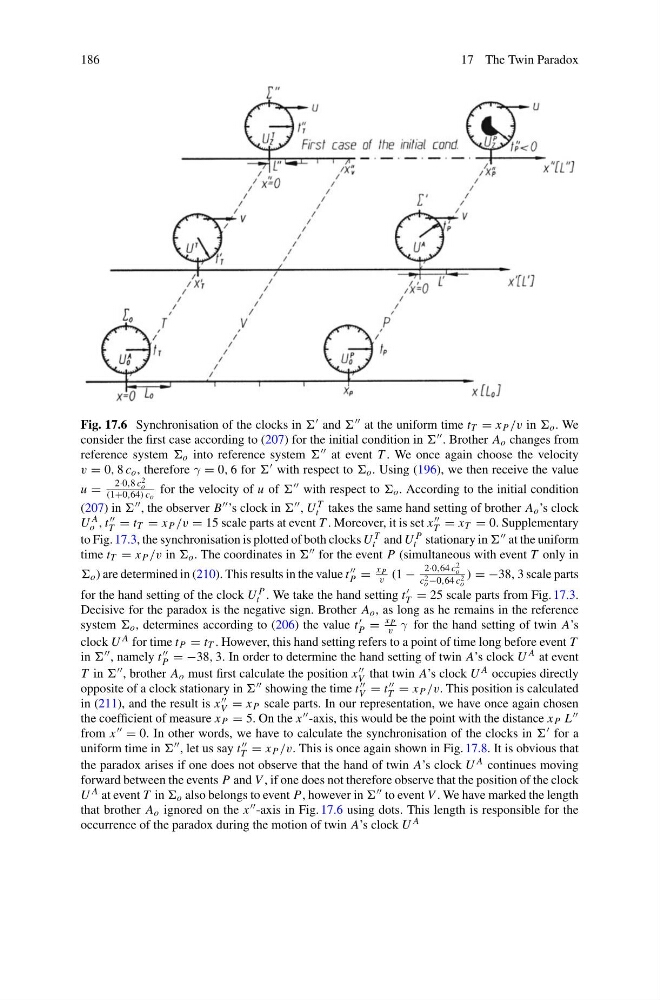
Fig. 17.6 Synchronisation of the clocks in and at the uniform time t T = x P /v in o . We
consider the first case according to (207) for the initial condition in . Brother A o changes from
reference system o into reference system at event T . We once again choose the velocity
v = 0, 8 c o , therefore γ = 0, 6 for with respect to o . Using (196), we then receive the value
u =
2·0,8 c 2
o
(1+0,64) co for the velocity of u of with respect to o . According to the initial condition
(207) in , the observer B ’s clock in , U T
t takes the same hand setting of brother A o ’s clock
U A
o , t
T = t T = x P /v = 15 scale parts at event T . Moreover, it is set x
T = x T = 0. Supplementary
to Fig. 17.3, the synchronisation is plotted of both clocks U T
t and U P
t stationary in at the uniform
time t T = x P /v in o . The coordinates in for the event P (simultaneous with event T only in
o ) are determined in (210). This results in the value t
P =
x P
v (1 −
2·0,64 c 2
o
c 2
o −0,64 c 2
o
) = −38, 3 scale parts
for the hand setting of the clock U P
t . We take the hand setting t
T = 25 scale parts from Fig. 17.3.
Decisive for the paradox is the negative sign. Brother A o , as long as he remains in the reference
system o , determines according to (206) the value t
P =
x P
v γ for the hand setting of twin A’s
clock U A for time t P = t T . However, this hand setting refers to a point of time long before event T
in , namely t
P = −38, 3. In order to determine the hand setting of twin A’s clock U A at event
T in , brother A o must first calculate the position x
V that twin A’s clock U A occupies directly
opposite of a clock stationary in showing the time t
V = t
T = x P /v. This position is calculated
in (211), and the result is x
V = x P scale parts. In our representation, we have once again chosen
the coefficient of measure x P = 5. On the x -axis, this would be the point with the distance x P L
from x = 0. In other words, we have to calculate the synchronisation of the clocks in for a
uniform time in , let us say t
T = x P /v. This is once again shown in Fig. 17.8. It is obvious that
the paradox arises if one does not observe that the hand of twin A’s clock U A continues moving
forward between the events P and V , if one does not therefore observe that the position of the clock
U A at event T in o also belongs to event P, however in to event V . We have marked the length
that brother A o ignored on the x -axis in Fig. 17.6 using dots. This length is responsible for the
occurrence of the paradox during the motion of twin A’s clock U A
17 The Twin Paradox
Fig. 17.6 Synchronisation of the clocks in and at the uniform time t T = x P /v in o . We
consider the first case according to (207) for the initial condition in . Brother A o changes from
reference system o into reference system at event T . We once again choose the velocity
v = 0, 8 c o , therefore γ = 0, 6 for with respect to o . Using (196), we then receive the value
u =
2·0,8 c 2
o
(1+0,64) co for the velocity of u of with respect to o . According to the initial condition
(207) in , the observer B ’s clock in , U T
t takes the same hand setting of brother A o ’s clock
U A
o , t
T = t T = x P /v = 15 scale parts at event T . Moreover, it is set x
T = x T = 0. Supplementary
to Fig. 17.3, the synchronisation is plotted of both clocks U T
t and U P
t stationary in at the uniform
time t T = x P /v in o . The coordinates in for the event P (simultaneous with event T only in
o ) are determined in (210). This results in the value t
P =
x P
v (1 −
2·0,64 c 2
o
c 2
o −0,64 c 2
o
) = −38, 3 scale parts
for the hand setting of the clock U P
t . We take the hand setting t
T = 25 scale parts from Fig. 17.3.
Decisive for the paradox is the negative sign. Brother A o , as long as he remains in the reference
system o , determines according to (206) the value t
P =
x P
v γ for the hand setting of twin A’s
clock U A for time t P = t T . However, this hand setting refers to a point of time long before event T
in , namely t
P = −38, 3. In order to determine the hand setting of twin A’s clock U A at event
T in , brother A o must first calculate the position x
V that twin A’s clock U A occupies directly
opposite of a clock stationary in showing the time t
V = t
T = x P /v. This position is calculated
in (211), and the result is x
V = x P scale parts. In our representation, we have once again chosen
the coefficient of measure x P = 5. On the x -axis, this would be the point with the distance x P L
from x = 0. In other words, we have to calculate the synchronisation of the clocks in for a
uniform time in , let us say t
T = x P /v. This is once again shown in Fig. 17.8. It is obvious that
the paradox arises if one does not observe that the hand of twin A’s clock U A continues moving
forward between the events P and V , if one does not therefore observe that the position of the clock
U A at event T in o also belongs to event P, however in to event V . We have marked the length
that brother A o ignored on the x -axis in Fig. 17.6 using dots. This length is responsible for the
occurrence of the paradox during the motion of twin A’s clock U A