

17 The Twin Paradox
183
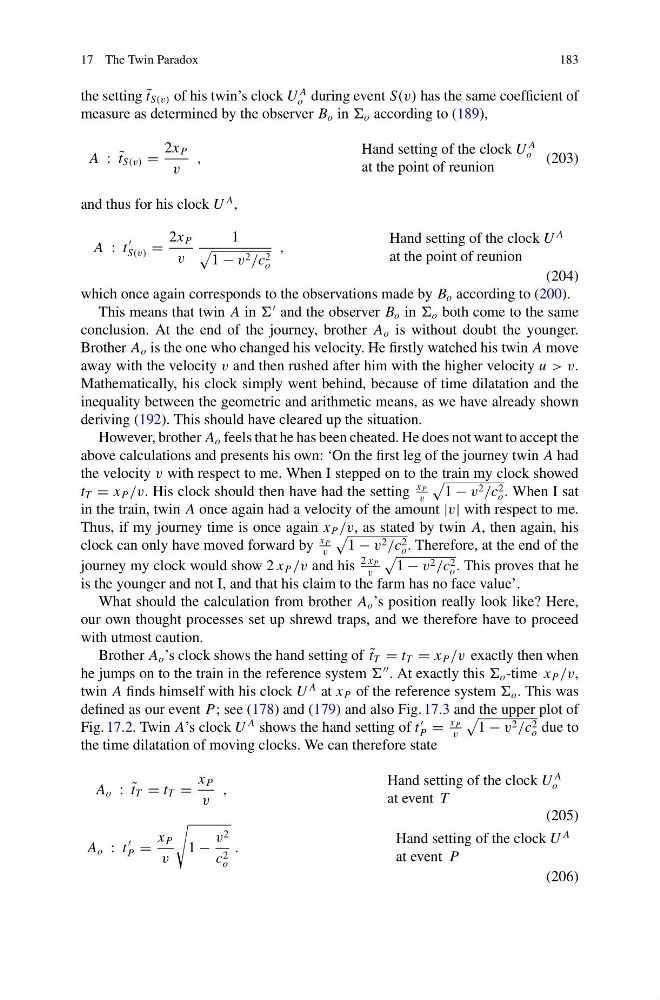
the setting ˜
t S(v) of his twin’s clock U
A
o during event S(v) has the same coefficient of
measure as determined by the observer B o in o according to (189),
A : ˜
t S(v) =
2x P
v
,
Hand setting of the clock U
A
o
at the point of reunion
(203)
and thus for his clock U
A ,
A : t
S(v) =
2x P
v
1
1 − v 2 /c 2
o
,
Hand setting of the clock U
A
at the point of reunion
(204)
which once again corresponds to the observations made by B o according to (200).
This means that twin A in
and the observer B o in o both come to the same
conclusion. At the end of the journey, brother A o is without doubt the younger.
Brother A o is the one who changed his velocity. He firstly watched his twin A move
away with the velocity v and then rushed after him with the higher velocity u > v.
Mathematically, his clock simply went behind, because of time dilatation and the
inequality between the geometric and arithmetic means, as we have already shown
deriving (192). This should have cleared up the situation.
However, brother A o feels that he has been cheated. He does not want to accept the
above calculations and presents his own: ‘On the first leg of the journey twin A had
the velocity v with respect to me. When I stepped on to the train my clock showed
t T = x P /v. His clock should then have had the setting
x P
v
1 − v 2 /c 2
o . When I sat
in the train, twin A once again had a velocity of the amount |v| with respect to me.
Thus, if my journey time is once again x P /v, as stated by twin A, then again, his
clock can only have moved forward by
x P
v
1 − v 2 /c 2
o . Therefore, at the end of the
journey my clock would show 2 x P /v and his
2 x P
v
1 − v 2 /c 2
o . This proves that he
is the younger and not I, and that his claim to the farm has no face value’.
What should the calculation from brother A o ’s position really look like? Here,
our own thought processes set up shrewd traps, and we therefore have to proceed
with utmost caution.
Brother A o ’s clock shows the hand setting of ˜
t T = t T = x P /v exactly then when
he jumps on to the train in the reference system
. At exactly this o -time x P /v,
twin A finds himself with his clock U
A at x P of the reference system o . This was
defined as our event P; see (178) and (179) and also Fig. 17.3 and the upper plot of
Fig. 17.2. Twin A’s clock U
A shows the hand setting of t
P =
x P
v
1 − v 2 /c 2
o due to
the time dilatation of moving clocks. We can therefore state
A o : ˜
t T = t T =
x P
v
,
Hand setting of the clock U
A
o
at event T
(205)
A o : t
P =
x P
v
1 −
v 2
c 2
o
.
Hand setting of the clock U
A
at event P
(206)
183
the setting ˜
t S(v) of his twin’s clock U
A
o during event S(v) has the same coefficient of
measure as determined by the observer B o in o according to (189),
A : ˜
t S(v) =
2x P
v
,
Hand setting of the clock U
A
o
at the point of reunion
(203)
and thus for his clock U
A ,
A : t
S(v) =
2x P
v
1
1 − v 2 /c 2
o
,
Hand setting of the clock U
A
at the point of reunion
(204)
which once again corresponds to the observations made by B o according to (200).
This means that twin A in
and the observer B o in o both come to the same
conclusion. At the end of the journey, brother A o is without doubt the younger.
Brother A o is the one who changed his velocity. He firstly watched his twin A move
away with the velocity v and then rushed after him with the higher velocity u > v.
Mathematically, his clock simply went behind, because of time dilatation and the
inequality between the geometric and arithmetic means, as we have already shown
deriving (192). This should have cleared up the situation.
However, brother A o feels that he has been cheated. He does not want to accept the
above calculations and presents his own: ‘On the first leg of the journey twin A had
the velocity v with respect to me. When I stepped on to the train my clock showed
t T = x P /v. His clock should then have had the setting
x P
v
1 − v 2 /c 2
o . When I sat
in the train, twin A once again had a velocity of the amount |v| with respect to me.
Thus, if my journey time is once again x P /v, as stated by twin A, then again, his
clock can only have moved forward by
x P
v
1 − v 2 /c 2
o . Therefore, at the end of the
journey my clock would show 2 x P /v and his
2 x P
v
1 − v 2 /c 2
o . This proves that he
is the younger and not I, and that his claim to the farm has no face value’.
What should the calculation from brother A o ’s position really look like? Here,
our own thought processes set up shrewd traps, and we therefore have to proceed
with utmost caution.
Brother A o ’s clock shows the hand setting of ˜
t T = t T = x P /v exactly then when
he jumps on to the train in the reference system
. At exactly this o -time x P /v,
twin A finds himself with his clock U
A at x P of the reference system o . This was
defined as our event P; see (178) and (179) and also Fig. 17.3 and the upper plot of
Fig. 17.2. Twin A’s clock U
A shows the hand setting of t
P =
x P
v
1 − v 2 /c 2
o due to
the time dilatation of moving clocks. We can therefore state
A o : ˜
t T = t T =
x P
v
,
Hand setting of the clock U
A
o
at event T
(205)
A o : t
P =
x P
v
1 −
v 2
c 2
o
.
Hand setting of the clock U
A
at event P
(206)