

182
17 The Twin Paradox
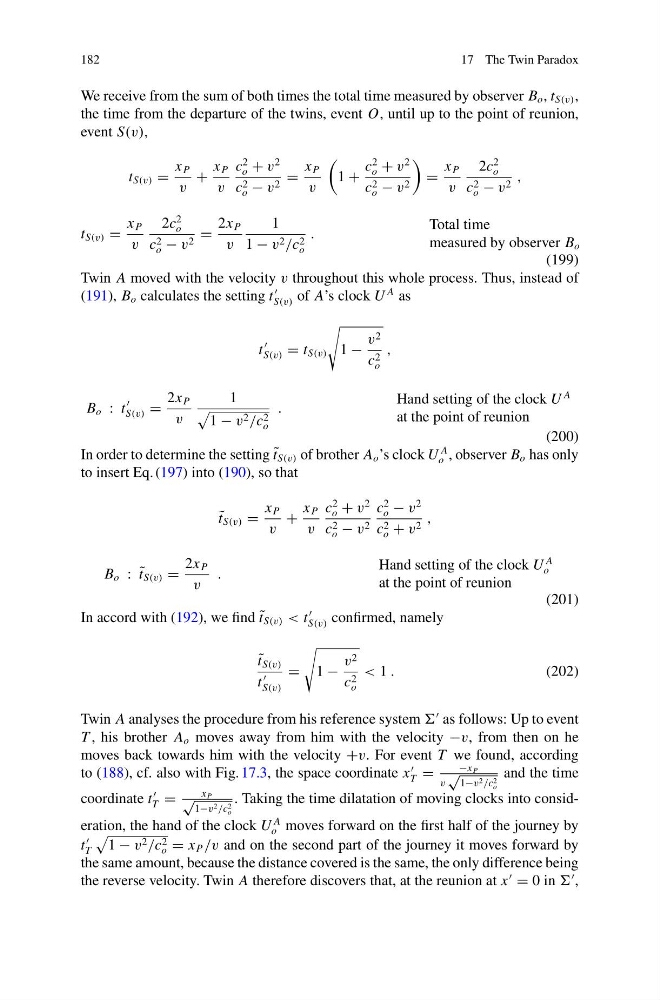
We receive from the sum of both times the total time measured by observer B o , t S(v) ,
the time from the departure of the twins, event O, until up to the point of reunion,
event S(v),
t S(v) =
x P
v
+
x P
v
c
2
o + v
2
c 2
o − v 2 =
x P
v
1 +
c
2
o + v
2
c 2
o − v 2
=
x P
v
2c
2
o
c 2
o − v 2 ,
t S(v) =
x P
v
2c
2
o
c 2
o − v 2 =
2x P
v
1
1 − v 2 /c 2
o
.
Total time
measured by observer B o
(199)
Twin A moved with the velocity v throughout this whole process. Thus, instead of
(191), B o calculates the setting t
S(v) of A’s clock U
A as
t
S(v) = t S(v)
1 −
v 2
c 2
o
,
B o : t
S(v) =
2x P
v
1
1 − v 2 /c 2
o
.
Hand setting of the clock U
A
at the point of reunion
(200)
In order to determine the setting ˜
t S(v) of brother A o ’s clock U
A
o , observer B o has only
to insert Eq. (197) into (190), so that
˜
t S(v) =
x P
v
+
x P
v
c
2
o + v
2
c 2
o − v 2
c
2
o − v
2
c 2
o + v 2 ,
B o : ˜
t S(v) =
2x P
v
.
Hand setting of the clock U
A
o
at the point of reunion
(201)
In accord with (192), we find ˜
t S(v) < t
S(v) confirmed, namely
˜
t S(v)
t
S(v)
=
1 −
v 2
c 2
o
< 1 .
(202)
Twin A analyses the procedure from his reference system
as follows: Up to event
T , his brother A o moves away from him with the velocity −v, from then on he
moves back towards him with the velocity +v. For event T we found, according
to (188), cf. also with Fig. 17.3, the space coordinate x
T =
−x P
v
√
1−v 2 /c 2
o
and the time
coordinate t
T =
x P
√
1−v 2 /c 2
o
. Taking the time dilatation of moving clocks into consideration, the hand of the clock U
A
o moves forward on the first half of the journey by
t
T
1 − v 2 /c 2
o = x P /v and on the second part of the journey it moves forward by
the same amount, because the distance covered is the same, the only difference being
the reverse velocity. Twin A therefore discovers that, at the reunion at x
= 0 in
,
17 The Twin Paradox
We receive from the sum of both times the total time measured by observer B o , t S(v) ,
the time from the departure of the twins, event O, until up to the point of reunion,
event S(v),
t S(v) =
x P
v
+
x P
v
c
2
o + v
2
c 2
o − v 2 =
x P
v
1 +
c
2
o + v
2
c 2
o − v 2
=
x P
v
2c
2
o
c 2
o − v 2 ,
t S(v) =
x P
v
2c
2
o
c 2
o − v 2 =
2x P
v
1
1 − v 2 /c 2
o
.
Total time
measured by observer B o
(199)
Twin A moved with the velocity v throughout this whole process. Thus, instead of
(191), B o calculates the setting t
S(v) of A’s clock U
A as
t
S(v) = t S(v)
1 −
v 2
c 2
o
,
B o : t
S(v) =
2x P
v
1
1 − v 2 /c 2
o
.
Hand setting of the clock U
A
at the point of reunion
(200)
In order to determine the setting ˜
t S(v) of brother A o ’s clock U
A
o , observer B o has only
to insert Eq. (197) into (190), so that
˜
t S(v) =
x P
v
+
x P
v
c
2
o + v
2
c 2
o − v 2
c
2
o − v
2
c 2
o + v 2 ,
B o : ˜
t S(v) =
2x P
v
.
Hand setting of the clock U
A
o
at the point of reunion
(201)
In accord with (192), we find ˜
t S(v) < t
S(v) confirmed, namely
˜
t S(v)
t
S(v)
=
1 −
v 2
c 2
o
< 1 .
(202)
Twin A analyses the procedure from his reference system
as follows: Up to event
T , his brother A o moves away from him with the velocity −v, from then on he
moves back towards him with the velocity +v. For event T we found, according
to (188), cf. also with Fig. 17.3, the space coordinate x
T =
−x P
v
√
1−v 2 /c 2
o
and the time
coordinate t
T =
x P
√
1−v 2 /c 2
o
. Taking the time dilatation of moving clocks into consideration, the hand of the clock U
A
o moves forward on the first half of the journey by
t
T
1 − v 2 /c 2
o = x P /v and on the second part of the journey it moves forward by
the same amount, because the distance covered is the same, the only difference being
the reverse velocity. Twin A therefore discovers that, at the reunion at x
= 0 in
,