

2 The Ether and the Wave Equation
7
medium (or through space) with a characteristic velocity by specific motions of a
medium. During this process, no material is transported. The medium (or space) still
has the same form, and it is in the same state after the energy in the wave has ‘flowed’
past. The transportation of energy with the help of waves can be repeated as often as
needed without any side effects. This system needs no servicing to keep it in order.
The medium (or space) in which the transportation of energy takes place shows no
phenomena of wear. We can send radio waves through the ‘ether’ as often as we want.
The space between the sender and the receiver does not show any signs of damage.
The same applies to laser rays. The transmission of electric energy through highvoltage lines is also based on the propagation of electromagnetic waves funnelled
along a wire in a certain direction. The motion of these waves along the wire causes
absolutely no damage to the wire. Take a conversation between two neighbours as
another example. One can talk as much and as long as one likes. After the transmission
of mechanical energy with the help of sound waves, the medium through which the
waves travelled, here air, returns to its original state.
1
Let us examine and apply the wave equation on an especially simple system. We
will take a straight elastic rod. Here, the simplification is that there is only one special
direction, the direction of the rod itself. The propagation of waves through the rod
is part of the field of acoustics. If we generate an impulse at one end of the rod
(e.g. we hit one of the ends with a hammer), we produce an elastic deformation that
moves along the rod with the speed c =
√
E/ρ, the sound velocity. The deformation
energy is transported to the other end of the rod. Here, ρ is the mass density of the
rod, and the material parameter E is the modulus of elasticity. The constant c is the
propagation velocity of an acoustic signal. Morse code signals that are tapped on the
left end of the rod with the length L arrive at the right end of the rod after the time
t = L/c. The rod itself does not change permanently in form or appearance, unless
the rod was bent, deformed or broken by too violent blows of the hammer.
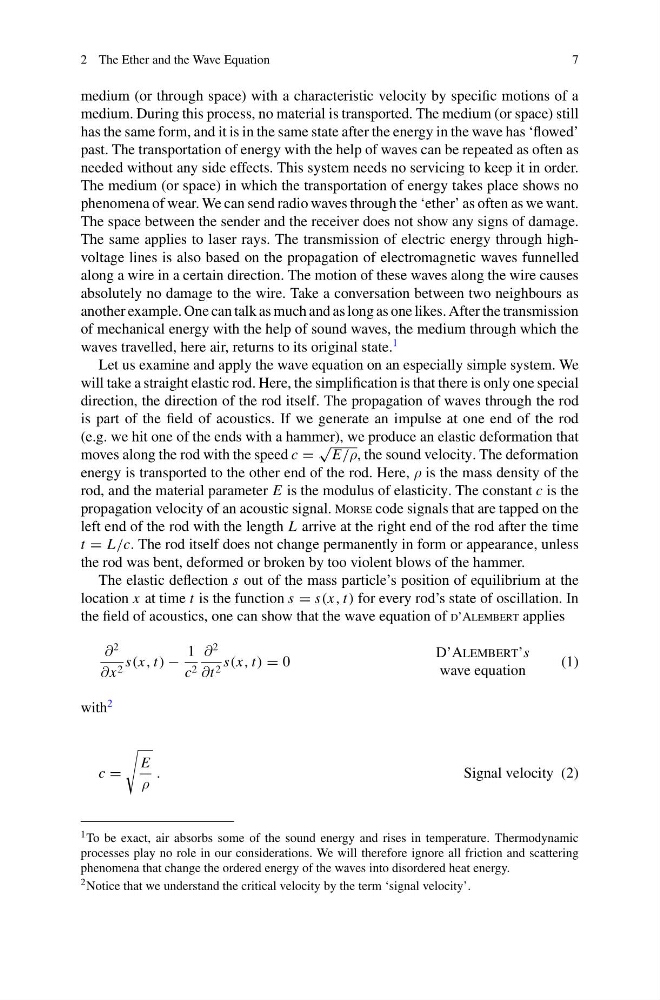
The elastic deflection s out of the mass particle’s position of equilibrium at the
location x at time t is the function s = s(x, t) for every rod’s state of oscillation. In
the field of acoustics, one can show that the wave equation of d’Alembert applies
∂
2
∂x 2 s(x, t) −
1
c 2
∂
2
∂t 2 s(x, t) = 0
D’Alembert’s
wave equation
(1)
with
2
c =
E
ρ
.
Signal velocity (2)
1 To be exact, air absorbs some of the sound energy and rises in temperature. Thermodynamic
processes play no role in our considerations. We will therefore ignore all friction and scattering
phenomena that change the ordered energy of the waves into disordered heat energy.
2 Notice that we understand the critical velocity by the term ‘signal velocity’.
7
medium (or through space) with a characteristic velocity by specific motions of a
medium. During this process, no material is transported. The medium (or space) still
has the same form, and it is in the same state after the energy in the wave has ‘flowed’
past. The transportation of energy with the help of waves can be repeated as often as
needed without any side effects. This system needs no servicing to keep it in order.
The medium (or space) in which the transportation of energy takes place shows no
phenomena of wear. We can send radio waves through the ‘ether’ as often as we want.
The space between the sender and the receiver does not show any signs of damage.
The same applies to laser rays. The transmission of electric energy through highvoltage lines is also based on the propagation of electromagnetic waves funnelled
along a wire in a certain direction. The motion of these waves along the wire causes
absolutely no damage to the wire. Take a conversation between two neighbours as
another example. One can talk as much and as long as one likes. After the transmission
of mechanical energy with the help of sound waves, the medium through which the
waves travelled, here air, returns to its original state.
1
Let us examine and apply the wave equation on an especially simple system. We
will take a straight elastic rod. Here, the simplification is that there is only one special
direction, the direction of the rod itself. The propagation of waves through the rod
is part of the field of acoustics. If we generate an impulse at one end of the rod
(e.g. we hit one of the ends with a hammer), we produce an elastic deformation that
moves along the rod with the speed c =
√
E/ρ, the sound velocity. The deformation
energy is transported to the other end of the rod. Here, ρ is the mass density of the
rod, and the material parameter E is the modulus of elasticity. The constant c is the
propagation velocity of an acoustic signal. Morse code signals that are tapped on the
left end of the rod with the length L arrive at the right end of the rod after the time
t = L/c. The rod itself does not change permanently in form or appearance, unless
the rod was bent, deformed or broken by too violent blows of the hammer.
The elastic deflection s out of the mass particle’s position of equilibrium at the
location x at time t is the function s = s(x, t) for every rod’s state of oscillation. In
the field of acoustics, one can show that the wave equation of d’Alembert applies
∂
2
∂x 2 s(x, t) −
1
c 2
∂
2
∂t 2 s(x, t) = 0
D’Alembert’s
wave equation
(1)
with
2
c =
E
ρ
.
Signal velocity (2)
1 To be exact, air absorbs some of the sound energy and rises in temperature. Thermodynamic
processes play no role in our considerations. We will therefore ignore all friction and scattering
phenomena that change the ordered energy of the waves into disordered heat energy.
2 Notice that we understand the critical velocity by the term ‘signal velocity’.