

170
17 The Twin Paradox
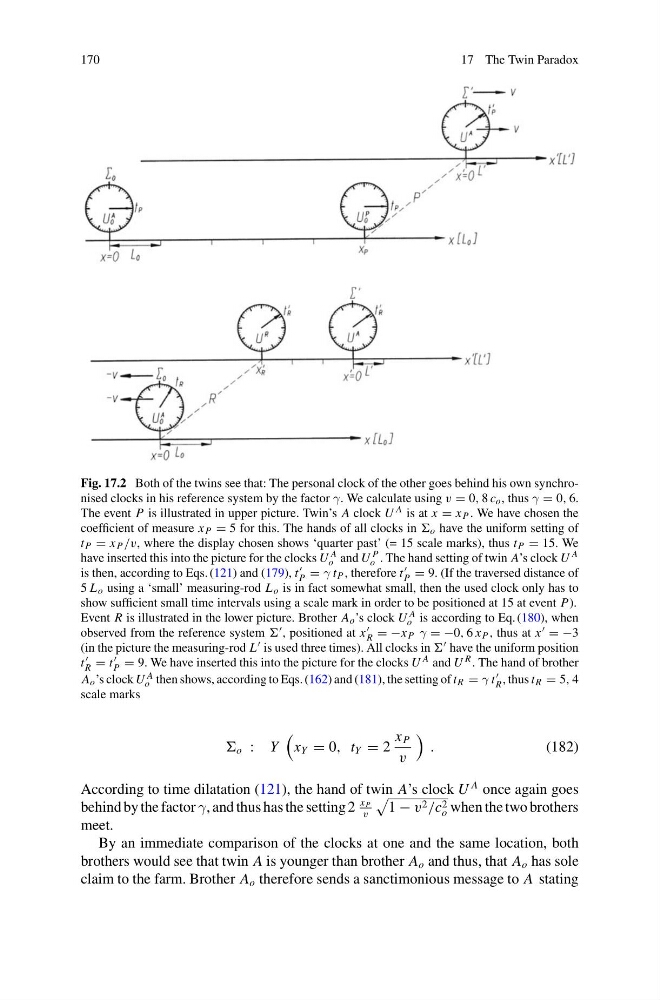
Fig. 17.2 Both of the twins see that: The personal clock of the other goes behind his own synchronised clocks in his reference system by the factor γ. We calculate using v = 0, 8 c o , thus γ = 0, 6.
The event P is illustrated in upper picture. Twin’s A clock U A is at x = x P . We have chosen the
coefficient of measure x P = 5 for this. The hands of all clocks in o have the uniform setting of
t P = x P /v, where the display chosen shows ‘quarter past’ (= 15 scale marks), thus t P = 15. We
have inserted this into the picture for the clocks U A
o and U P
o . The hand setting of twin A’s clock U A
is then, according to Eqs. (121) and (179), t
P = γ t P , therefore t
P = 9. (If the traversed distance of
5 L o using a ‘small’ measuring-rod L o is in fact somewhat small, then the used clock only has to
show sufficient small time intervals using a scale mark in order to be positioned at 15 at event P).
Event R is illustrated in the lower picture. Brother A o ’s clock U A
o is according to Eq. (180), when
observed from the reference system , positioned at x
R = −x P γ = −0, 6 x P , thus at x = −3
(in the picture the measuring-rod L is used three times). All clocks in have the uniform position
t
R = t
P = 9. We have inserted this into the picture for the clocks U A and U R . The hand of brother
A o ’s clock U A
o then shows, according to Eqs. (162) and (181), the setting of t R = γ t
R , thus t R = 5, 4
scale marks
o : Y
x Y = 0, t Y = 2
x P
v
.
(182)
According to time dilatation (121), the hand of twin A’s clock U
A once again goes
behind by the factor γ, and thus has the setting 2
x P
v
1 − v 2 /c 2
o when the two brothers
meet.
By an immediate comparison of the clocks at one and the same location, both
brothers would see that twin A is younger than brother A o and thus, that A o has sole
claim to the farm. Brother A o therefore sends a sanctimonious message to A stating
17 The Twin Paradox
Fig. 17.2 Both of the twins see that: The personal clock of the other goes behind his own synchronised clocks in his reference system by the factor γ. We calculate using v = 0, 8 c o , thus γ = 0, 6.
The event P is illustrated in upper picture. Twin’s A clock U A is at x = x P . We have chosen the
coefficient of measure x P = 5 for this. The hands of all clocks in o have the uniform setting of
t P = x P /v, where the display chosen shows ‘quarter past’ (= 15 scale marks), thus t P = 15. We
have inserted this into the picture for the clocks U A
o and U P
o . The hand setting of twin A’s clock U A
is then, according to Eqs. (121) and (179), t
P = γ t P , therefore t
P = 9. (If the traversed distance of
5 L o using a ‘small’ measuring-rod L o is in fact somewhat small, then the used clock only has to
show sufficient small time intervals using a scale mark in order to be positioned at 15 at event P).
Event R is illustrated in the lower picture. Brother A o ’s clock U A
o is according to Eq. (180), when
observed from the reference system , positioned at x
R = −x P γ = −0, 6 x P , thus at x = −3
(in the picture the measuring-rod L is used three times). All clocks in have the uniform position
t
R = t
P = 9. We have inserted this into the picture for the clocks U A and U R . The hand of brother
A o ’s clock U A
o then shows, according to Eqs. (162) and (181), the setting of t R = γ t
R , thus t R = 5, 4
scale marks
o : Y
x Y = 0, t Y = 2
x P
v
.
(182)
According to time dilatation (121), the hand of twin A’s clock U
A once again goes
behind by the factor γ, and thus has the setting 2
x P
v
1 − v 2 /c 2
o when the two brothers
meet.
By an immediate comparison of the clocks at one and the same location, both
brothers would see that twin A is younger than brother A o and thus, that A o has sole
claim to the farm. Brother A o therefore sends a sanctimonious message to A stating