

17 The Twin Paradox
169
his clock U
A goes behind the clock U
P
o by the amount t P − t
P . The telegram of his
twin brother, that he, brother A o is now the elder of the two (and thus has the sole
claim to their dad’s hereditary farm) can be confirmed. However, A is not too happy
about this and thus turns the tables and also argues that: The personal clock U
A
o of
my twin brother A o moves with the velocity −v. If I as the slandered younger twin
A read the hand setting t
P of my clock U
A in
, then brother A o with his clock U
A
o
is at location x
R = −v t
P in my system. We will call this event R with t
R = t
P , thus
with (179)
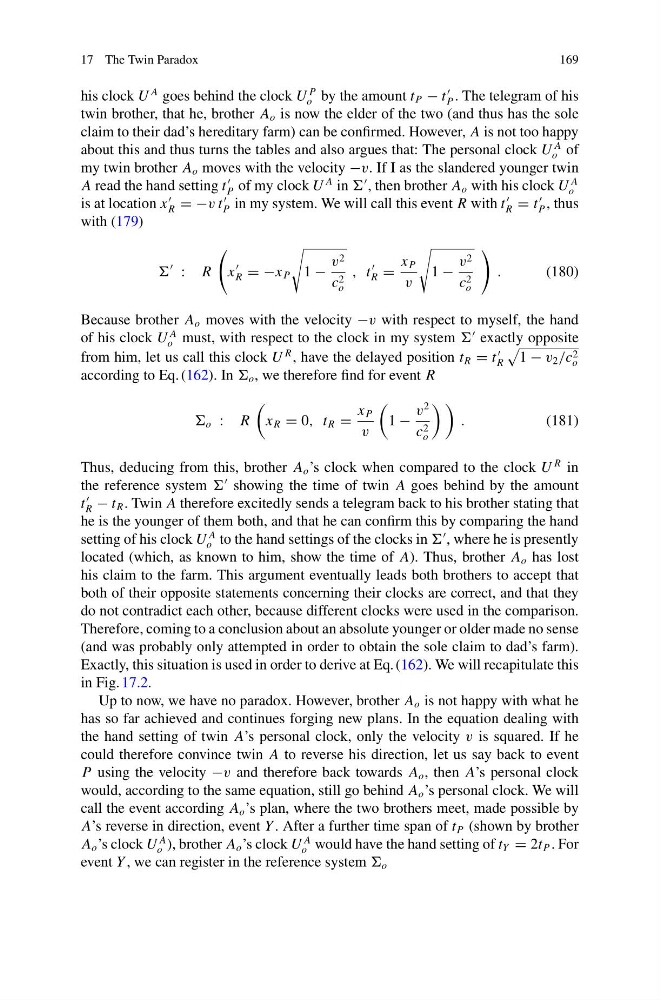
: R
x
R = −x P
1 −
v 2
c 2
o
, t
R =
x P
v
1 −
v 2
c 2
o
.
(180)
Because brother A o moves with the velocity −v with respect to myself, the hand
of his clock U
A
o must, with respect to the clock in my system
exactly opposite
from him, let us call this clock U
R , have the delayed position t R = t
R
1 − v 2 /c 2
o
according to Eq. (162). In o , we therefore find for event R
o : R
x R = 0, t R =
x P
v
1 −
v
2
c 2
o
.
(181)
Thus, deducing from this, brother A o ’s clock when compared to the clock U
R in
the reference system
showing the time of twin A goes behind by the amount
t
R − t R . Twin A therefore excitedly sends a telegram back to his brother stating that
he is the younger of them both, and that he can confirm this by comparing the hand
setting of his clock U
A
o to the hand settings of the clocks in
, where he is presently
located (which, as known to him, show the time of A). Thus, brother A o has lost
his claim to the farm. This argument eventually leads both brothers to accept that
both of their opposite statements concerning their clocks are correct, and that they
do not contradict each other, because different clocks were used in the comparison.
Therefore, coming to a conclusion about an absolute younger or older made no sense
(and was probably only attempted in order to obtain the sole claim to dad’s farm).
Exactly, this situation is used in order to derive at Eq. (162). We will recapitulate this
in Fig. 17.2.
Up to now, we have no paradox. However, brother A o is not happy with what he
has so far achieved and continues forging new plans. In the equation dealing with
the hand setting of twin A’s personal clock, only the velocity v is squared. If he
could therefore convince twin A to reverse his direction, let us say back to event
P using the velocity −v and therefore back towards A o , then A’s personal clock
would, according to the same equation, still go behind A o ’s personal clock. We will
call the event according A o ’s plan, where the two brothers meet, made possible by
A’s reverse in direction, event Y . After a further time span of t P (shown by brother
A o ’s clock U
A
o ), brother A o ’s clock U
A
o would have the hand setting of t Y = 2t P . For
event Y , we can register in the reference system o
169
his clock U
A goes behind the clock U
P
o by the amount t P − t
P . The telegram of his
twin brother, that he, brother A o is now the elder of the two (and thus has the sole
claim to their dad’s hereditary farm) can be confirmed. However, A is not too happy
about this and thus turns the tables and also argues that: The personal clock U
A
o of
my twin brother A o moves with the velocity −v. If I as the slandered younger twin
A read the hand setting t
P of my clock U
A in
, then brother A o with his clock U
A
o
is at location x
R = −v t
P in my system. We will call this event R with t
R = t
P , thus
with (179)
: R
x
R = −x P
1 −
v 2
c 2
o
, t
R =
x P
v
1 −
v 2
c 2
o
.
(180)
Because brother A o moves with the velocity −v with respect to myself, the hand
of his clock U
A
o must, with respect to the clock in my system
exactly opposite
from him, let us call this clock U
R , have the delayed position t R = t
R
1 − v 2 /c 2
o
according to Eq. (162). In o , we therefore find for event R
o : R
x R = 0, t R =
x P
v
1 −
v
2
c 2
o
.
(181)
Thus, deducing from this, brother A o ’s clock when compared to the clock U
R in
the reference system
showing the time of twin A goes behind by the amount
t
R − t R . Twin A therefore excitedly sends a telegram back to his brother stating that
he is the younger of them both, and that he can confirm this by comparing the hand
setting of his clock U
A
o to the hand settings of the clocks in
, where he is presently
located (which, as known to him, show the time of A). Thus, brother A o has lost
his claim to the farm. This argument eventually leads both brothers to accept that
both of their opposite statements concerning their clocks are correct, and that they
do not contradict each other, because different clocks were used in the comparison.
Therefore, coming to a conclusion about an absolute younger or older made no sense
(and was probably only attempted in order to obtain the sole claim to dad’s farm).
Exactly, this situation is used in order to derive at Eq. (162). We will recapitulate this
in Fig. 17.2.
Up to now, we have no paradox. However, brother A o is not happy with what he
has so far achieved and continues forging new plans. In the equation dealing with
the hand setting of twin A’s personal clock, only the velocity v is squared. If he
could therefore convince twin A to reverse his direction, let us say back to event
P using the velocity −v and therefore back towards A o , then A’s personal clock
would, according to the same equation, still go behind A o ’s personal clock. We will
call the event according A o ’s plan, where the two brothers meet, made possible by
A’s reverse in direction, event Y . After a further time span of t P (shown by brother
A o ’s clock U
A
o ), brother A o ’s clock U
A
o would have the hand setting of t Y = 2t P . For
event Y , we can register in the reference system o