

16 Two Axiomatic Systems for Special Relativity
159
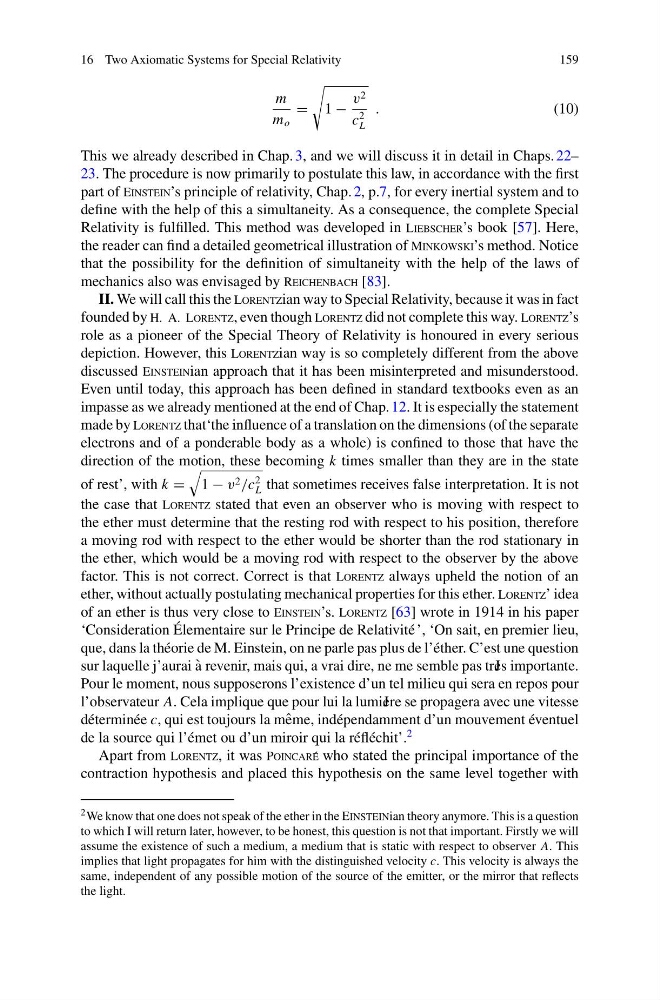
m
m o
=
1 −
v 2
c
2
L
.
(10)
This we already described in Chap. 3, and we will discuss it in detail in Chaps. 22–
23. The procedure is now primarily to postulate this law, in accordance with the first
part of Einstein’s principle of relativity, Chap. 2, p.7, for every inertial system and to
define with the help of this a simultaneity. As a consequence, the complete Special
Relativity is fulfilled. This method was developed in Liebscher’s book [57]. Here,
the reader can find a detailed geometrical illustration of Minkowski’s method. Notice
that the possibility for the definition of simultaneity with the help of the laws of
mechanics also was envisaged by Reichenbach [83].
II. We will call this the Lorentzian way to Special Relativity, because it was in fact
founded by H. A. Lorentz, even though Lorentz did not complete this way. Lorentz’s
role as a pioneer of the Special Theory of Relativity is honoured in every serious
depiction. However, this Lorentzian way is so completely different from the above
discussed Einsteinian approach that it has been misinterpreted and misunderstood.
Even until today, this approach has been defined in standard textbooks even as an
impasse as we already mentioned at the end of Chap. 12. It is especially the statement
made by Lorentz that‘the influence of a translation on the dimensions (of the separate
electrons and of a ponderable body as a whole) is confined to those that have the
direction of the motion, these becoming k times smaller than they are in the state
of rest’, with k =
1 − v 2 /c
2
L that sometimes receives false interpretation. It is not
the case that Lorentz stated that even an observer who is moving with respect to
the ether must determine that the resting rod with respect to his position, therefore
a moving rod with respect to the ether would be shorter than the rod stationary in
the ether, which would be a moving rod with respect to the observer by the above
factor. This is not correct. Correct is that Lorentz always upheld the notion of an
ether, without actually postulating mechanical properties for this ether. Lorentz’ idea
of an ether is thus very close to Einstein’s. Lorentz [63] wrote in 1914 in his paper
‘Consideration Élementaire sur le Principe de Relativité ’, ‘On sait, en premier lieu,
que, dans la théorie de M. Einstein, on ne parle pas plus de l’éther. C’est une question
sur laquelle j’aurai `
a revenir, mais qui, a vrai dire, ne me semble pas trJ es importante.
Pour le moment, nous supposerons l’existence d’un tel milieu qui sera en repos pour
l’observateur A. Cela implique que pour lui la lumiJ ere se propagera avec une vitesse
déterminée c, qui est toujours la mˆ eme, indépendamment d’un mouvement éventuel
de la source qui l’émet ou d’un miroir qui la réfléchit’.
2
Apart from Lorentz, it was Poincaré who stated the principal importance of the
contraction hypothesis and placed this hypothesis on the same level together with
2 We know that one does not speak of the ether in the Einsteinian theory anymore. This is a question
to which I will return later, however, to be honest, this question is not that important. Firstly we will
assume the existence of such a medium, a medium that is static with respect to observer A. This
implies that light propagates for him with the distinguished velocity c. This velocity is always the
same, independent of any possible motion of the source of the emitter, or the mirror that reflects
the light.
159
m
m o
=
1 −
v 2
c
2
L
.
(10)
This we already described in Chap. 3, and we will discuss it in detail in Chaps. 22–
23. The procedure is now primarily to postulate this law, in accordance with the first
part of Einstein’s principle of relativity, Chap. 2, p.7, for every inertial system and to
define with the help of this a simultaneity. As a consequence, the complete Special
Relativity is fulfilled. This method was developed in Liebscher’s book [57]. Here,
the reader can find a detailed geometrical illustration of Minkowski’s method. Notice
that the possibility for the definition of simultaneity with the help of the laws of
mechanics also was envisaged by Reichenbach [83].
II. We will call this the Lorentzian way to Special Relativity, because it was in fact
founded by H. A. Lorentz, even though Lorentz did not complete this way. Lorentz’s
role as a pioneer of the Special Theory of Relativity is honoured in every serious
depiction. However, this Lorentzian way is so completely different from the above
discussed Einsteinian approach that it has been misinterpreted and misunderstood.
Even until today, this approach has been defined in standard textbooks even as an
impasse as we already mentioned at the end of Chap. 12. It is especially the statement
made by Lorentz that‘the influence of a translation on the dimensions (of the separate
electrons and of a ponderable body as a whole) is confined to those that have the
direction of the motion, these becoming k times smaller than they are in the state
of rest’, with k =
1 − v 2 /c
2
L that sometimes receives false interpretation. It is not
the case that Lorentz stated that even an observer who is moving with respect to
the ether must determine that the resting rod with respect to his position, therefore
a moving rod with respect to the ether would be shorter than the rod stationary in
the ether, which would be a moving rod with respect to the observer by the above
factor. This is not correct. Correct is that Lorentz always upheld the notion of an
ether, without actually postulating mechanical properties for this ether. Lorentz’ idea
of an ether is thus very close to Einstein’s. Lorentz [63] wrote in 1914 in his paper
‘Consideration Élementaire sur le Principe de Relativité ’, ‘On sait, en premier lieu,
que, dans la théorie de M. Einstein, on ne parle pas plus de l’éther. C’est une question
sur laquelle j’aurai `
a revenir, mais qui, a vrai dire, ne me semble pas trJ es importante.
Pour le moment, nous supposerons l’existence d’un tel milieu qui sera en repos pour
l’observateur A. Cela implique que pour lui la lumiJ ere se propagera avec une vitesse
déterminée c, qui est toujours la mˆ eme, indépendamment d’un mouvement éventuel
de la source qui l’émet ou d’un miroir qui la réfléchit’.
2
Apart from Lorentz, it was Poincaré who stated the principal importance of the
contraction hypothesis and placed this hypothesis on the same level together with
2 We know that one does not speak of the ether in the Einsteinian theory anymore. This is a question
to which I will return later, however, to be honest, this question is not that important. Firstly we will
assume the existence of such a medium, a medium that is static with respect to observer A. This
implies that light propagates for him with the distinguished velocity c. This velocity is always the
same, independent of any possible motion of the source of the emitter, or the mirror that reflects
the light.