

158
16 Two Axiomatic Systems for Special Relativity
x
= x cosh ϕ − c L t sinh ϕ ,
c L t
= −x sinh ϕ + c L t cosh ϕ .
(174)
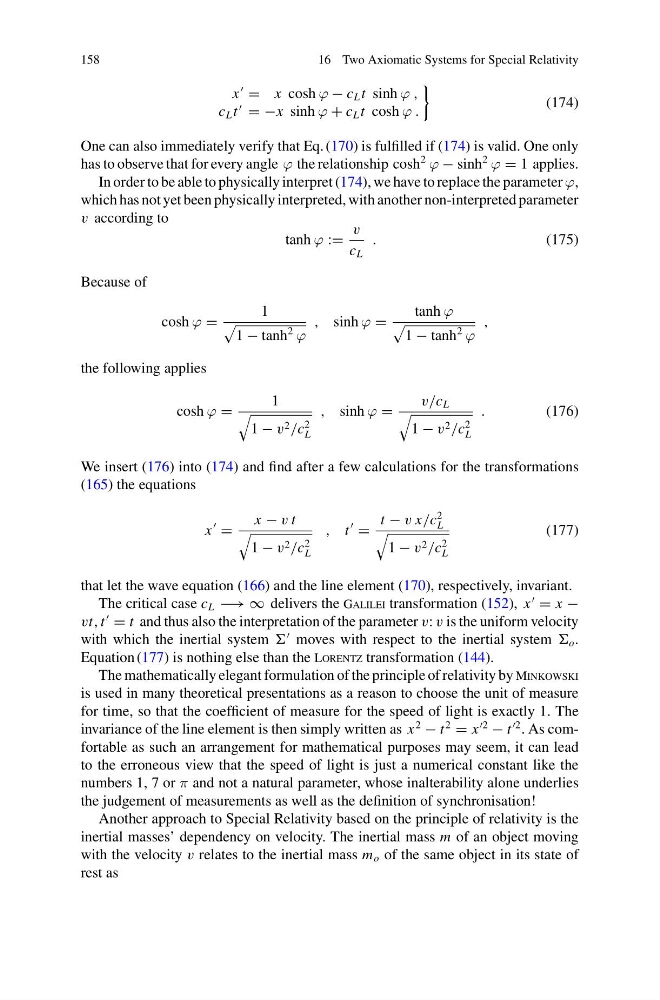
One can also immediately verify that Eq. (170) is fulfilled if (174) is valid. One only
has to observe that for every angle ϕ the relationship cosh
2
ϕ − sinh
2
ϕ = 1 applies.
In order to be able to physically interpret (174), we have to replace the parameter ϕ,
which has not yet been physically interpreted, with another non-interpreted parameter
v according to
tanh ϕ :=
v
c L
.
(175)
Because of
cosh ϕ =
1
1 − tanh
2
ϕ
, sinh ϕ =
tanh ϕ
1 − tanh
2
ϕ
,
the following applies
cosh ϕ =
1
1 − v 2 /c
2
L
, sinh ϕ =
v/c L
1 − v 2 /c
2
L
.
(176)
We insert (176) into (174) and find after a few calculations for the transformations
(165) the equations
x
=
x − v t
1 − v 2 /c
2
L
, t
=
t − v x/c
2
L
1 − v 2 /c
2
L
(177)
that let the wave equation (166) and the line element (170), respectively, invariant.
The critical case c L −→ ∞ delivers the Galilei transformation (152), x
= x −
vt, t
= t and thus also the interpretation of the parameter v: v is the uniform velocity
with which the inertial system
moves with respect to the inertial system o .
Equation (177) is nothing else than the Lorentz transformation (144).
The mathematically elegant formulation of the principle of relativity by Minkowski
is used in many theoretical presentations as a reason to choose the unit of measure
for time, so that the coefficient of measure for the speed of light is exactly 1. The
invariance of the line element is then simply written as x
2
− t
2
= x
2
− t
2 . As comfortable as such an arrangement for mathematical purposes may seem, it can lead
to the erroneous view that the speed of light is just a numerical constant like the
numbers 1, 7 or π and not a natural parameter, whose inalterability alone underlies
the judgement of measurements as well as the definition of synchronisation!
Another approach to Special Relativity based on the principle of relativity is the
inertial masses’ dependency on velocity. The inertial mass m of an object moving
with the velocity v relates to the inertial mass m o of the same object in its state of
rest as
16 Two Axiomatic Systems for Special Relativity
x
= x cosh ϕ − c L t sinh ϕ ,
c L t
= −x sinh ϕ + c L t cosh ϕ .
(174)
One can also immediately verify that Eq. (170) is fulfilled if (174) is valid. One only
has to observe that for every angle ϕ the relationship cosh
2
ϕ − sinh
2
ϕ = 1 applies.
In order to be able to physically interpret (174), we have to replace the parameter ϕ,
which has not yet been physically interpreted, with another non-interpreted parameter
v according to
tanh ϕ :=
v
c L
.
(175)
Because of
cosh ϕ =
1
1 − tanh
2
ϕ
, sinh ϕ =
tanh ϕ
1 − tanh
2
ϕ
,
the following applies
cosh ϕ =
1
1 − v 2 /c
2
L
, sinh ϕ =
v/c L
1 − v 2 /c
2
L
.
(176)
We insert (176) into (174) and find after a few calculations for the transformations
(165) the equations
x
=
x − v t
1 − v 2 /c
2
L
, t
=
t − v x/c
2
L
1 − v 2 /c
2
L
(177)
that let the wave equation (166) and the line element (170), respectively, invariant.
The critical case c L −→ ∞ delivers the Galilei transformation (152), x
= x −
vt, t
= t and thus also the interpretation of the parameter v: v is the uniform velocity
with which the inertial system
moves with respect to the inertial system o .
Equation (177) is nothing else than the Lorentz transformation (144).
The mathematically elegant formulation of the principle of relativity by Minkowski
is used in many theoretical presentations as a reason to choose the unit of measure
for time, so that the coefficient of measure for the speed of light is exactly 1. The
invariance of the line element is then simply written as x
2
− t
2
= x
2
− t
2 . As comfortable as such an arrangement for mathematical purposes may seem, it can lead
to the erroneous view that the speed of light is just a numerical constant like the
numbers 1, 7 or π and not a natural parameter, whose inalterability alone underlies
the judgement of measurements as well as the definition of synchronisation!
Another approach to Special Relativity based on the principle of relativity is the
inertial masses’ dependency on velocity. The inertial mass m of an object moving
with the velocity v relates to the inertial mass m o of the same object in its state of
rest as